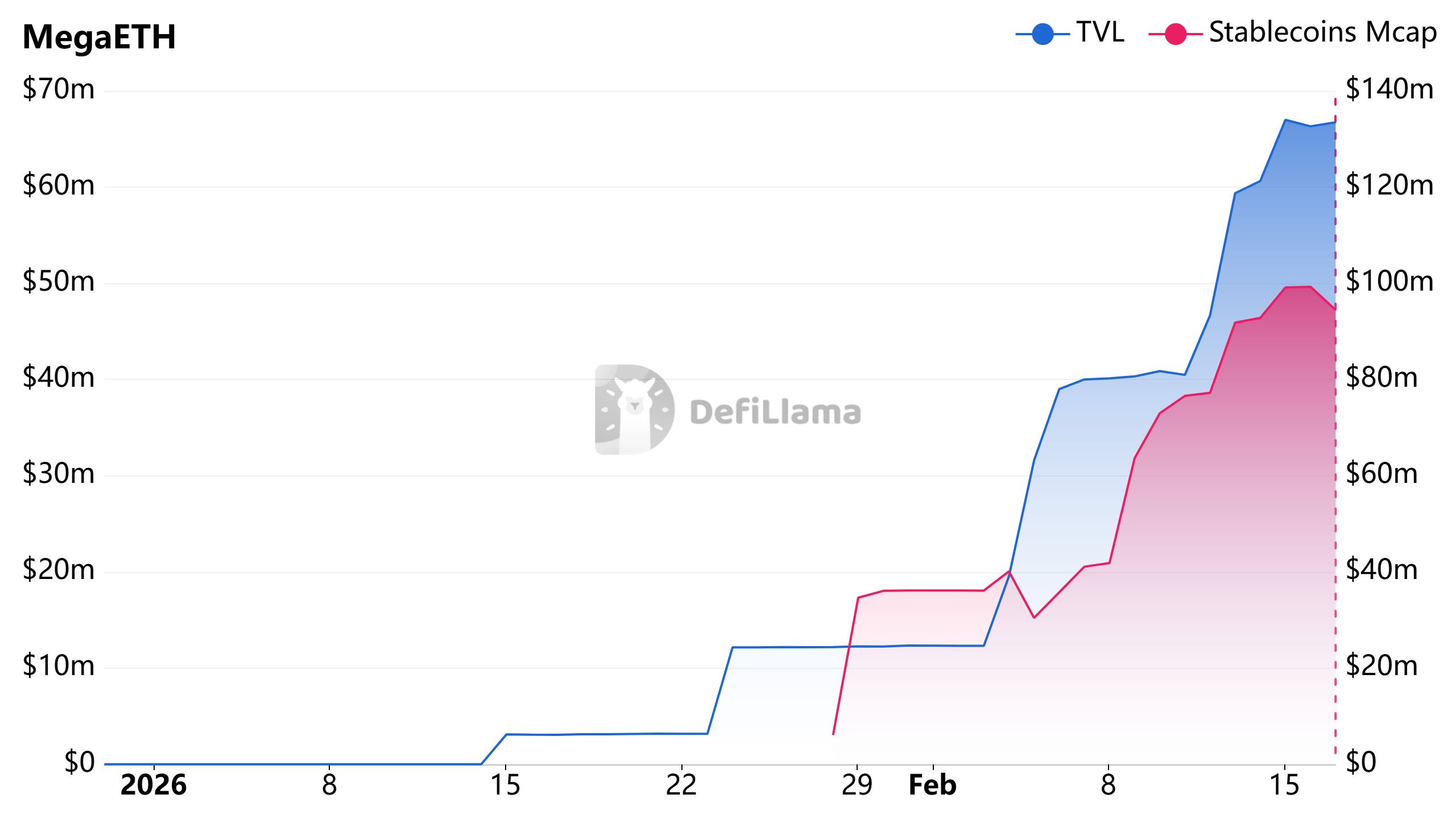
MegaETH launched its mainnet on February 9, 2026. The new Ethereum Layer-2 blockchain claims a throughput of over 100,000 transactions per second. After one week, total value locked (TVL) stands at $66 million. Base, the leading L2, holds close to $4 billion by comparison.
The project had attracted significant investor interest ahead of launch. Dragonfly Capital led a $20 million seed round. Its token sale in October 2025 drew roughly $1.4 billion in bids, making it 20x oversubscribed. Ethereum co-founders Vitalik Buterin and Joe Lubin back the project. Still, MegaETH faces the same problem as dozens of other L2 projects: a market saturated with blockspace supply.
How MegaETH works: specialized nodes instead of uniform architecture
MegaETH markets itself as a "real-time blockchain" with a block time of 10 milliseconds. Ethereum itself processes fewer than 30 transactions per second. MegaETH aims to surpass that throughput by a factor of 3,000. Its technical approach therefore differs fundamentally from other L2 solutions.
Instead of uniform full nodes, MegaETH uses specialized node types. The sequencer orders and executes transactions but requires 100 CPU cores and up to 4 TB of RAM. Replica nodes validate blocks via cryptographic proofs without re-execution. They operate with just 4 to 8 cores and 16 GB of RAM. Full nodes re-execute all transactions and require 16 cores with 64 GB of RAM. A separate prover validates asynchronously outside the normal sequence.
The project's own research paper openly names the technical limitations. State root updates cost nearly ten times as much as actual transaction execution. For 100,000 ERC-20 transfers per second, around 152 megabits per second in bandwidth would be needed for state synchronization alone. On top of that, median parallelism in Ethereum blocks is below 2. This severely limits the theoretical speed gains achievable through parallel execution.
$66 million TVL in the first week
DeFi TVL started at $40.3 million on launch day and grew 65 percent within one week to $66 million. Stablecoin market capitalization on the chain stands at $99 million. The largest protocol is the decentralized exchange Kumbaya with roughly $51 million in TVL. MegaETH thus placed among the top 20 L2s.
Context, though, puts these numbers into perspective. Currently, L2beat lists 73 Layer-2 blockchains, with 82 more in the pipeline. The L2 ecosystem as a whole manages approximately $41 billion. MegaETH holds about 0.14 percent of that.
The MEGA token remains locked for now. Its token generation event (TGE) is tied to three possible conditions. First: $500 million market capitalization for the MegaUSD stablecoin. Second: at least ten apps each with 100,000 transactions across 25,000 wallets. Third: at least three dApps generating $50,000 in daily fees over one month. So far, MegaETH has not reached any of these thresholds.



The L2 oversupply and the question of real demand
Daily L2 transactions rose from 1 million in 2023 to 11 million in 2026. Now 89 percent of all Ethereum transactions run through Layer-2 networks. Total TVL grew from under $4 billion in early 2023 to the current $41 billion. Yet the distribution is extremely uneven. Arbitrum and Base dominate the market, while most new L2s collapse after the incentive cycle ends.
A familiar pattern keeps repeating. A points program launches, a token follows, then usage drops to zero. Airdrop farming has established itself as a structural problem in the L2 landscape. Real blockspace demand currently concentrates on Solana and Base, not the dozens of competitors.
Even Vitalik Buterin has shifted his position. He argues that Ethereum L1 is already scaling directly and will offer low fees in 2026. The original "rollup-centric vision" needs to change accordingly. Going forward, L2s should deliver value through features like privacy, very low latency, or app-specific architecture. Scaling alone no longer suffices as a reason to exist.
MegaETH between technical ambition and market reality
MegaETH enters a crowded market with a technically demanding approach. The hardware requirements for the sequencer are exceptionally high. Specifically, 100 cores and up to 4 TB of RAM stand in tension with the decentralization ethos that Ethereum purists demand. At the same time, the project addresses a real need with 10-millisecond blocks. High-frequency trading, gaming, and real-time applications require latency levels that neither Ethereum L1 nor most existing L2s can deliver.
The investor base is also notable. Buterin and Lubin as Ethereum co-founders signal that they view low latency as a legitimate L2 niche. Meanwhile, the 20x oversubscription of the token sale confirms this conviction. Institutional capital is betting on new approaches despite L2 saturation. Whether this translates into sustainable usage depends on the three TGE conditions. They function as a built-in stress test. If MegaETH fails to achieve real adoption, the token stays locked.
The L2 market faces a consolidation phase. MegaETH must hold its own with $66 million in TVL against 73 existing and 82 planned competitors. Technical differentiation through real-time performance is there. Whether it is enough will not be decided by the theoretical capacity of 100,000 TPS. What matters is whether developers and users actually demand that capacity.