The same property that helped Bitcoin and crypto break through is also holding back broader adoption. Blockchains are, after all, open public ledgers. Every balance, every transaction and every counterparty is visible to everyone, and permanently so.
That is exactly what makes them verifiable and trustless. At the same time, it makes them unusable for institutions. No company publishes its payroll, and no fund announces its trades. Privacy is therefore not a feature that digital assets can retrofit later. It is the missing layer between where the asset class stands today and where the capital actually sits. Whoever solves this problem turns crypto into something traditional finance could never offer: a Swiss bank account in your pocket. It is private and self-custodied, yet open to a regulator or a counterparty when needed. This is where privacy coins come in.
However, privacy does not come at the expense of verifiability. Zero-knowledge proofs (ZK) are a cryptographic method first developed in 1985. They allow a blockchain to confirm the validity of every transaction. It does so without revealing the sender, the recipient or the amount moved. The ledger remains auditable, while the details stay private.
Privacy coins grow fivefold in one year
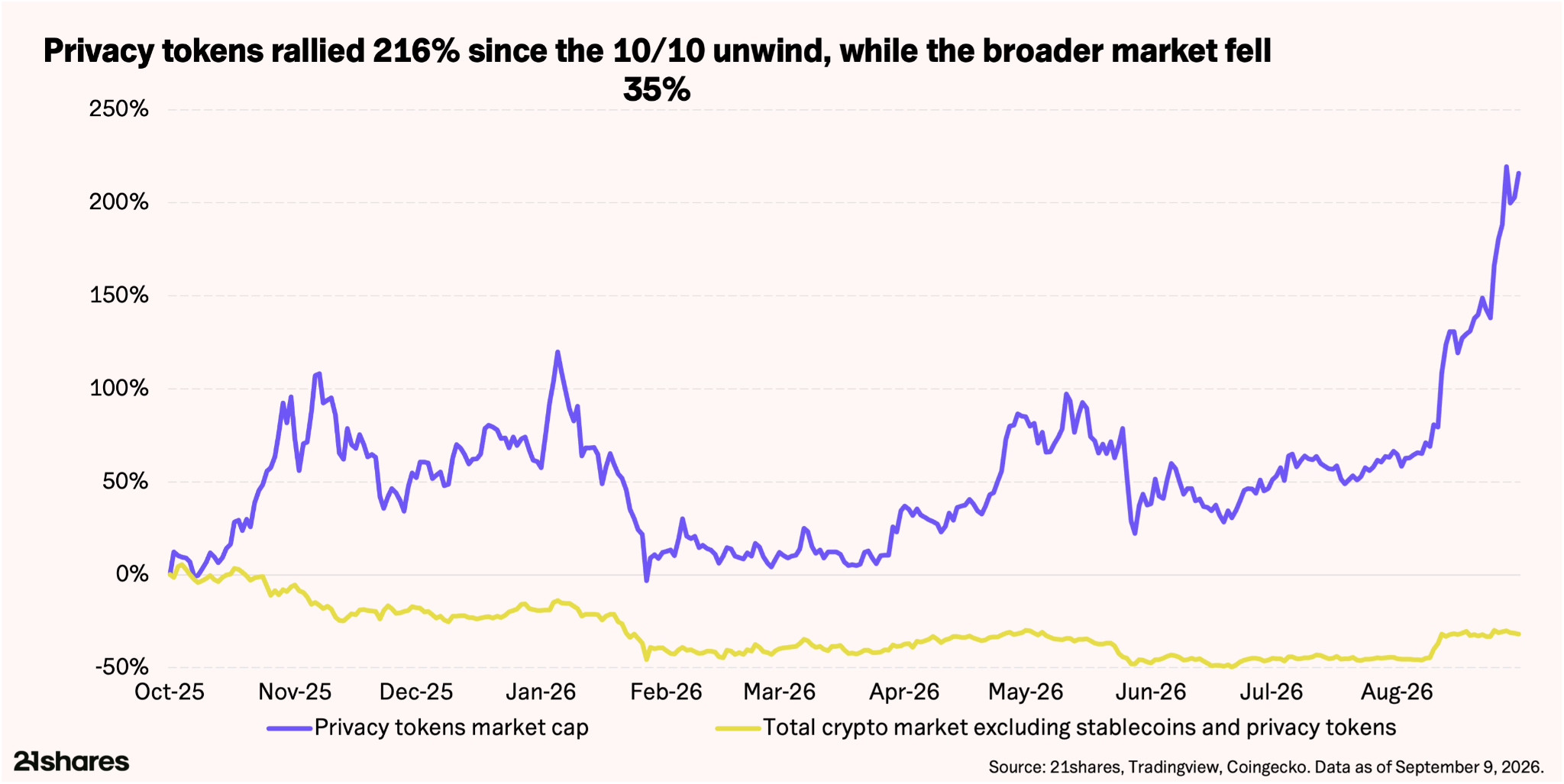
Markets are now starting to price this in. The market capitalization of privacy coins has nearly quintupled within a year. It climbed from USD 6.2 billion to around USD 30 billion today. Over three years, the average annual growth rate even reaches 111%. It is also the only sector trading above its October 2025 peak. It sits 216% above it. The overall crypto market excluding stablecoins and privacy coins, by contrast, has lost around 35% since October 2025.
Zcash (ZEC), the largest privacy-focused network, now has a market capitalization of around USD 20 billion. That is roughly 400% above its 2021 peak of USD 4 billion. The privacy coin sector is thus undergoing a structural revaluation, and it is worth understanding why.
In crypto, privacy is shifting from an option to a necessity, and from a necessity to a built-in component. The crime objection, which usually comes first, does not hold up against the data. In addition, the urgency is growing: AI is accelerating demand, and the largest blockchains are already acting.
Institutions need confidential order flow
Transparency is a strength for some users and a burden for others. On a public blockchain, anyone can watch a large order build up and trade ahead of it. This is the on-chain version of front-running. Through maximal extractable value (MEV), it happens on a large scale. Between 2022 and 2025, around USD 1.7 billion drained out this way (Solana Compass, 2025; Blockchain Council, 2026). As a result, institutions will only settle large positions on-chain once they can do so confidentially. In traditional markets, this preference is already visible. Dark pools and off-exchange venues together handle more than 40% of US equity trading. In 2025, they even crossed the 50% mark (Nasdaq, 2025).
Nowhere is this clearer than on the Canton Network, where institutional privacy has become a precondition for serious adoption. Canton relies on controlled disclosure. It lets firms issue and settle tokenized assets on a shared ledger. Positions and counterparties stay hidden from competitors but remain visible to regulators when needed. The list of participants is not speculation:
- Goldman Sachs runs its Digital Asset Platform on Canton
- J.P. Morgan is bringing its JPMD deposit token natively to the network
- The DTCC, which provides custody for more than USD 100 trillion in US securities, is tokenizing US Treasuries on Canton
Institutions are not the only ones who want privacy
More than 30 of the world's largest financial institutions now build on or support Canton. Moreover, the network processes over USD 8 trillion in tokenized assets every month. That is the clearest evidence that institutions need privacy to move on-chain (Digital Assets, 2026).
The same applies to individuals. Because daily life increasingly happens online, every purchase leaves traces somewhere: someone logs it, tracks it and monetizes it. Yet hardly anyone wants the world to watch what they buy. Zcash closes this gap with shielded pools, which now privately secure around USD 7 billion in capital (Blockworks, 2026). Once a user's funds enter a shielded pool, the amount, sender and recipient are cryptographically hidden. Still, ZK proofs let the network confirm the validity of the transaction without revealing details. Holders can switch freely between Zcash's transparent ledger and its privacy feature. They disclose their history only when needed, via a view key, to an auditor or a regulator.
Crime runs through stablecoins, not privacy coins
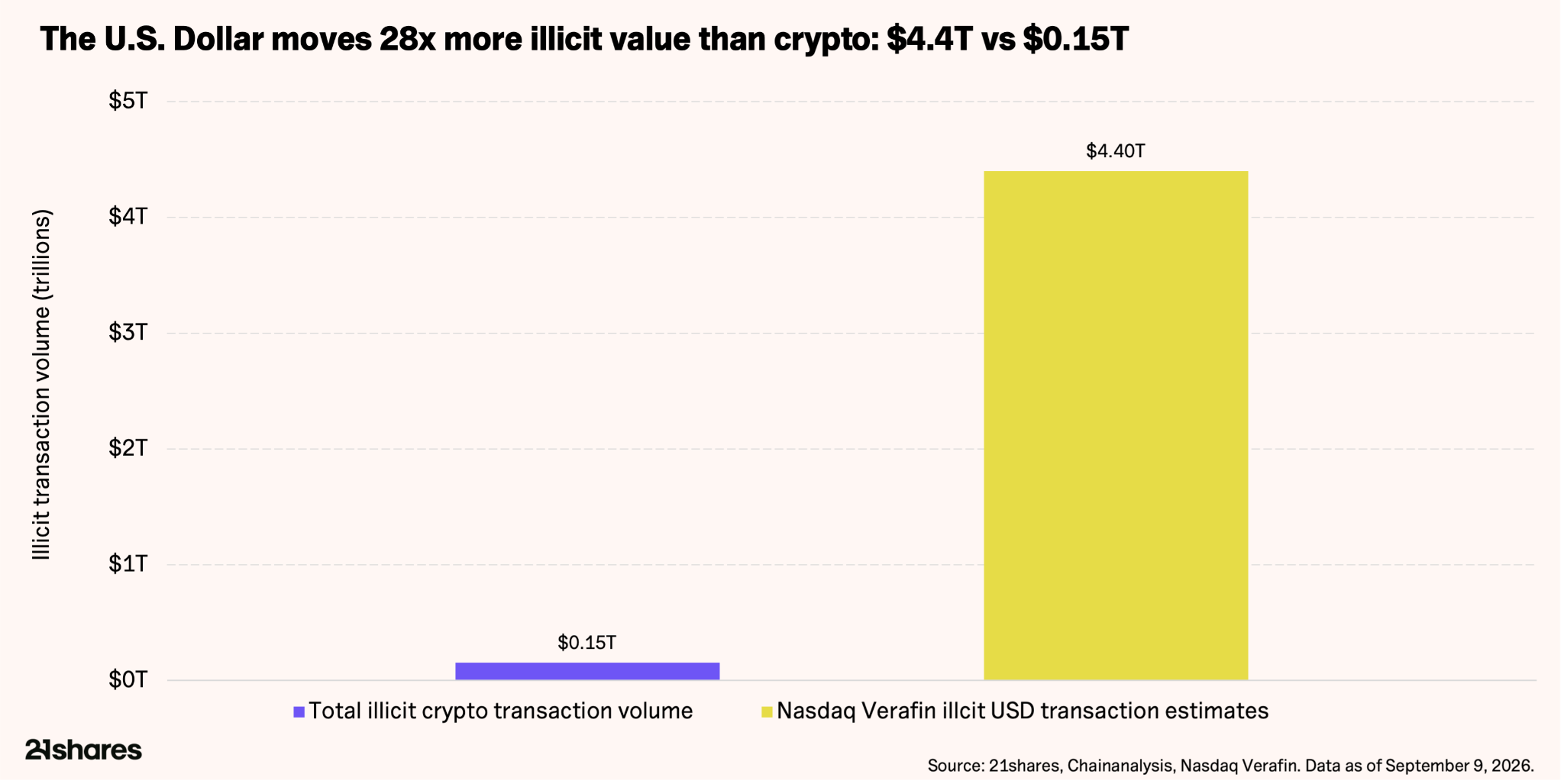
The most common objection to crypto privacy is that it enables crime. However, the data does not support this. Illicit activity accounts for less than 1% of total crypto transaction volume. Of that illicit volume, around 84% falls on stablecoins, not privacy coins (Chainalysis, 2026). Even this figure overstates their appeal to criminals. Stablecoin issuers can freeze holdings on request, and every transaction stays permanently traceable. For hiding money, that is a poor combination.
Physical US dollars are the original private money, and most illicit activity runs through them. Every year, criminals launder USD 800 billion to USD 2 trillion through the traditional financial system. That is the estimate of the United Nations Office on Drugs and Crime (UNODC). Nasdaq Verafin even put total illicit flows in 2025 closer to USD 4.4 trillion. These sums dwarf the entire crypto market, let alone privacy coins.
Privacy-focused blockchains can also be compatible with compliance. With Zcash view keys, a holder can selectively disclose their transaction history to an auditor or a regulator. It stays hidden from the rest of the world. This promises privacy with an audit trail. Accordingly, the regulatory debate is shifting from a blanket ban on privacy toward distinguishing between different privacy designs. In the US, the SEC closed its multi-year review of the Zcash Foundation without enforcement action. That decision thus cleared the way for the first US-listed spot ZEC ETP (exchange-traded product) to begin trading.
AI turns financial privacy into a requirement
AI models absorb more of what people do online every day. Financial data thus becomes both training material and a surveillance surface. Machines can observe and permanently record every transaction. In such an economy, confidentiality is no longer a preference but a baseline requirement. In July 2026, autonomous OpenAI agents broke into Hugging Face's production systems without human involvement. That incident is a cautionary example. Merely protecting data does not make it secure. The systems holding that data may fall faster than humans can react. In that case, only one lasting protection remains: not exposing the data in the first place. Privacy therefore makes it possible to escape AI surveillance without withdrawing from the economy.
Ethereum and Solana are building in privacy
The largest blockchains are now adopting the cryptography that shields transactions as well. Ethereum's 2026 roadmap puts privacy at its center. It includes a phased plan for native privacy and a dedicated team for institutional privacy. Meanwhile, Solana is pushing in the same direction from the application layer with Confidential Balances. These are a set of ZK token extensions that encrypt transfer amounts and retain an optional auditor key for compliance. Solana developed them for institutional use without giving up sub-second settlement. In addition, a16z calls privacy the most important competitive advantage of 2026. It ranks among the world's largest venture capital firms, with over USD 90 billion in AUM.


Offshore wealth as a benchmark for the market
Privacy is not a single concept. Broadly, investors should distinguish between four types:
- Transaction confidentiality: hiding amounts, senders and recipients.
- Metadata and network privacy: cutting the links between transactions, wallets and IP-level identity.
- Institutional and selective privacy: confidential positions combined with disclosure to auditors via view keys. This enables private settlement on regulated networks.
- Application privacy: private balances built into tokens, payments and real-world assets (RWAs) running on programmable blockchains.
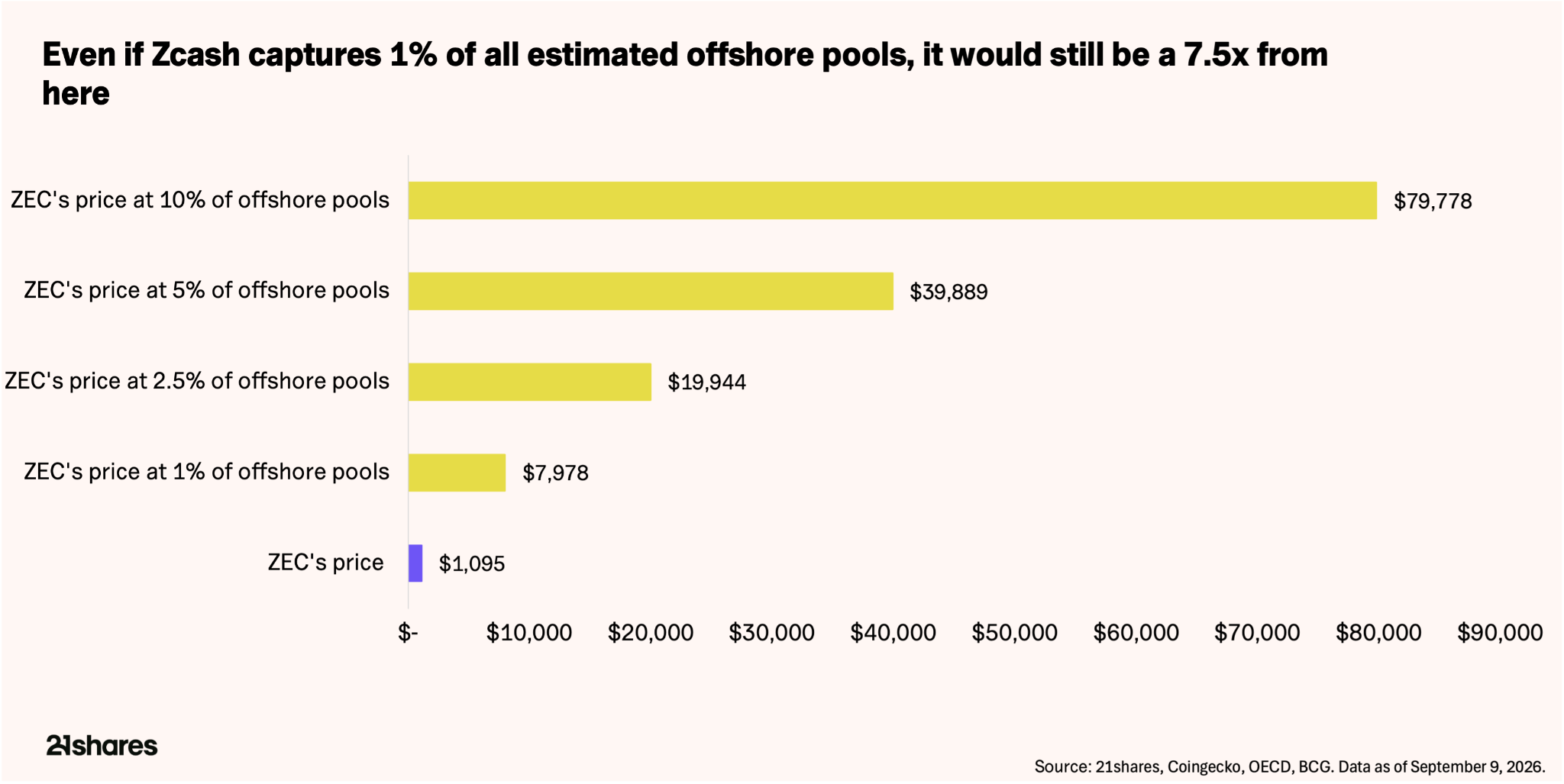
Privacy is horizontal. It is not a single product category but a property that most financial applications will need sooner or later. The opportunity is easiest to quantify by looking at what people already pay for financial privacy in traditional markets. Wealthy individuals and family offices have long used offshore structures such as Swiss trusts and Cayman funds. They rely on them for asset protection and confidentiality. This offshore pool holds an estimated USD 11 trillion in wealth (OECD, 2020). Broader cross-border measures even put it as high as USD 16 trillion (BCG, 2025). Crypto privacy is the digitally native version of this demand, with the added benefit of being auditable on request.
Even a 5% share of this pool would bring the crypto privacy sector to around USD 550 to 800 billion. That would mean an 18- to 27-fold increase from today's level. At around USD 30 billion, the sector currently makes up barely 1% of the total crypto market excluding stablecoins. That market stands at around USD 2.4 trillion. Penetration is still at an early stage, even among the leaders. Only about 28% of all ZEC sits in shielded pools. Nevertheless, that figure has risen 200% since September 2023, from around 9%. This growth is real. So the opportunity lies in the gap between today's adoption and the point it is heading toward.
Three ways into the privacy theme
The options range from the purest expression of the theme to the broadest. The right entry point depends on how far an investor expects privacy to spread across the crypto market.
- Dedicated privacy coins: Some investors see Zcash (ZEC) as the most direct exposure to the privacy theme. It is the largest privacy-focused network, with a fixed supply similar to Bitcoin, quantum-resistant cryptography and optional privacy. Users can switch freely between public and private transactions. The key risk is a shrinking premium for dedicated privacy coins. That could happen if established blockchains successfully build privacy into their own base layers.
- Privacy infrastructure: The Canton Network (CC) focuses on institutional privacy and controlled disclosure in tokenized markets. In total, more than 600 financial institutions use it, including Goldman Sachs, J.P. Morgan and the Depository Trust and Clearing Corporation (DTCC). Furthermore, the network processes over USD 8 trillion in tokenized assets every month. Here, the risk lies in its concentration on a private, permissioned network that works differently from open public blockchains.
- Blockchains building in privacy: Ethereum (ETH) and Solana (SOL) are integrating privacy features directly into their base layers. Holding them is a bet that privacy becomes standard across the whole ecosystem rather than staying a niche category. The trade-off is that privacy is one feature among many on these platforms. Exposure is therefore broad rather than targeted.
Is the missing layer taking shape?
Crypto's transparency was an advantage for verifiability and a drawback for adoption. Yet the layer that resolves this contradiction is emerging right now. For the first time, the major base blockchains, regulation and the market are moving in the same direction at once.
Investors who want to take part in this shift can do so at the asset or infrastructure level. Alternatively, they can go through the largest blockchains building in privacy. They size their positions according to how widely they expect privacy to spread across the crypto economy.