Monad is a Layer-1 blockchain designed to solve two core problems in the Web3 ecosystem: lack of scalability and inefficient smart contract execution.
While Ethereum - despite its market leadership - reaches its limits under heavy network load, Monad aims to create a network that offers the same developer tooling but operates significantly faster and more efficiently. The platform is fully EVM-equivalent. This means existing Ethereum smart contracts can run on Monad without any modifications. Developers do not need to rewrite or recompile their code and can migrate applications almost 1:1. This is where Monad differs from many “EVM-compatible” chains, which often introduce deviations in the bytecode and thereby create new risks.
Monad compared to existing Layer-1 networks
The technical uniqueness of Monad lies in pipelining and parallel transaction execution. Traditional blockchains operate sequentially: each transaction is processed, verified, and confirmed one at a time. Monad breaks this pattern by distributing processing steps across multiple phases, similar to a well-coordinated assembly line. This creates a massive increase in throughput, which - according to the project description - should enable thousands of transactions per second without sacrificing decentralization. Additionally, the blockchain reduces block time to around one second and aims for finalized results within a single slot. For users, this means faster confirmations, shorter waiting times, and a smoother overall experience.
Another key focus of Monad is accessibility. Despite its high performance, the network is intended to be operated with relatively moderate hardware requirements. This is meant to prevent only data centers or institutional actors from running nodes. The decentralization objective is therefore preserved. At the same time, the team is working to build a comprehensive ecosystem - including wallet support, developer tools, and infrastructure partners. Projects currently facing gas costs and scaling bottlenecks on Ethereum may thus gain an alternative without having to sacrifice their technical foundation.
Launch and initial on-chain data
The MON token and Monad’s mainnet officially went live on 24 November 2025. According to current data from DeFiLlama, the Total Value Locked (TVL) in the Monad network at launch amounts to around 74 million USD. Compared to established Layer-1 blockchains, this value is still very low - networks such as Solana or Avalanche report TVLs in the billions.
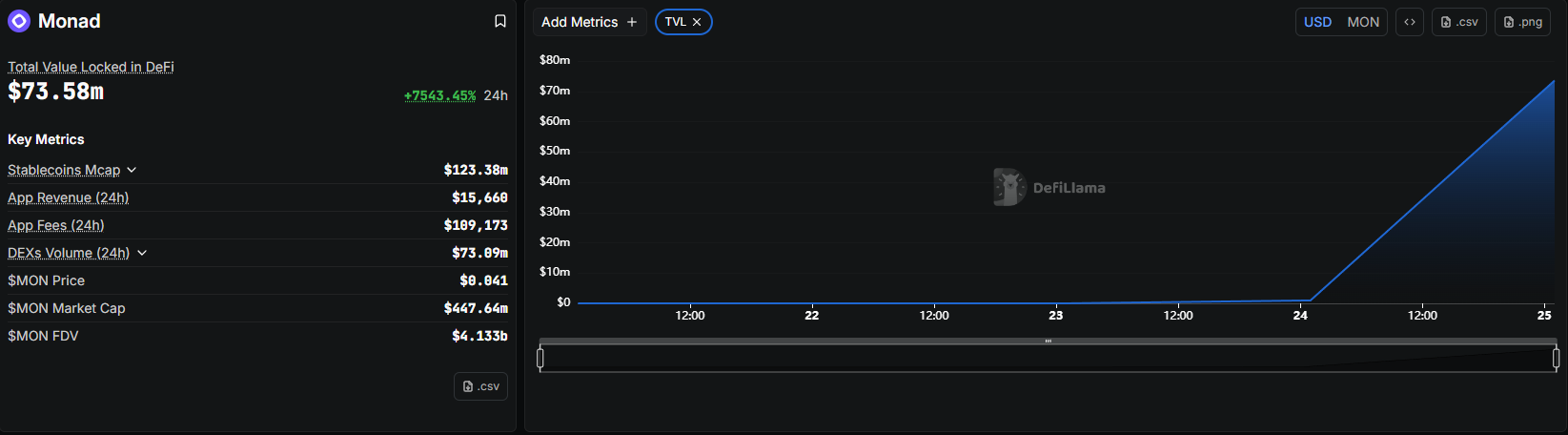
This relatively low initial capitalization does not necessarily reflect a lack of potential but rather the fresh launch status of Monad. At the same time, significant usage metrics have already been recorded: 24-hour transaction fees amounted to just over 109,000 USD, while DEX volume reached around 73 million USD.



Why EVM equivalence is crucial
One of Monad’s biggest advantages is its bytecode-level equivalence with the Ethereum Virtual Machine (EVM). This means smart contracts running on Ethereum today can be ported over without modifications - a technical distinction with enormous practical relevance. Many alternative chains advertise “EVM compatibility” but require code adjustments or new developer tools. Monad avoids this issue entirely: existing tools, frameworks, and wallets - including MetaMask, Hardhat, and Foundry - work natively.
For developers, this means they do not have to choose between performance and ecosystem access. This is especially important for DeFi protocols and large applications with millions of on-chain users, where frictionless migration is a major advantage. Instead of a full redeployment, existing projects can be moved over almost identically, while users benefit from lower fees and faster execution times.