Close Menu
Crypto Valley Journal
    Facebook X (Twitter) Instagram
    Crypto Valley Journal
    • Hot Topics
      • News
      • Minds
    • Focus
      • Background
      • Blockchain
      • Legal & Compliance
      • Non-Fungible Token (NFTs)
    • Investing
      • Markets
      • Financial Products
      • Decentralized Finance (DeFi)
      • Exchange overview
    • Education
      • Basics
      • Glossary
      • Politicians on crypto
    • Statistics
      • Bitcoin-ETF-Flows
      • Ethereum-ETF-Flows
      • Crypto market data
      • On-chain data
    • Academy
      • Overview
      • Part 1: Blockchain
      • Part 2: Money
      • Part 3: Bitcoin
      • Part 4: Cryptocurrencies
      • Part 5: Decentralized Finance
      • Part 6: Investing
    • English
      • Deutsch
    Crypto Valley Journal
    You are at:Home » Hot Topics » News » 30% mining tax in the USA postponed until further notice
    30% Mining-Steuer in den USA bis auf Weiteres aufgeschoben

    30% mining tax in the USA postponed until further notice

    By Editorial Office CVJ.CH on 31. May 2023 News

    The White House's plan to burden the mining industry with high taxes appears to be off the table following a major agreement between President Joe Biden and leading Republicans. This agreement aims to prevent the United States from being unable to repay its debts.

    The originally proposed tax plan, called the Digital Assets Mining Energy (DAME) Tax, in early May, intended to impose a 10% tax on the electricity consumption of Bitcoin and other crypto miners starting from 2024. The tax rate was supposed to increase to 30% by 2026. However, with the recent agreement reached regarding the debt ceiling, it seems unlikely that this tax legislation will be implemented.

    Mining tax put on hold

    The White House wanted to punish those who generate costs for others in both economic and environmental terms. The high energy consumption of cryptocurrency companies has a negative impact on the environment, quality of life, and power grids at the locations of these companies across the country. Therefore, such a disadvantage for the resident mining industry was deemed appropriate.
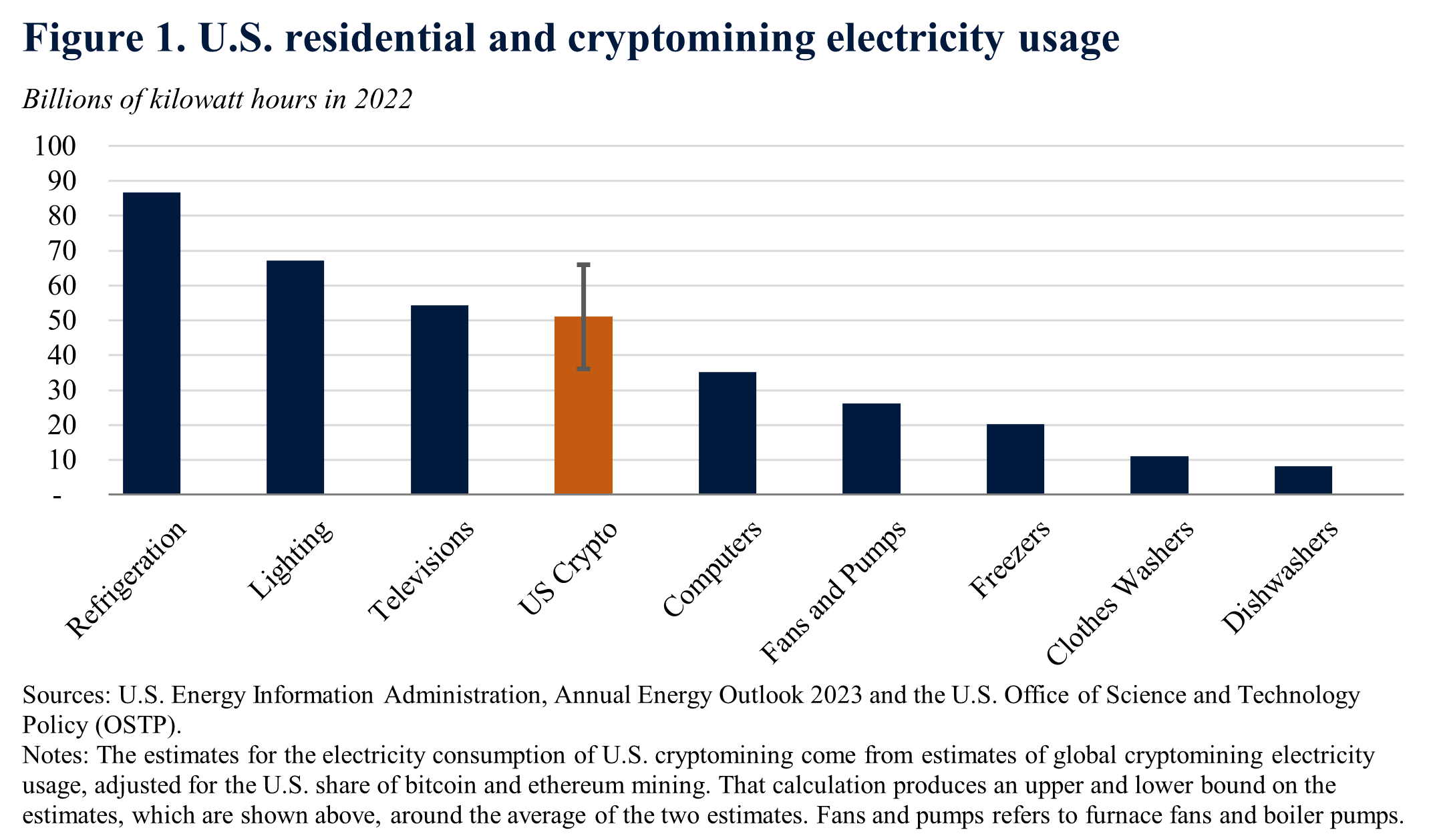
    U.S. household electricity consumption and crypto mining / Source: White House
    However, the debates surrounding the US debt ceiling put an end to these plans of the White House. From time to time, the US Congress must vote on raising or suspending the debt ceiling so that the USA can borrow more money to pay its bills. Currently, the debt ceiling stands at $31.4 trillion, which includes spending on federal employees, the military, social security, healthcare, as well as interest on the national debt and tax refunds.

    In recent years, reaching an agreement on the terms of a new ceiling has become increasingly difficult as both sides fail to come to terms. As this year's threshold was reached early in the year, a default by the United States was looming. However, over the weekend, negotiators from both parties finally reached an agreement. This agreement would fully suspend the debt ceiling until 2025. As part of the agreement, the proposed taxes by the White House, including the crypto mining tax (DAME Tax), were removed.

    Crypto mining under global scrutiny

    Laws like the DAME mining tax are not unique internationally. Critics of crypto mining often criticize its impact on the environment due to the significant energy requirements of the process. The carbon footprint associated with proof-of-work mining contributes to climate change and undermines global sustainability efforts. The original MiCA regulatory framework in the EU even proposed a ban on crypto mining. However, industry representatives emphasize that the environmental impact of crypto mining is often exaggerated. They point out that the industry is increasingly transitioning to renewable energy sources and becoming more efficient each year.

    The proof-of-work algorithm enables transaction verification in blockchain networks without the need for a third party, preventing double spending as seen in traditional systems. Network participants must solve specific cryptographic problems to verify the validity of transactions. Miners achieve this by using specialized computers that calculate hashes around the clock. This process requires real resources (computing power and energy), making malicious takeover of the network extremely cost-intensive. Mining is thus considered the foundation of the decentralized monetary system Bitcoin, similar to how gold mining is central to preserving its value.

    "The marginal cost of gold mining typically approaches the gold price. Gold mining is a waste, but that waste is far less than the utility of having gold available as a medium of exchange. I think the case will be the same for Bitcoin. The utility of the exchanges made possible by Bitcoin will far exceed the cost of electricity consumed. Therefore, not having Bitcoin would be the waste." - Satoshi Nakamoto, pseudonymous founder of the Bitcoin network in a forum discussion


    Share. Facebook Twitter LinkedIn Email Telegram WhatsApp

    About the author

    Editorial Office CVJ.CH
    • Website
    • Twitter
    • LinkedIn

    Since 2018, the editorial team at Crypto Valley Journal has been reporting from Zug - the heart of Switzerland’s Crypto Valley - on Bitcoin, cryptocurrency, blockchain, and regulatory developments in digital assets. Behind the publication’s collective editorial voice is a team of writers with backgrounds in financial markets, law, and technology.

    Related Articles

    Trump's financial disclosure reports over 1.4 billion USD in crypto income for 2025, making cryptocurrencies his largest source of income.

    Trump reports 1.4 billion USD in crypto income for 2025

    More than 100 financial firms, including BlackRock, Visa, and Mastercard, are founding the Open Standard consortium and planning to launch the OpenUSD stablecoin in the second half of the year.

    OpenUSD: BlackRock, BNY, Visa, Stripe, and others plan dollar stablecoin

    ARK Invest buys Coinbase, Circle, Bullish and Robinhood shares for USD 16.9 million - the second crypto-basket purchase within one week.

    Cathie Wood’s ARK Invest buys more Coinbase and Circle shares

    Six Swiss crypto service providers secured MiCA authorization. AMINA was the world's first; Sygnum and Bitcoin Suisse followed later.
    2. July 2026

    Six Swiss crypto service providers secure MiCA authorization

    Robinhood Perpetual Futures in Europe now cover commodities and currencies, and the broker plans a crypto launch in the United Kingdom.
    2. July 2026

    Robinhood Perpetual Futures expand to commodities in Europe

    The Clarity Act delay is intensifying: Galaxy Research cut the odds of a 2026 signing to 50%, while Polymarket now prices them at just 39%.
    1. July 2026

    Window missed: Clarity Act faces delay until 2030

    twitter image button instagram image button linkedin image button youtube image button

    About Crypto Valley Journal
    About Crypto Valley Journal

    On the pulse of the movement

    • Academy
    • Contact
    • Advertising
    • About us
    • Partner
    • Imprint
    • Privacy
    • Disclaimer
    Search

    Type above and press Enter to search. Press Esc to cancel.