In its weekly update, Strategy reported no Bitcoin purchase for the first time in months. Instead, the company bought back its own debt. Specifically, it is retiring convertible notes with a face value of 1.5 billion USD for roughly 1.38 billion USD in cash. Meanwhile, Michael Saylor spoke publicly about the "charging BitVac".
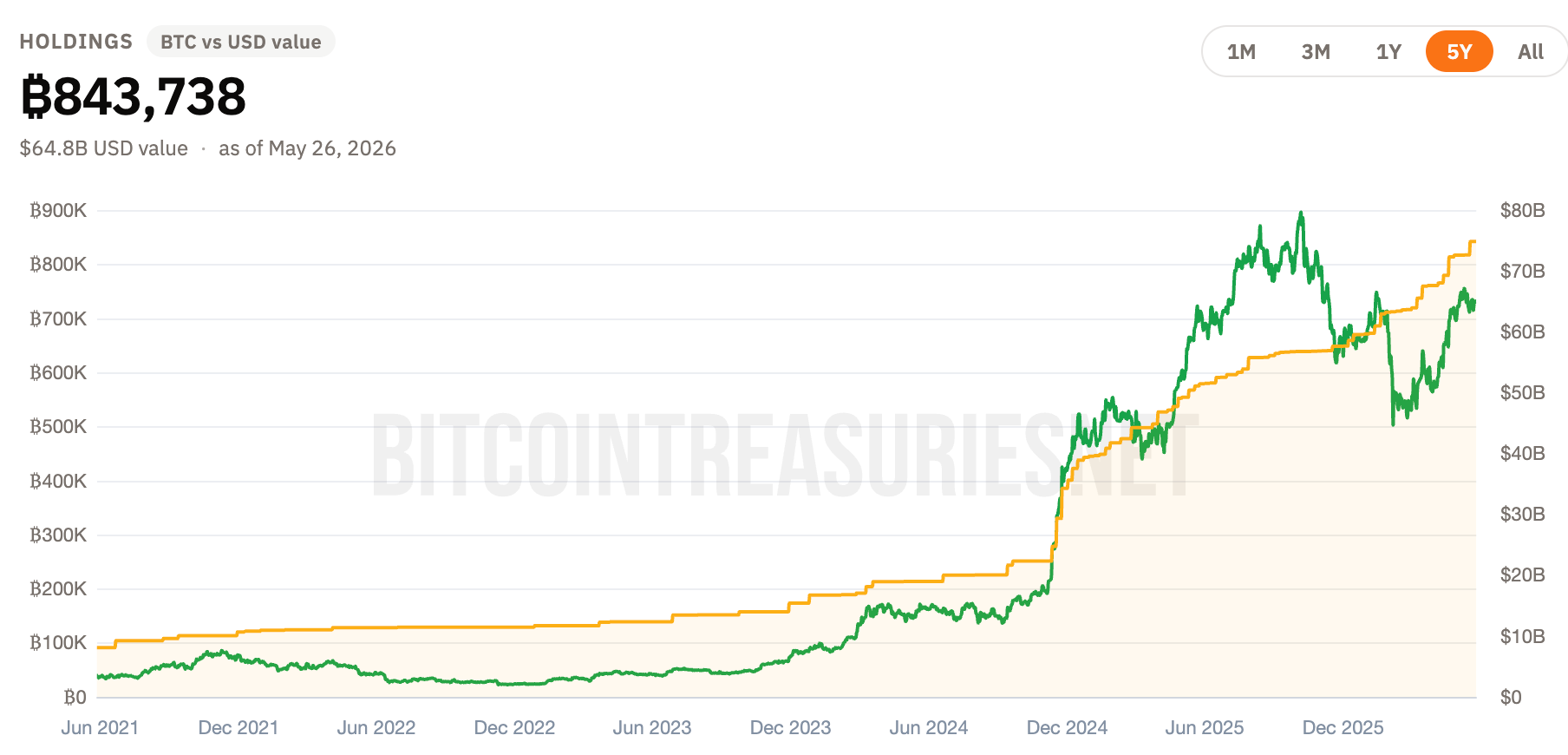
Strategy, formerly MicroStrategy, is the world's largest publicly traded Bitcoin holding company. Since 2020, the company has transformed from a business intelligence provider into a pure Bitcoin vehicle. As a result, it now holds 843,738 BTC as of 25 May 2026, with a market value of around 65.25 billion USD. A press release names the latest milestone. In privately negotiated transactions, Strategy is buying back its own convertible notes due 2029, with a face value of roughly 1.5 billion USD. The purchase price stands at around 1.38 billion USD and may vary slightly depending on the MSTR share price during the measurement period. Furthermore, the notes carry a 0% coupon.
Buyback of the zero-coupon notes due 2029
Originally, the notes now being repurchased served to finance Bitcoin purchases. Since mid-2020, Strategy raised more than 7 billion USD through convertible notes, and outstanding debt recently exceeded 4 billion USD, with maturities between 2027 and 2030. For the first time, the company is therefore reducing its liabilities in a meaningful way, instead of shifting the raised capital directly into BTC.
As funding sources for the buyback, Strategy cites existing cash reserves, share sales through at-the-market programs, and possibly Bitcoin sales. Saylor himself described limited Bitcoin sales before year-end as "not unlikely". However, the share of each of these three sources in the buyback remains open.




From permanent issuer to debt repayer
This step marks a turning point in the company's operating pattern. In the prior week, Strategy still bought 24,869 BTC for around 2.01 billion USD and financed the purchase through sales of the STRC preferred stock as well as MSTR common shares. This sequence of capital raising and immediate BTC accumulation had been the standard mode since 2024.
Strategy currently sits on an unrealized book gain of around 1.5 billion USD. The acquisition cost of the BTC holdings stands at roughly 63.9 billion USD, which corresponds to an average price of about 75,700 USD per Bitcoin. As a result, the company could have serviced the debt from ongoing market value gains, without launching new capital measures.
"This week we bought bonds, not Bitcoin. The BitVac is charging up." - Michael Saylor, Executive Chairman, Strategy
The "BitVac" term comes from Saylor's vocabulary and describes the company's role as a market volume absorber. In effect, Strategy pulls Bitcoin out of the circulating supply. The "charging up" suggests a phase of liquidity building that precedes a new round of purchases.
Background on the 21/21 plan and million-BTC target
The debt repayment stands in tension with the stated growth target. In autumn 2024, Strategy had announced the "21/21 plan": 21 billion USD each in capital raised through stock and notes. In 2026, the company increased the program to 42 billion USD, because the target is 1 million BTC by year-end. Until then, around 156,000 BTC are still missing.
According to an SEC proxy filing, Strategy raised a total of 25.3 billion USD in the capital market in 2025. By its own account, the company was therefore the largest equity issuer among US public companies for two consecutive years. In addition, it launched five classes of preferred stock, marketed as "Digital Credit" instruments: STRK, STRF, STRD, STRC, and STRE. The STRC market capitalization reached around 6.4 billion USD in April 2026.
At the same time, the note buyback signals a shift in priorities. Instead of balance sheet expansion, selective balance sheet cleanup now takes precedence. Whether this is a tactical response to the outstanding debt wall of the years 2027 to 2030, or a structural adjustment of the funding strategy, cannot be conclusively judged from the available statements. Saylor's X post suggests a pause, not a change in strategy. Therefore, the next weekly update on 2 June 2026 should show how quickly the BitVac starts to suck again.