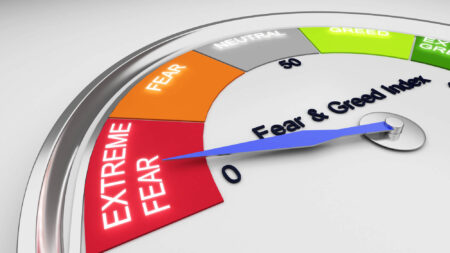
What has happened this week in the world of blockchain and cryptocurrencies? The most relevant local and international events, as well as interesting background reports, are summarized concisely in this weekly review.
Selected articles of the week:
Vanguard ends its two-year blockade and allows its over 50 million brokerage customers to trade Bitcoin, Ethereum, XRP, and Solana ETFs. The asset manager with 11.6 trillion USD in assets under management positions itself as a distribution platform without developing its own crypto products. CEO Salim Ramji, who previously managed the IBIT Bitcoin ETF at BlackRock, drove the strategic shift forward. Bloomberg Intelligence estimates that five percent adoption could generate additional inflows of 15 to 25 billion USD. The announcement came while Bitcoin traded at 86,000 USD – 32 percent below the October high of 126,000 USD. Memecoin ETFs remain blocked.
The Vanguard Group announced that customers can now trade ETFs and mutual funds that hold Bitcoin, Ethereum, XRP, and Solana.
Bank of America grants 15,000 advisors ETF recommendations
Bank of America allows its over 15,000 advisors at Merrill Lynch, Private Bank, and Merrill Edge to recommend four Bitcoin ETFs with allocations of one to four percent starting January 5, 2025. Approved products include those from Bitwise, Fidelity, Grayscale, and BlackRock. The decision ends a restriction spanning over 15 years, during which advisors could only mention crypto products upon explicit client request. With 3.6 trillion USD in assets under management at Merrill, BofA signals industry-wide normalization of institutional Bitcoin exposure. Morgan Stanley took a comparable step in August 2024 for high-net-worth clients, while Wells Fargo, Goldman Sachs, and UBS remain restrictive.
Sovereign Wealth Funds buy Bitcoin during price declines
BlackRock CEO Larry Fink confirmed at the New York Times DealBook Summit that several sovereign wealth funds systematically expanded their Bitcoin positions during the recent price correction. The purchases occurred at 120,000, 100,000, and below 90,000 USD as long-term strategic positions spanning multiple years. Fink characterizes Bitcoin as an “asset of fear” – a hedge against currency devaluation, sovereign debt, and geopolitical instability. Abu Dhabi holds approximately 1.1 billion USD in iShares Bitcoin Trust shares via two sovereign wealth funds, Bhutan over 13,000 BTC worth 1.2 billion USD. Fink predicted in Davos that a two to five percent allocation of the 13 trillion USD in sovereign wealth fund assets could drive Bitcoin to 500,000 to 700,000 USD.
BlackRock CEO Larry Fink confirmed at a summit that several sovereign wealth funds have been systematically increasing their Bitcoin positions.
Kraken integrates Swiss tokenization platform
Kraken acquires Backed Finance AG from Switzerland, a leading issuer of tokenized securities with over 60 products on Solana and Ethereum. The xStocks platform reached a combined trading volume of ten billion USD within four months after launching in early 2025. Over 11,000 users hold the Tesla token, with volume exceeding two billion USD already in August. The purchase price was not disclosed. The transaction marks Kraken’s fifth acquisition in 2025 and follows an 800 million USD funding round in November. Co-CEO Arjun Sethi emphasizes vertical integration of issuance, trading, and settlement as the foundation for programmable capital markets. Analysts project growth for the RWA sector to two to 30 trillion USD by 2030-2034.
The crypto exchange Kraken has announced the acquisition of the Swiss tokenization company Backed Finance.
Zurich authorities seize 23 Million CHF from Cryptomixer
In addition: The Zurich city and cantonal police seized approximately 23 million francs in Bitcoin from the mixing platform Cryptomixer.io in late November in cooperation with Europol and Eurojust. Active since 2016, the service obscured transaction paths by mixing deposits, thereby facilitating money laundering from darknet marketplaces, ransomware payments, and crypto thefts. The cumulative volume of laundered funds exceeded one billion francs. Investigators secured twelve terabytes of data and server infrastructure and took the platform offline. The Zurich Public Prosecutor’s Office clarified that using mixing services under Article 305bis of the Criminal Code is not inherently criminal – criminal liability arises only when laundering proceeds from crime. Operators generated several million francs in profit.

Zurich authorities seize millions in Bitcoin during the Cryptomixer.io investigation; prosecutor outlines legal boundaries.