
What has been happening this week in the world of blockchain and cryptocurrencies? Current events and background reports in our weekly review.
Selected articles of the week:
The digital franc CHFD gains partners that shape everyday payments. This week, exchange operator SIX and payment app TWINT joined the CHF stablecoin sandbox. As a result, nine companies instead of seven now test in a protected live environment. UBS, PostFinance, Sygnum, Raiffeisen, Zürcher Kantonalbank, BCV and Swiss Stablecoin AG launched the project in April. So far, however, it was mainly an exercise for banks. Now two players join whose systems would become the bottlenecks in a rollout. According to the Swiss Payment Monitor, TWINT holds a Swiss market share of 67.8%, while Apple Pay reaches only 12.5%. Use cases include public payouts or fair access to event tickets. The payment instrument itself carries the conditions. The test phase should run until the end of 2026, with an open outcome. Therefore, a market launch remains undecided. Moreover, the matching license will not arrive before 2027.
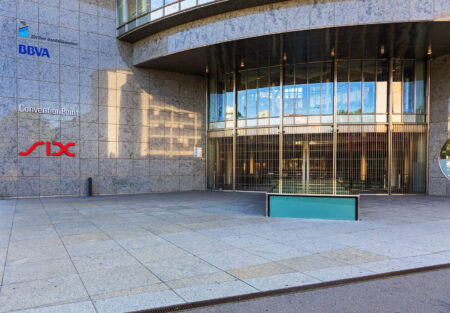
SIX and TWINT bring the CHF stablecoin sandbox to nine partners, which are testing the franc stablecoin CHFD until the end of 2026.
Bitcoin Suisse shifts work to Bratislava and Vietnam
While Swiss institutions rally around the digital franc, a Crypto Valley pioneer is looking abroad. Crypto financial service provider Bitcoin Suisse has told its Zug staff about job cuts. Up to 60 positions could disappear. To cut costs, back-office tasks will move to Bratislava or to a new site in Vietnam. The first layoffs should take effect this year. This is because, according to CEO Andrej Majcen, international growth now takes priority, not just Switzerland. In addition, the firm wants to grow in wealth and asset management beyond crypto. For this purpose, it obtained licenses in Bermuda, Liechtenstein and Abu Dhabi this year. The Liechtenstein license opens up the entire EEA. In Switzerland, by contrast, the road was rocky. Bitcoin Suisse withdrew an application for a banking license in 2021 because FINMA classified it as “not eligible for approval”. Nevertheless, Zug remains the headquarters.

Bitcoin Suisse job cuts put up to 60 positions in Zug at risk, as the group moves back-office tasks to Bratislava and Vietnam.
Senate Republicans lack at least seven votes for the Clarity Act
The US Senate is wrestling over clear crypto rules, so far without a majority. This week, Republicans presented a revised, 630-page version of the Clarity Act. The bill aims to divide oversight between the SEC and the CFTC. In addition, it defines when a crypto asset counts as a security and when as a digital commodity. The draft now contains more than 114 provisions requested by Democrats. Nevertheless, according to Politico, no Democrat backs the new version. That matters, because the cloture vote on September 15 requires 60 of 100 votes. Republicans, however, hold only 53 seats. Disputes concern, for example, yield on stablecoins and the ethics clause. Although the clause bars officials from issuing their own tokens, only the Justice Department may enforce it. Moreover, it expires in January 2029. If the vote fails, the gap between the SEC and the CFTC stays open for now.

The revised Clarity Act runs to 630 pages ahead of the first Senate vote on September 15, but Democrats have not yet backed it.
Hunter Biden’s memecoin LAPTOP loses over 95% in one hour
This week, Hunter Biden showed how quickly a token from the political sphere can crash. His memecoin LAPTOP launched on Base, the Layer-2 network operated by Coinbase. Within one hour, it lost more than 95% of its value. Analytics firm Bubblemaps counted 12,151 buyers with losses, roughly 80% of 15,206. The gains, by contrast, stayed in a few hands. In fact, 88 addresses, fewer than 0.6% of buyers, collected roughly USD 5.57 million combined. Across all wallets, the net gain comes to only about USD 178,000, which means redistribution rather than value creation. Moreover, roughly 60% of the largest holders used fresh addresses. These only received funds shortly before the launch. However, that does not prove insider trading. Before the launch, Hunter Biden had called the TRUMP coin a “grift”. Nevertheless, his “fun currency” took a similar path.

Of 15,206 wallets that bought the Hunter Biden memecoin LAPTOP, 12,151 lost money, while 88 addresses took home USD 5.57 million.
Bitcoin L2 sidechain loses USD 320 million
In addition: the Bitcoin sidechain Liquid, run by infrastructure provider Blockstream, has lost roughly 4,000 BTC worth USD 320 million. Of a reserve of about 4,200 BTC, only around 197 remained. The attackers did not steal a key, however. Instead, they exploited a bug in the Elements node to create unbacked L-BTC. During withdrawals, the federation checked only the address, not the backing. Notably, a patch had existed as a commit since early August. However, it was missing from the current release. The attackers call themselves “whitehats”, meaning friendly hackers. They offer to return most of the funds once operators have updated every node. Charles Guillemet, CTO of wallet maker Ledger, disagrees, however. In his view, serious researchers report a vulnerability before they move reserves of this size.

Roughly USD 320 million in Bitcoin left the federation wallet in the Liquid Network hack. Blockstream then paused the sidechain.