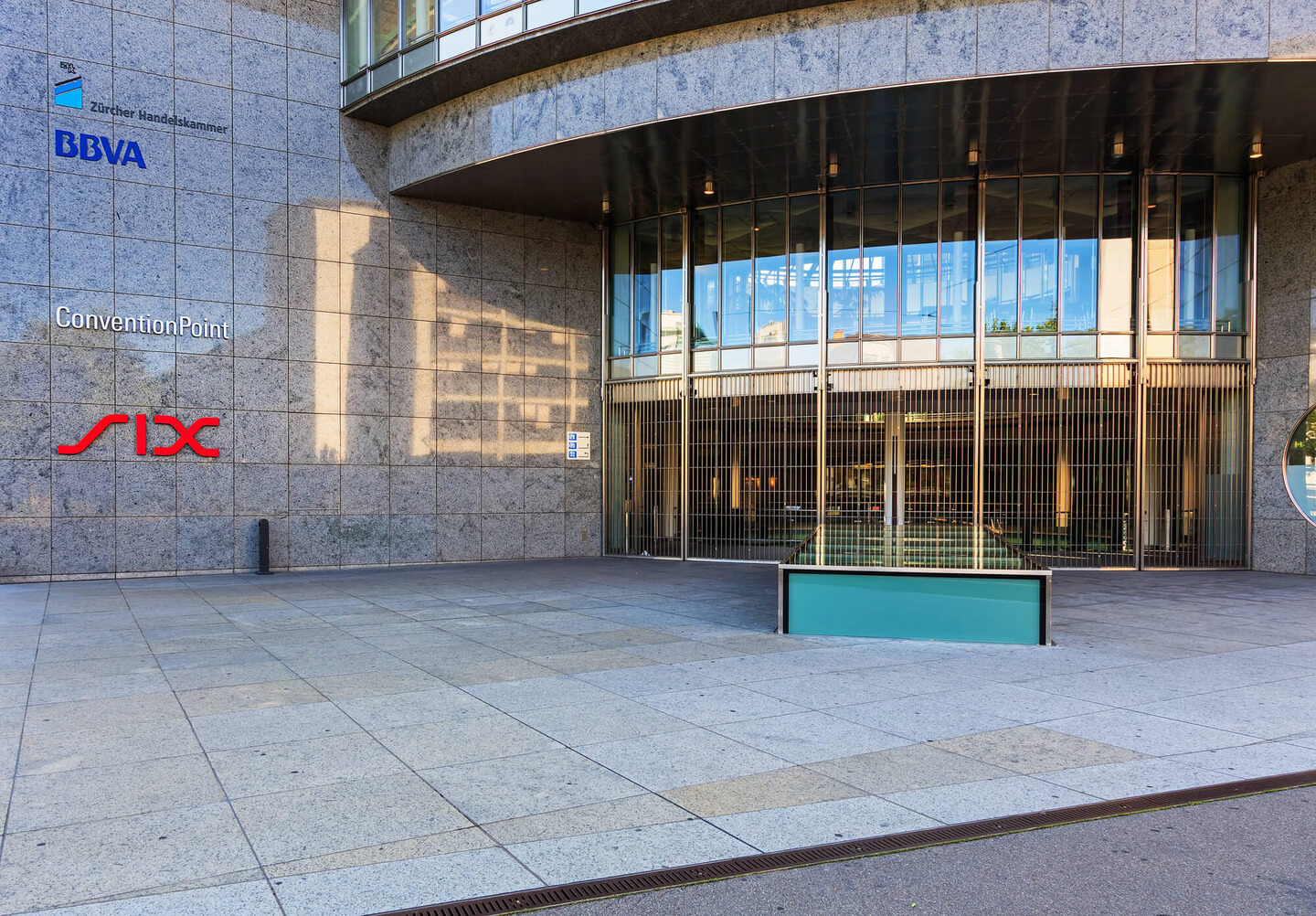
Swiss exchange operator SIX and the payment app TWINT have joined the CHF stablecoin sandbox. Nine Swiss companies are now examining, in a protected live environment, how the digital franc CHFD can be used in concrete use cases.
A stablecoin is a digital asset that typically tracks a currency 1:1, and for CHFD that currency is the Swiss franc. The sandbox itself is a controlled live environment with a restricted group of participants and amount limits, where the institutions involved can try out new digital financial products under realistic conditions without taking on the risks of an open market launch. UBS, PostFinance, Sygnum, Raiffeisen, Zürcher Kantonalbank, BCV and Swiss Stablecoin AG launched the initiative in April 2026, as CVJ.CH reported. Former SP Council of States member Pascale Bruderer founded Swiss Stablecoin AG in 2022 (interview with CVJ.CH here), and its subsidiary CHFD Infrastruktur AG operates the platform. CHFD has been technically live since the end of June, and with the two new arrivals the group grows from seven to nine partners, so the initiative now leaves its preparatory phase.
SIX and TWINT strengthen the CHF stablecoin sandbox
The two new arrivals bring capabilities that the founding partners so far lacked. SIX operates the Swiss stock exchange, settles securities transactions, processes financial information and provides a substantial share of the country's payment infrastructure. That puts an institution at the table whose systems would one day have to carry the settlement of any franc stablecoin in institutional business. There is no way around this infrastructure wherever tokenized assets and a digital means of payment have to meet. TWINT covers the other side, namely the payments between end customers and merchants.
The numbers behind the app show how dominant that position is: more than 6 million people were actively using TWINT as of mid-2025, while the provider processed 773 million transactions in 2024. In the 2024 survey by the Swiss Payment Monitor of the University of St. Gallen, the app reached a market share of 67.8%, far ahead of Apple Pay with 12.5%, Google Pay with 3.3% and Samsung Pay with 2.7%. Some 81% of brick-and-mortar stores and 84% of online shops in the country accept it. A payment solution that bypasses this reach therefore has a hard time in Switzerland.
The initiative was in essence an exercise among banks until the two companies joined. The operator of the market infrastructure and the de facto standard in Swiss everyday payments are now testing alongside the banks, two players whose systems would be the bottlenecks anyway in the event of an introduction. That shifts the character of the project from a feasibility study among institutions toward a test that touches the entire payment system. Both companies also contribute expertise in financial market infrastructure and digital payment solutions.
Programmable payments as a new test field
The use cases fall into two groups, and the first covers patterns already established internationally: automated transactions between financial institutions and the settlement of tokenized digital assets. Both target the interbank business and the question of whether a franc stablecoin settles faster and more cheaply there than existing procedures. Little about that is new, but this part delivers a solid basis for comparison against what already runs in the market today.
The second group is more interesting, because there the partners genuinely enter new territory. The tests examine whether programmability can lower the fraud risk on online marketplaces, whether fair access to event tickets becomes enforceable and whether public sector payouts can run more efficiently. What these three cases share is that they embed conditions directly in the means of payment instead of securing them through contracts and intermediaries. An amount then becomes available only once a defined condition has occurred. That moves the test into a field that has only marginal overlap with classic banking.
CHFD Infrastruktur AG operates the CHF stablecoin platform on which the cases run. The partners themselves speak of groundwork for future developments in digital payments, and that wording is precise: the point is not market-ready products but the question of which application areas hold up at all. The selection is striking nonetheless. Ticket sales and government payouts are areas where the franc stablecoin competes not against existing crypto products but against procedures that today are organized neither digitally nor efficiently.




An open-ended test phase until the end of 2026
The test phase will presumably run until the end of 2026, and the partners deliberately leave its outcome open. The focus is on insight: where a CHF stablecoin could create added value, which challenges exist and which technical, operational and regulatory conditions further development would require. An overview of the results should follow once the initiative concludes. The setup expressly does not constitute a decision on a later market launch.
This restraint has a regulatory background. The Federal Council and FINMA are pushing ahead with a reform of the Financial Institutions Act whose consultation ran from October 2025 to February 2026. The draft provides for a new license category called payment institution, which expressly permits the issuance of value-stable crypto-based means of payment and lifts the previous ceiling of CHF 100 million for customer deposits under the fintech authorization. Its entry into force is unlikely before 2027. Until then, redemption claims of stablecoin holders count as deposits under the applicable Banking Act, which keeps the room for maneuver for issuers narrow.
Anyone who wants to issue a stablecoin in Switzerland today operates within a framework that is currently being rebuilt. The sandbox safeguards, the limited group of participants and the amount limits, are precisely the answer to that. They keep the test within tight boundaries while the future license category is still taking shape. And the timing fits: the results of the test phase will be available before the new legal framework takes hold, the framework that should give stablecoin issuers a category of their own for the first time.
The digital franc remains a niche market
Measured against what is happening globally, all of this plays out in a very small corner. The worldwide stablecoin market currently stands at around USD 300 billion and is dominated by dollar-based products, while all franc stablecoins together come to roughly USD 40 million, with the decentrally collateralized Frankencoin making up most of that. That order of magnitude explains why the financial center approaches the topic cooperatively. The market is simply too small for a solo effort.
Competition exists nonetheless, and so far it comes from outside the banking circle. The Frankencoin is a decentrally collateralized project with no issuer balance sheet behind it, and it works by different rules than a payment instrument issued by a bank. Sygnum, in turn, has issued its own franc token, the Digital CHF (DCHF), since 2020, and the bank takes part as a sandbox partner at the same time. The DCHF is not a stablecoin, however, but a deposit token: Sygnum holds a banking license, keeps the equivalent of every token issued as a deposit, and the holder has a claim against the bank. Its main use is settling transactions in tokenized assets.
Nine of the most important players in the financial center are jointly clarifying fundamental questions that would be expensive for each of them to answer alone, and they do so without committing to a common product. That is where the institutional appeal of the arrangement lies. The stated goal of those involved is to support the build-out of a Swiss ecosystem for digital money and to strengthen the competitiveness of the financial center. Whether a digital franc for the market emerges from it will not be decided in the sandbox, but the conditions for it are being clarified there.
Update 08.09.2026: An earlier version of this article described Sygnum's Digital CHF (DCHF) as a franc stablecoin and stated that it was backed by funds held at the Swiss National Bank. The DCHF is a deposit token, that is tokenized commercial bank money issued by a licensed bank, and the equivalent is held as a deposit. The passage has been corrected.