
Titans of traditional finance, from Ray Dalio to Carl Icahn, have slowly warmed up to digital assets as traditional assets no longer fitting the bill
Specifically Mr Dalio, who in the past has referred to bitcoin as a “bubble”. His team at Bridgewater Associates, the world’s largest hedge fund, even recently opined that bitcoin offers numerous attractive attributes. This begs the question: why the change of tune? The answer to this question is, naturally, multifarious.
A portfolio of traditional assets simply does not provide the performance and diversification it used to. Generally speaking, the ultimate goal of a well-diversified portfolio is to maximise returns while protecting against market volatility. Bridgewater argues that the appeal of bitcoin is increasing in the current global macro environment context. Many sovereign bonds no longer offer the returns they once did, correlations across asset classes are high, and currencies face greater risk of depreciation – due partly to unprecedented levels of quantitative easing. As a result, investors are looking for alternative stores of value.
How do digital assets fit into a portfolio diversification strategy?
Grayscale Investments, a leading digital assets investment services company, conducted a series of portfolio simulations to see how an allocation to bitcoin might affect the risk-adjusted return of a portfolio comprised of global equities and bonds (the “Global 60/40”). The Global 60/40 consists of a 60% allocation to the iShares MSCI ACWI and a 40% allocation to the Vanguard Total International Bond ETF.
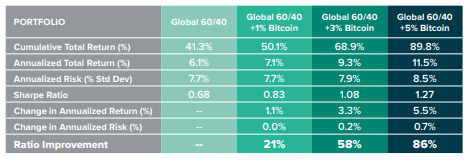
They found that even small allocations to bitcoin could significantly enhance the returns of traditional portfolios, such as the Global 60/40, without materially increasing volatility. What is powerful about this analysis is that it provides a reasonable benchmark for institutional investors and corporate treasuries to follow. Although Micro Strategy’s 100,000 bitcoin investment and Tesla’s sporadic announcements make headlines, many investors require a more pragmatic approach.
Opportunity for traditional players to offer new products
US banks have been given the regulatory okay to offer custody of crypto assets, and banking software is being upgraded to facilitate crypto investing. Hence, why the asset class has developed to traditional ways of investing: mutual/hedge funds, ETPs, ETFs, and AMCs. Through this, people who prefer not to manage cryptocurrencies themselves or are not sure what to buy, but want exposure, can delegate an asset manager or bank to make decisions for them, and still reap the benefits.
Crypto Finance has two funds: the Systematic DLT Fund and the Portunus Fund; while the Portunus Fund is a long only product, the Systematic DLT Fund aims to benefit from the volatility present within the crypto markets through a long/short strategy.
Institutionally launched cryptocurrencies
By launching a cryptocurrency, banks could more efficiently process payments, facilitate international cash transactions, provide escrow services, and offer loans. However, only recently a few banks and financial services have started to build their own blockchain ecosystem. In 2019, JPMorgan Chase introduced its own cryptocurrency, JMP Coin, which it uses to settle transactions among clients and transfer funds more quickly. Furthermore, multiple central banks have set up teams to explore offering digital FIAT, such as the digital euro or e-krona.
Despite increasing activity, many institutional players are still uncertain about how to best use these currencies, and how to treat the ecosystem efficiently. However, the path forward is becoming clearer as industry players are learning and adjusting to new ways.
Cryptocurrencies: developed use case for blockchain technology
Cryptocurrencies fuel blockchain applications. Therefore, we believe, anyone who has faith in blockchain technology and wants to understand how it works, needs to experiment with cryptocurrencies and become educated. The only way to do this is by getting familiar with using the cryptocurrency ecosystems. Whether that is by providing liquidity on a decentralised exchange, or by sending cryptocurrencies from one wallet to another, financial institutions that educate themselves now, will be well positioned to lead their industry.