
Investing in crypto is often associated with short-term gains or losses, as crypto is a historically volatile asset class. However, smart investors know that an investment strategy is built for the long term. Instead of making quick bets, they build a diversified investment portfolio over time.
Cryptocurrencies are known to move in cycles, experiencing both bull and bear markets characterized by price increases and decreases, respectively. This text explores the historical cycles of cryptocurrencies, such as Bitcoin, and emphasizes the importance of understanding these cycles when investing. It also discusses strategies like dollar-cost averaging and diversification to navigate the volatile nature of the crypto market.
Cryptocurrency moves in cycles
You might have heard of bull and bear markets. These animal metaphors refer to two diametrically opposed market phases. In a bull period, prices are rising, and the market is expanding. In a bear period, prices are falling while the market is contracting. Crypto has experienced several bear and bull markets over the course of its history. These periods can last for a few weeks or several months.
Bitcoin experienced a 3-months euphoria in 2017, when its price rose from 4k USD to 20k USD. This was followed by a bear period, as Bitcoin dropped under 3k USD. Another bull period took place in 2020-2021, with prices jumping up from 5k USD to 60k USD. Again, prices fell under 20k USD in the months immediately after.

What’s the lesson here? Some crypto assets have proven they can rebound after strong downturns - it’s worth keeping an eye on the market even when it looks slow. Investors who had bought big just before a crash suffered serious losses, while early-adopters stood to make big wins - or still not recoup their investment if the asset does not recover. But predicting cycles is no easy task, and investing smaller amounts on a regular timeline and over the long-term can help smooth these variations.
Cryptocurrencies are experiencing growing adoption
- Crypto is a teenager: Bitcoin was unveiled in 2009, Ethereum in 2015. Both have surged in popularity in the last few years, as exemplified by the number of unique addresses (the “account number” used for making transactions). There are over 170M unique Ethereum addresse and over 1Bn Bitcoin addresses.
- The technology keeps expanding: Crypto is an innovative field, and has already proven it can reinvent itself. Processes are regularly improved, allowing for faster and more efficient transactions. The latest revolution is ETH’s Merge, which took place in December 2022. After this upgrade, transactions on the ETH blockchain consume 99% less energy.
- Low-barrier to entry: Capitalise on small initial crypto investment. There is no “minimum” amount required to invest in crypto. One could invest as little as a few dollars a month, and benefit from spectacular rises in value over time.
- Diversification strategy: You don’t have to go all-in on crypto to reap its rewards. We have seen that crypto is volatile, and easy to acquire. This makes it a good candidate for diversification within a portfolio. We dive deeper into this topic in our article on diversification with crypto.
How to invest in crypto: Timing matters
As an investor, you would like to buy when prices are low, and sell when they have reached their peak. But how can you identify this sweet spot? There is no easy answer: it takes time and effort to analyse the market. Luckily, there are tools to assist you with this. Learn everything you can about the crypto you want to invest in. Check its historical performance, underlying technology, leadership board etc. All this information is available online, even if retrieving it can prove time consuming. But it’s not a step you can skip.
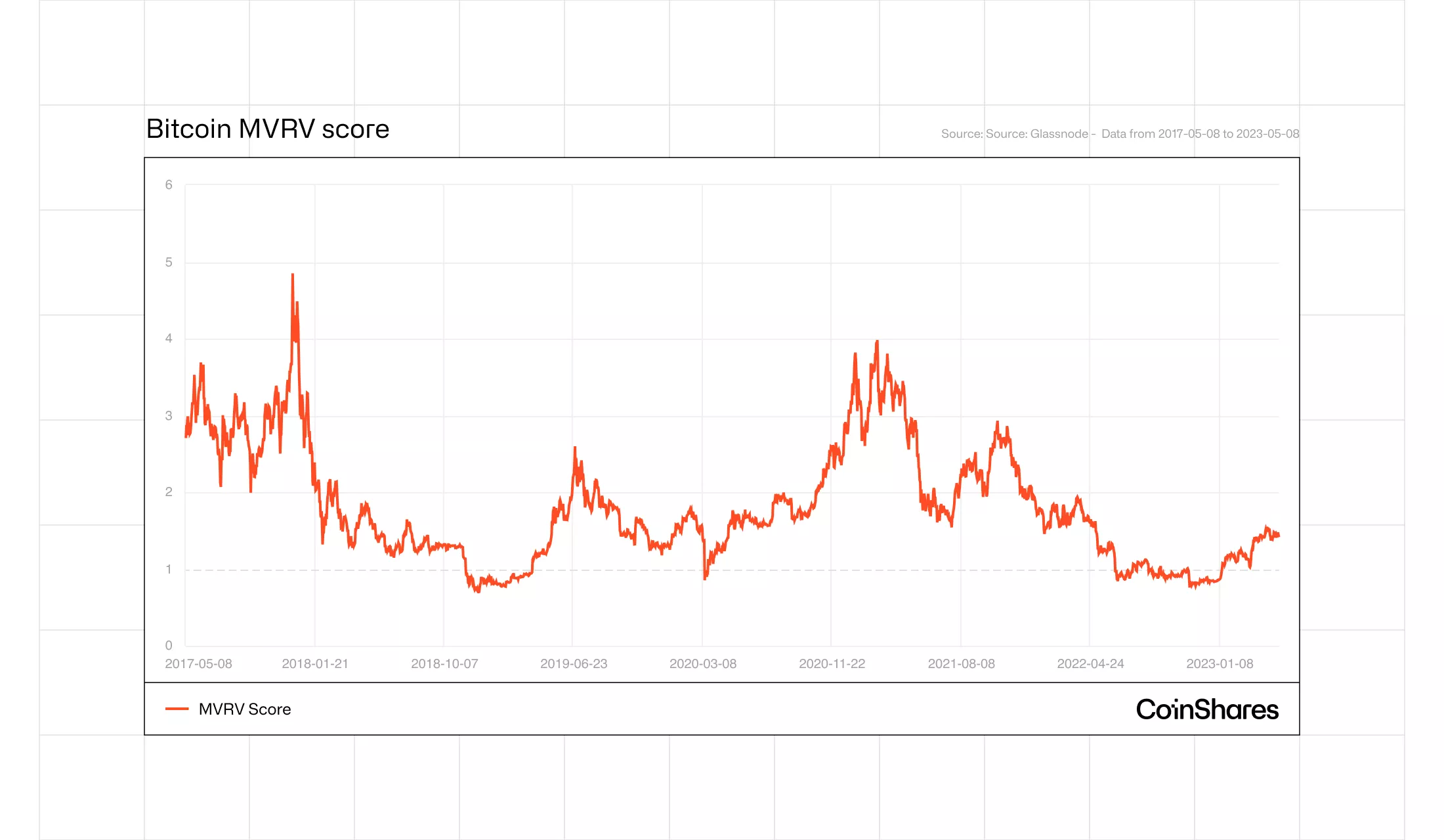
The Market Value to Realised Value Ratio charts whether an asset is undervalued or overvalued relative to its current value. Typically, a high MVRV score tends to indicate Bitcoin is overvalued; a low score could mean it’s undervalued.
Dollar-cost averaging (DCA) is an investment classic. It consists in buying a fixed amount on a regular basis - for example, 100$ in Bitcoin every week - regardless of price variations. This method is sometimes also referred to as a “savings plan”, when you put aside a portion of your income for investment purposes.
If you invest according to a predetermined savings plan , you don’t “care” whether Bitcoin is in a bull or bear period. You keep buying the predetermined amount, with the objective to smooth out your investment cost over time. You may then be able to lower the average cost per investment and reduce volatility and drawdown in your portfolio. This method can also prevent making poorly-timed lump sum investments.




Diversifying with Bitcoin over the long-term
Let’s have a look at 3 portfolios, active from October 2015 to November 24, 2022, with quarterly rebalancing:
- Standard portfolio is composed of stocks (60%) and bonds (40%). This is the “standard” asset repartition in traditional finance.
- This portfolio adds 4 percent of gold vs the standard one.
- This one introduces 4 percent of Bitcoin in the portfolio instead of gold. Its rounded composition is therefore stocks (57%), bonds (39%), and Bitcoin (4%).
A 4% Bitcoin allocation improved annualised returns from 6.9% to 14.4%, compared to portfolio 1. Despite BTC’s volatility, the portfolio as a whole is not significantly more volatile (10.4% vs 9.3% for portfolio 1). Its maximum drawdown (the maximum drop from a peak to a low) stands at 22.9%.

However, portfolio 2 (gold) had lower volatility and drawdown, as gold was a steadily rising asset on the period. With as little as 4% of Bitcoin in the portfolio, correlation to portfolio 1 is reduced by almost 8%. This is a further indication that Bitcoin is a suitable asset for diversification purposes. Based on this analysis, a long-term (8 years) and crypto-diversified portfolio performed optimally compared to more traditional approaches.