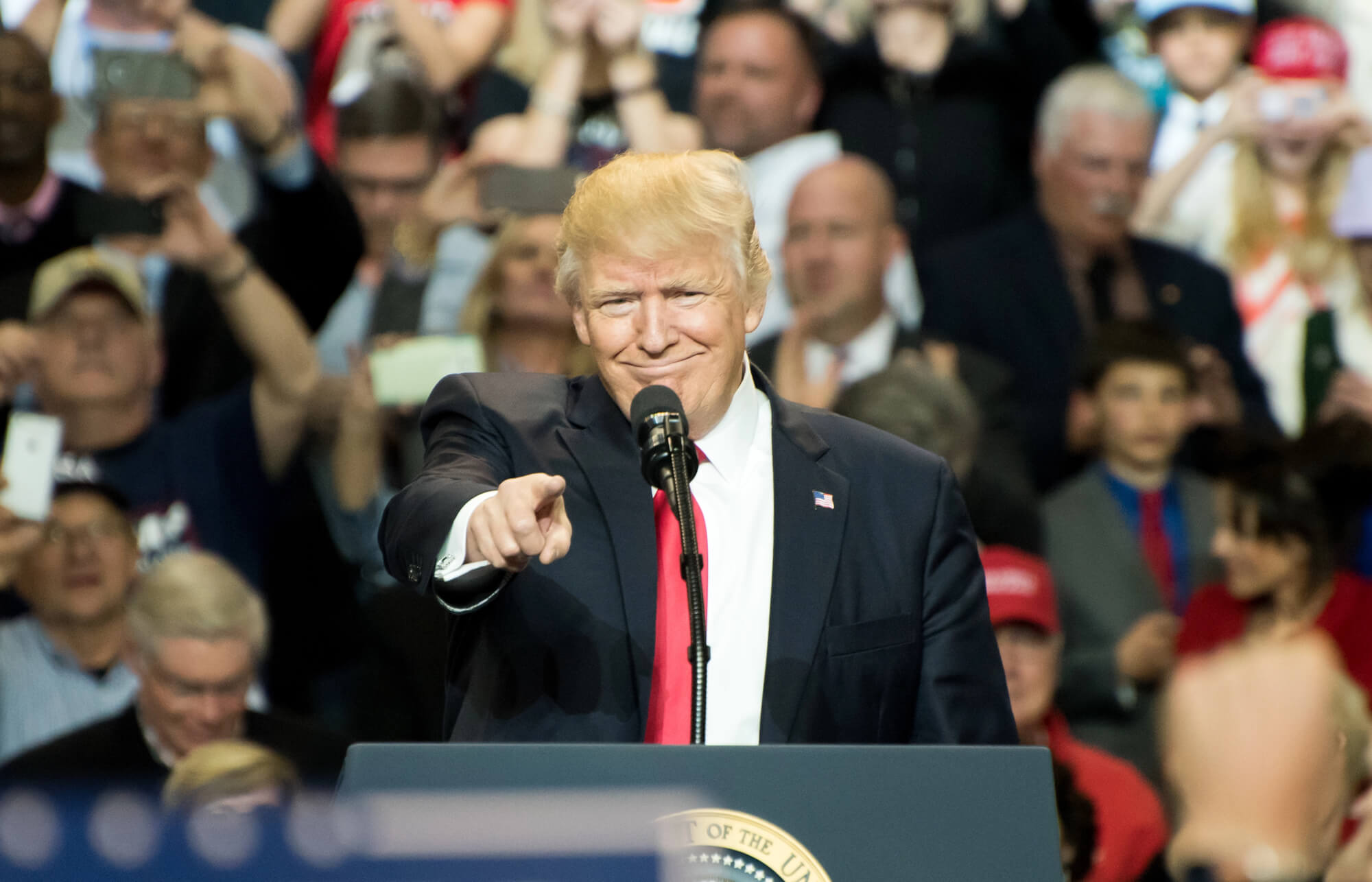
US President Donald Trump sharply attacked the banking industry in a Truth Social post on Tuesday evening. He accused banks of undermining the Genius Act and holding the Clarity Act hostage. Trump therefore urged Congress to pass the market structure bill without delay.
The post marks the president's most direct public attack on the banking lobby over crypto policy to date. Trump framed the conflict in geopolitical terms: the crypto industry cannot be taken away from the American people. Inaction plays into China's hands. He stressed: "Banks are making record profits, and we will not allow them to undermine our strong crypto agenda."
Stablecoin yields as core conflict between banks and crypto industry
The dispute revolves around a central question: can crypto exchanges pay yields on stablecoin balances to their users? Trump signed the Genius Act at the White House on July 18, 2025. The law created the first comprehensive US regulatory framework for dollar-based stablecoins. The Senate approved it in June 2025 by a vote of 68 to 30. The House followed in July with 308 to 122. Under the law, issuers must back their tokens one-to-one with dollars or other liquid assets. At the same time, the law explicitly prohibits stablecoin issuers from paying interest or yields to holders.
Still, the Genius Act is silent on whether exchanges or other intermediaries may offer such yields. Platforms like Coinbase exploit exactly this gap. Through its Coinbase One subscription service, subscribers earn around 3.5 percent yield on USDC balances. For comparison: traditional savings accounts in the US pay an average of less than 0.4 percent. Stablecoins already account for nearly 20 percent of Coinbase's revenue, specifically $355 million in the third quarter of 2025 alone. For the full year 2025, Coinbase generated approximately $1.35 billion in stablecoin revenue. The income primarily stems from a revenue-sharing arrangement with USDC issuer Circle on interest earned from reserves.
Banks warn of trillion-dollar outflows from stablecoin yields
Banks view this model as a major threat. The Bank Policy Institute (BPI) warned Congress that interest-like stablecoin products could trigger deposit outflows of up to $6.6 trillion. This figure is based on a US Treasury analysis from April 2025. Bank of America CEO Brian Moynihan stated in January 2026 that yield-bearing stablecoins could drain 30 to 35 percent of all bank deposits. According to BPI calculations, even a moderate scenario would reduce lending by $250 billion. In a more aggressive scenario involving yield competition, the estimated decline reaches $1.5 trillion. Of that, $110 billion would affect small business loans and $62 billion would hit agricultural loans. The crypto industry counters: consumers have the right to higher returns. Banks earn 4.5 percent on customer deposits but pay back virtually nothing.
Clarity Act stalls in the Senate, Coinbase withdraws support
The Clarity Act, officially the Digital Asset Market Clarity Act, passed the House in July 2025 by a vote of 294 to 134. In the Senate, the bill stalled. Two committees are working on their own drafts. On January 29, 2026, the Agriculture Committee advanced its version, the Digital Commodity Intermediaries Act, through a vote. The Banking Committee, in turn, published a 278-page draft on January 12. This draft would explicitly prohibit crypto firms from offering yields on stablecoin balances.
Coinbase CEO Brian Armstrong then withdrew his company's support for the bill. He described the Senate draft as a de facto ban on tokenized equities. He also criticized DeFi restrictions and a proposed shift in oversight from the CFTC to the SEC. Armstrong's decision forced the postponement of a planned Banking Committee vote. Within the crypto industry, the withdrawal caused division. Chris Dixon of a16z Crypto publicly disagreed and called for advancing the Clarity Act. For Coinbase, over $1.3 billion in annual revenue is at stake.
Despite this, talks at the White House have remained inconclusive. In recent weeks, representatives from the banking and crypto industries met repeatedly at the White House. The goal was to reach agreement on the bill's language. A self-imposed March 1 deadline passed without a compromise. On March 4, a Coinbase delegation led by Armstrong traveled to the White House again. JPMorgan CEO Jamie Dimon, meanwhile, emphasized in a CNBC interview that banks support innovation and competition. They demand equal rules for all participants, Dimon said. Anyone who wants to hold deposits and pay interest must submit to bank regulation.




Trump's crypto ventures and the conflict of interest with banks
Trump's sharp rhetoric toward banks also has a business backdrop. The Trump family is deeply embedded in the crypto business. World Liberty Financial, co-founded by the president, launched the stablecoin USD1 in March 2025. Its market capitalization currently stands at approximately $4.7 billion. According to a Reuters investigation, the family earned over $800 million through crypto ventures in the first half of 2025. Of that, $463 million came from the sale of WLFI tokens alone.
Beyond business ties, political power dynamics play a role. The crypto industry funded Trump's campaign and inauguration with substantial sums. It controls one of the largest campaign war chests in Washington. These funds remain strategically relevant, particularly ahead of the midterm elections in November 2026. Trump is considered the first explicitly crypto-friendly US president.
Members of the president's family regularly speak about having been excluded by banks in the past. This experience led them into the crypto world. Personal conviction and business calculation are intertwined. On Truth Social, Trump wrote: "The banks should not try to undermine the Genius Act or hold the Clarity Act hostage. They need to make a good deal with the crypto industry because it is in the best interest of the American people."
Clarity Act faces decisive weeks in the Senate
The Senate Banking Committee is targeting a vote in the second half of March. After that, the drafts from the Banking and Agriculture Committees must be reconciled. Final passage in the Senate requires 60 votes. Passage therefore demands support from Democrats. Senator Tim Scott, chairman of the Banking Committee, expressed confidence to Fox Business. He expects the Clarity Act to become law before the midterms. Ripple CEO Brad Garlinghouse estimated the probability at 80 to 90 percent by the end of April.
Prediction markets reflect cautious optimism. On the Polymarket platform, the probability of the Clarity Act being signed into law in 2026 stands at 72 percent. A week ago, the figure was 62 percent. The ten-percentage-point increase suggests that market participants view Trump's pressure as constructive. His public pressure on banks could shift the negotiations. The outcome remains open. The stablecoin yield question affects potentially $6.6 trillion in bank deposits. That is the foundation of traditional lending. A compromise must satisfy both sides without stalling the stablecoin market, which currently exceeds $310 billion in market capitalization.