
A summarizing review of what has been happening at the crypto markets of the past week. A look at trending sectors, liquidity, volatility, spreads and more. The weekly report in cooperation with market data provider Kaiko.
The last 7 days in cryptocurrency markets:
- Price Movements: Ethereum reached a new all time high of $2'190 and Bitcoin again broke $60k on the eve of Coinbase's public listing.
- Volume Dynamics: Stablecoins now surpass Bitcoin as the dominant quote asset in crypto markets.
- Order Book Liquidity: Coinbase's order book liquidity is the strongest out of all fiat exchanges but lags that of Binance, Huobi, and Okex.
- Volatility and Correlations: The algorithmic stablecoin Fei Protocol failed to hold its USD peg after launching to much fanfare.
New all time highs on the eve of Coinbase's public listing
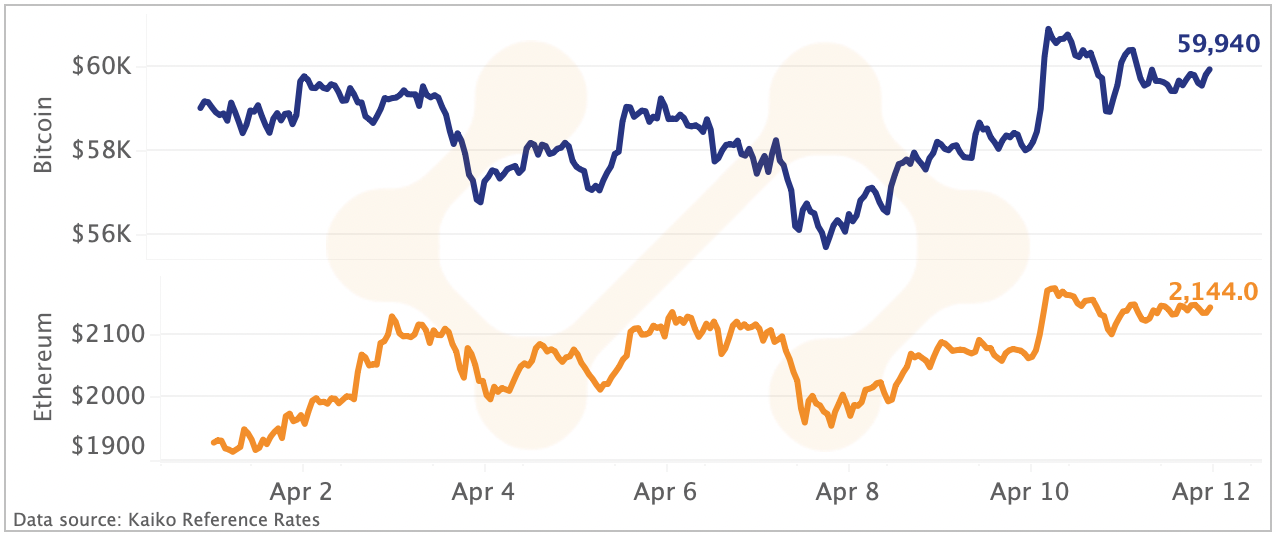
On April 14th, Coinbase will be the largest cryptocurrency company to ever go public, giving a new class of investors the ability to invest in the future of crypto without direct exposure to the asset class. The crypto industry will be watching with anticipation to see how traditional markets value Coinbase, thus this week could be exceptionally volatile depending on the exchange's public reception on Nasdaq. Coinbase's biggest competitor, Binance, had a stellar week for its native BNB token, which again broke new all time highs. Ethereum also broke a new all time high above $2'190 as altcoin markets heat up across nearly every sector of the crypto industry.
Stablecoins are increasingly dominant as a quote asset
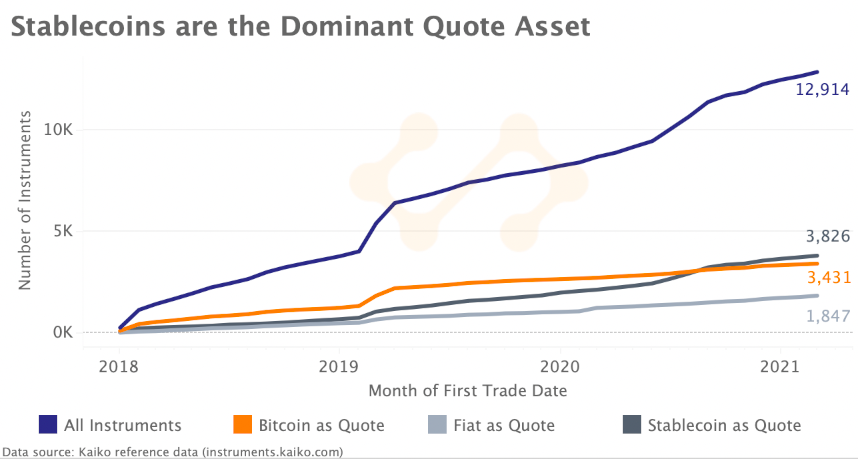
Until 2018, the majority of all traded instruments were denominated in Bitcoin. With the increasing popularity of stablecoins like Tether, more and more exchanges began listing instruments with stablecoins as the quote asset. We can observe that in 2020, a crossing over occurred between the number of instruments denominated in Bitcoin and in stablecoins. Today, nearly 1/3 of all instruments are denominated with a stablecoin while only about 1/7 of all instruments are denominated with a fiat currency. This is also indicative of a wider shift in market structure away from exclusively Bitcoin markets.
Coinbase liquidity lags Asian exchanges
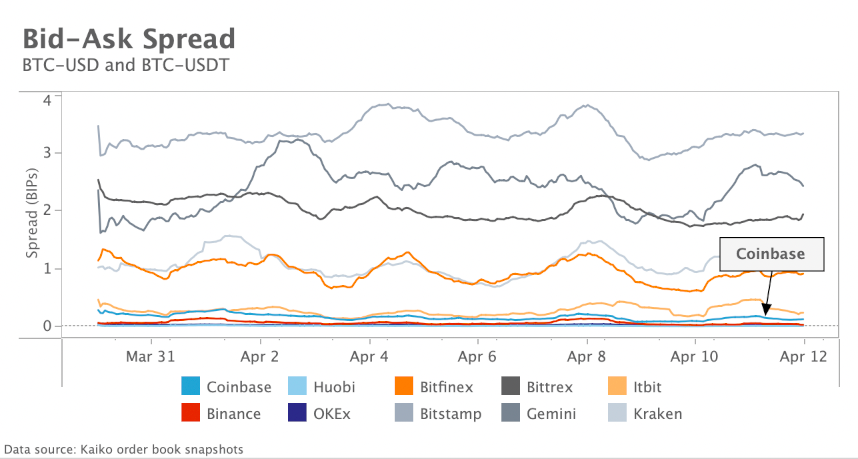
Coinbase is one of the few fiat exchanges competitive with Binance, Huobi, and Okex in terms of order book liquidity. We use the bid-ask spread as an indicator of market liquidity for BTC-USD and BTC-USDT trading pairs on a group of 10 exchanges. The narrower the spread for a trading pair, the more liquid the market. We can observe that Coinbase's spread for their BTC-USD market is the tightest out of all fiat exchanges, but lags behind the BTC-USDT markets on the Asian exchanges. Below, we rank the exchanges by average bid-ask spread over the past year:
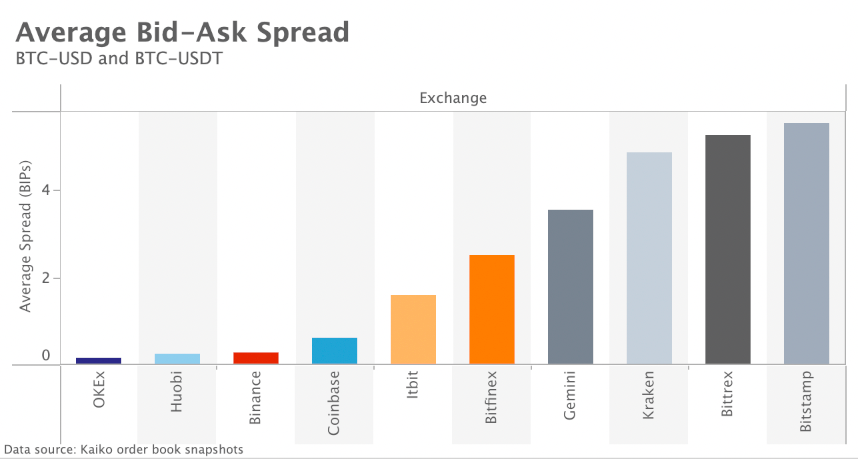
We can observe that Okex, Huobi, and Binance have the tightest spreads, with Coinbase coming in 4th place. It is important to note that exchanges sometimes incentivize market makers to keep spreads tight, resulting in artificially tight spreads at the loss to the market maker. In organic markets, market makers will widen spreads in response to volatility. If spreads remain tight during periods of extreme volatility, this suggests market makers are being incentivized to fix spreads.
Price slippage is often a better indicator of liquidity because it is more difficult to artificially maintain than the spread, thus gives a more realistic idea of how market orders will affect the price of an asset. When looking at price slippage for a simulated $100k sell order, we can observe that the ranking of exchanges has shifted slightly:
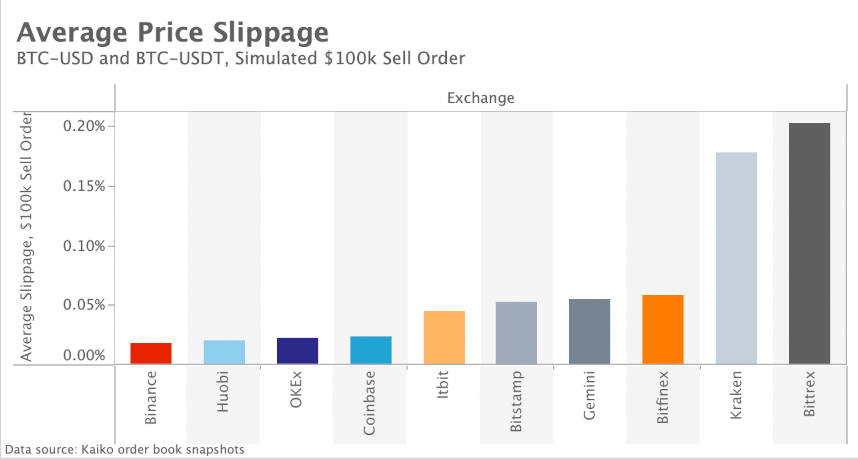
Coinbase is now neck-in-neck with Okex in terms of slippage, and on par with Binance and Huobi. The order of fiat exchanges has also shifted substantially, with Bitstamp moving from last place in terms of spread to 6th place in terms of slippage, which indicates Bitstamp's markets are actually more liquid than the spread would suggest.
Algorithmic stablecoin fails to hold peg
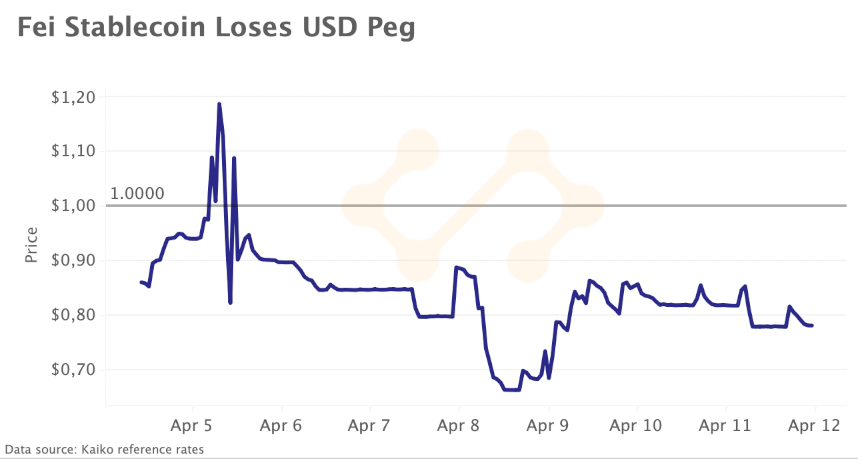
Last week, the Fei Protocol stablecoin launched with much fanfare, backed by prominent VCs and an innovative approach to algorithmically maintaining its 1:1 USD peg. Alas, an unexpected surge of demand at the launch caused the stabilization mechanism to fail, plunging the protocol well below its 1:1 peg, where it has now traded for days. Most stablecoins are backed 1:1 by U.S. Dollars, but the Fei team proposed an alternative method for stabilization involving a complex incentive structure that proved unfamiliar to those rushing to purchase the coin. At the least, this experiment highlights the complexities in stablecoin pricing models and that there is much work to do before a successful algorithmic protocol can function properly.