
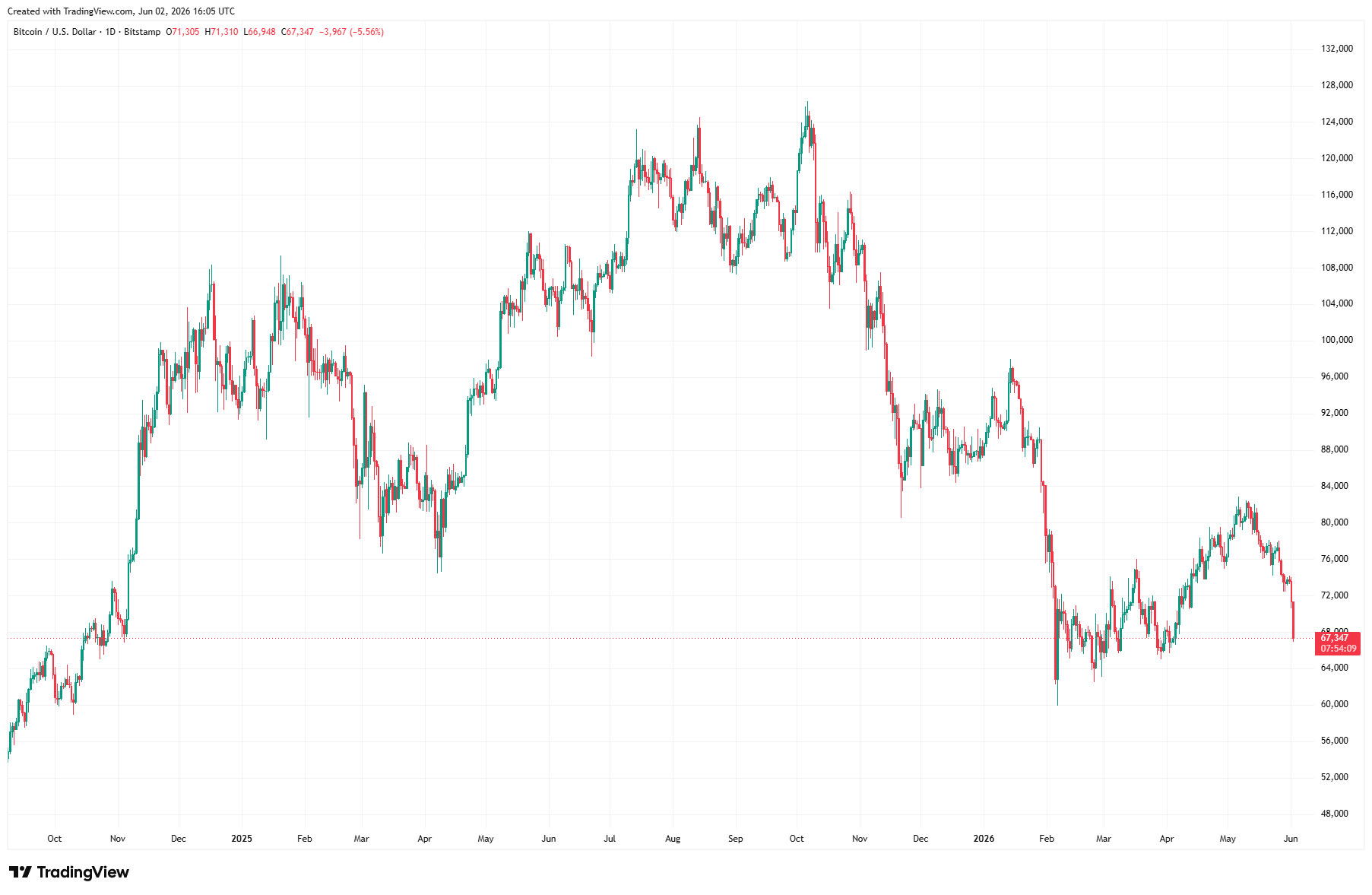
The Bitcoin crash sent the price to a two-month low, and it traded below USD 70,000 for the first time in roughly two months. The intraday low landed near USD 67,800, with a daily loss of 4.45 percent. Meanwhile, the broader crypto sector was dragged down alongside it. The Nasdaq, by contrast, closed slightly higher on the same day.
A single shock did not trigger the decline. Instead, a steady outflow of capital drove it. This becomes visible first in the US spot Bitcoin ETFs, the exchange-traded funds approved since January 2024 that provide regulated Bitcoin exposure. Since mid-May 2026, these funds have recorded outflows of roughly USD 3.45 billion over eleven consecutive trading days. As a result, the cumulative net inflows for the current year turned negative. Together with the pull of the AI boom and Strategy's first Bitcoin sale in years, the picture points to a structural reallocation rather than a panic.
Record outflow streak signals structural reallocation
The 11 consecutive outflow days mark the longest such streak since the ETFs launched in January 2024. May 2026 was therefore the worst month for these products in the entire year, with net outflows of USD 2.43 billion. BlackRock's IBIT, the largest of these funds, posted a single outflow of USD 440 million on the final trading day alone. The highest daily outflow across all US spot BTC ETFs, however, came in mid-May at USD 648.64 million.
As a result, assets under management shrank from over USD 104 billion to roughly USD 94 billion within just under two weeks. Bitcoin itself lost around 6 percent over the week and around 7 percent over the month. This decline differs markedly from the February crash. Back then, Bitcoin plunged from USD 78,000 to USD 60,000 in about 72 hours. The current drop, by contrast, unfolds as a slow, steady drip over weeks.
The divergence from the rest of the market stands out. Specifically, the Nasdaq closed the same day with a slight gain of 0.2 percent. Crypto assets came under pressure, yet the broad tech index therefore held steady. This split points less to a broad flight from risk than to a targeted reallocation of institutional capital. Many market observers see the zone around USD 63,000 as a more realistic support level, instead of the brief February low at USD 60,000.
Strategy's symbolic Bitcoin sale
Strategy, the listed software and Bitcoin treasury company led by Michael Saylor, sold Bitcoin for the first time in roughly five years at the end of May 2026. The company sold 32 BTC for USD 2.5 million at an average price of USD 77,135 per coin. It later disclosed the transaction through an 8-K filing. Moreover, the company intends to use the proceeds to fund the dividend on its STRC preferred share, whose rate stands at 11.5 percent annually.
In terms of volume, the sale is negligible. The 32 BTC correspond to 0.0038 percent of the total holding of 843,706 BTC, which the company holds at an average cost basis of USD 75,699. Saylor had moreover already flagged the move during the Q1 earnings call.
"We will probably sell some Bitcoin to pay a dividend, just to immunize the market and to signal that we have done it." - Michael Saylor, Executive Chairman, Strategy
The share reaction was nevertheless noticeable. The STRC share traded at USD 96.48, down 1.6 percent and at its lowest level since February 2026. The common stock MSTR lost 3.9 percent in pre-market trading. At the current Bitcoin price, the company is moreover sitting on a notional book loss of roughly USD 2.9 billion.




Alphabet and Marvell show where the capital is flowing
Alphabet, the parent company of Google, announced an equity raise totaling USD 80 billion. It is the company's first share issuance since 2005. The structure combines a public offering of USD 30 billion, an ATM program of USD 40 billion, and a private placement of USD 10 billion with Berkshire Hathaway. The capital should flow into AI computing infrastructure, whose demand exceeds the available supply according to the company. In addition, the company plans total investments of USD 180 to 190 billion for 2026, with USD 35.7 billion in the first quarter alone. The GOOG share fell 2.5 percent in pre-market trading, a reflex to the dilution.
Meanwhile, chip designer Marvell Technology received a strong boost. Nvidia chief Jensen Huang described the company at Computex in Taipei as the "next trillion-dollar company." The MRVL share consequently jumped 18 percent after market close, starting from a market capitalization of USD 200 billion. The stock had already risen sharply over the current year before this statement. Furthermore, Nvidia had previously invested USD 2 billion in Marvell in March 2026.
The same mechanism sits behind both movements. The AI capex cycle, driven by Alphabet, Microsoft, Meta, and Nvidia, ranks among the largest investment waves in technology history. Consequently, it increasingly ties up liquidity. Crypto treasury firms fell by double digits, yet the broad tech market held steady. The capital is therefore visibly rotating from digital assets toward computing infrastructure.