A summarizing review of what has been happening at the crypto markets. A look at trending sectors, liquidity, volatility, spreads and more. The weekly report in cooperation with market data provider Kaiko.
Bitcoin had a volatile week, dipping at one point below $57k before rebounding over the weekend as concerns eased over interest rates. In other news, restaking service Eigenlayer announced an airdrop, the former Binance CEO got a 4-month prison sentence, and Coinbase posted strong Q1 revenues. This week we explore:
- Slowing ETF inflows, despite Grayscale reversal
- Coinbase's institutional trading activity
- USDC's growing momentum
Is the ETF rally over?
ETFs have been one of the main drivers of the recent crypto rally, registering billions in inflows since their launch in early January.
However, both ETF inflows and the BTC rally have lost some steam since the start of April. Last week, BlackRock's IBIT registered its first-ever daily outflow of $37 million, interrupting 71 consecutive days of inflows. Net flows across all ETFs have also seen a steady drop since January.
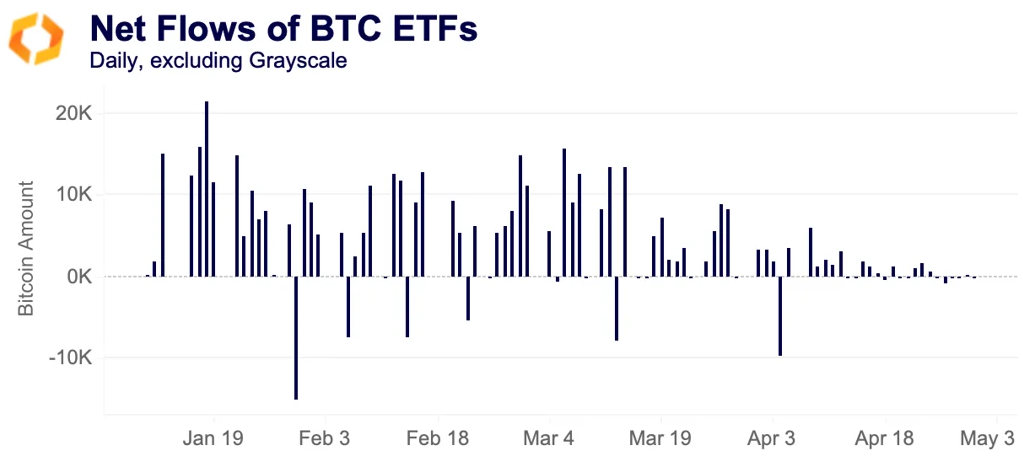
The good news is that this trend seemed to reverse on Friday, with ETFs, including Grayscale's GBTC, seeing strong inflows after cooler-than-expected US jobs data revived Fed rate cut bets.
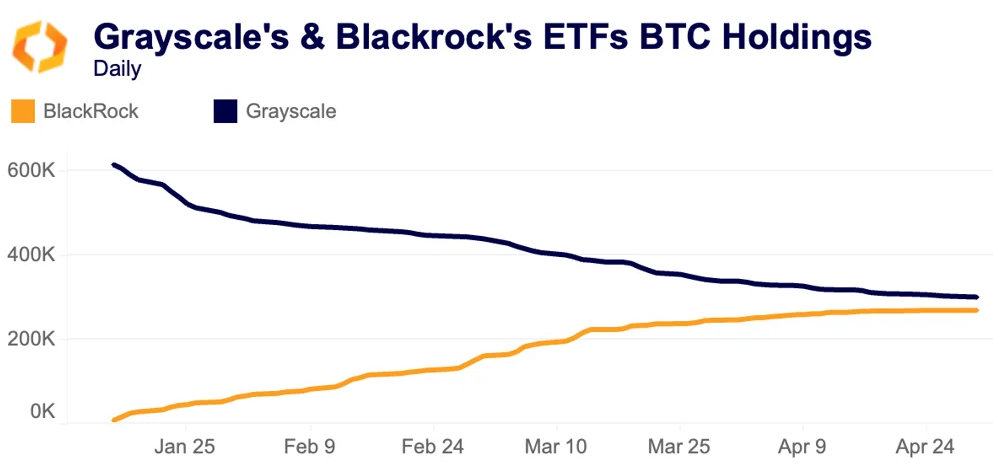
The turnaround for GBTC was the first time ever that the ETF saw positive inflows. Over the past few months, BlackRock has proven to be the dominant ETF issuer, with IBIT currently nearing parity in holdings with GBTC.
Globally, ETF competition has also been heating up. Last week, three mainland Chinese asset managers — Bosera Asset Management, Harvest Global Investments, and China Asset Management — launched BTC and ETH spot ETFs in Hong Kong.
The combined volume on the first day of trading (for HKD, RMB, and USD trading) reached $12.7 million, significantly lower than the $4.6 billion traded by US spot ETFs on their launch day. However, it is important to note that the Hong Kong ETF market is many times smaller than the US market.
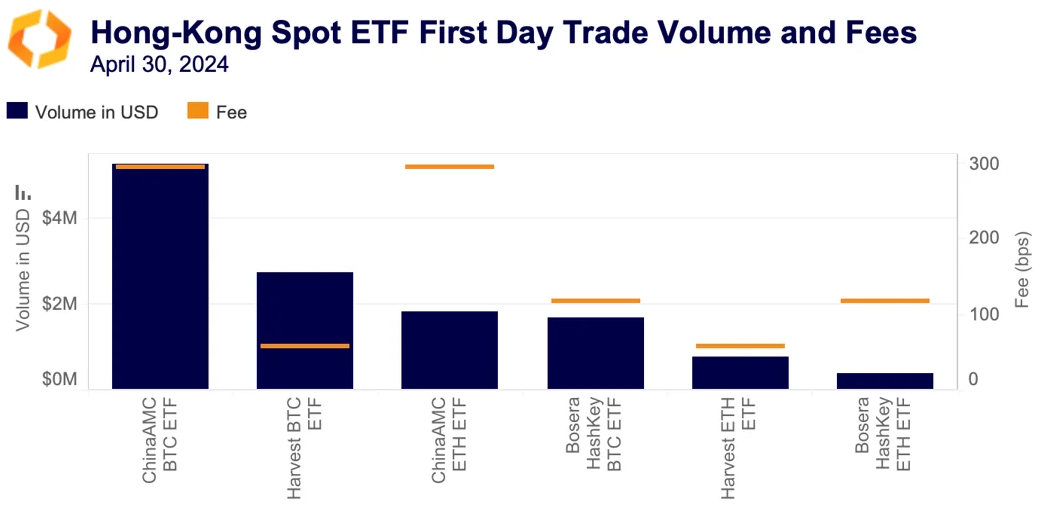
Interestingly, ChinaAMC's Bitcoin ETF saw the strongest volume despite its higher fee of 99 basis points. ETH ETFs attracted 23% of the total first day volume, while BTC accounted for the majority at 77%.
Overall, APAC demand for crypto exposure appears robust. According to the first batch of mandatory 13F filings with the US SEC revealed last week, a Hong Kong-based asset manager is the largest holder of BlackRock's IBIT fund.
While spot ETF inflows have lost some momentum, institutional interest in real world asset (RWA) tokenization has picked up.
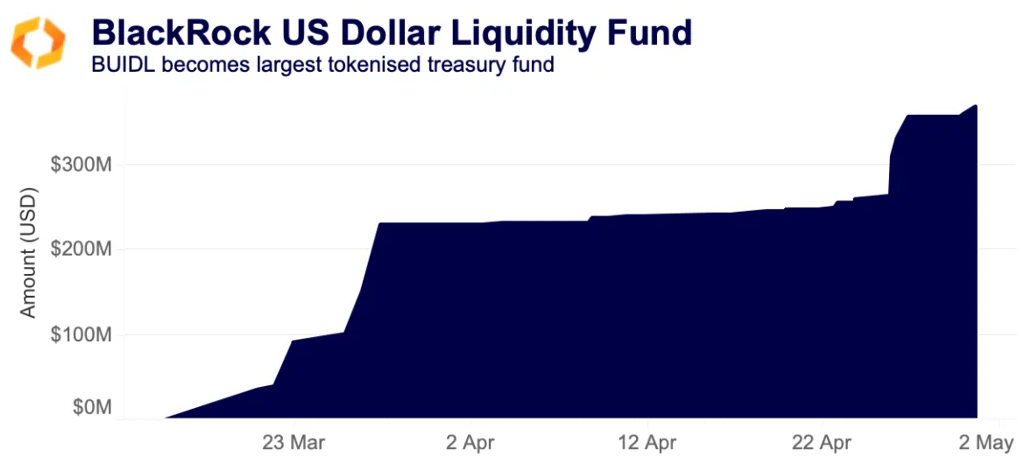
Last week, BlackRock's BUIDL fund exceeded $300mn, overtaking Franklin Templeton's BENJI as the largest US Treasuries tokenized fund. The newly minted BUIDL tokens were driven by Ondo Finance, which plans to move $95m to Blackrock's fund.
Coinbase beats market expectations on soaring volume
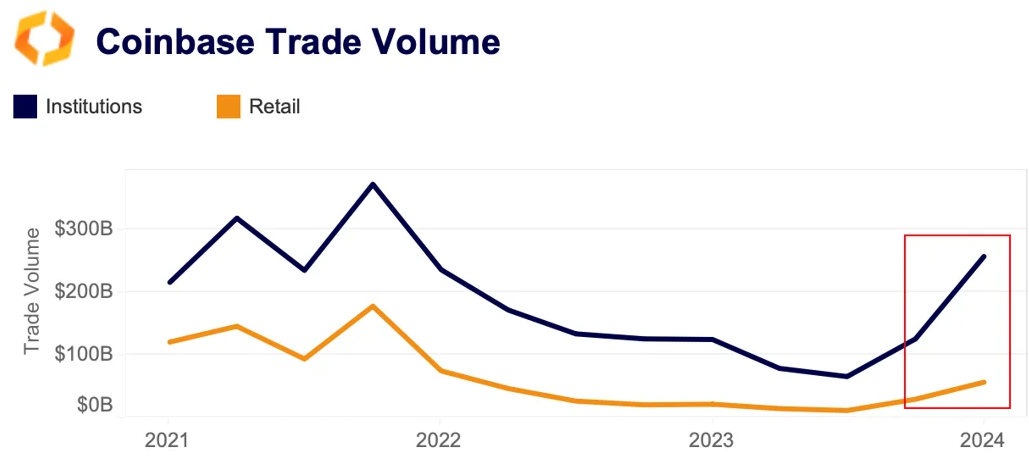
Last week, Coinbase reported a $1.2bn profit in Q1 due to rising trade volumes, strongly exceeding market expectations. Trade volume more than doubled to $312 billion, with institutional volume increasing faster than retail, accounting for 82% share of the total. However, COIN shares closed the week in the red amid worsening risk sentiment and falling BTC prices.
The exchange derives the majority of its revenue from retail transaction fees and from altcoins and staking services which are under regulatory scrutiny. Transaction revenue more than doubled relative to the previous quarter, reaching $1.08 billion and accounting for nearly 70% of Coinbase's net income. The increase was mostly driven by rising retail fees and payments from Coinbase's layer 2 BASE.
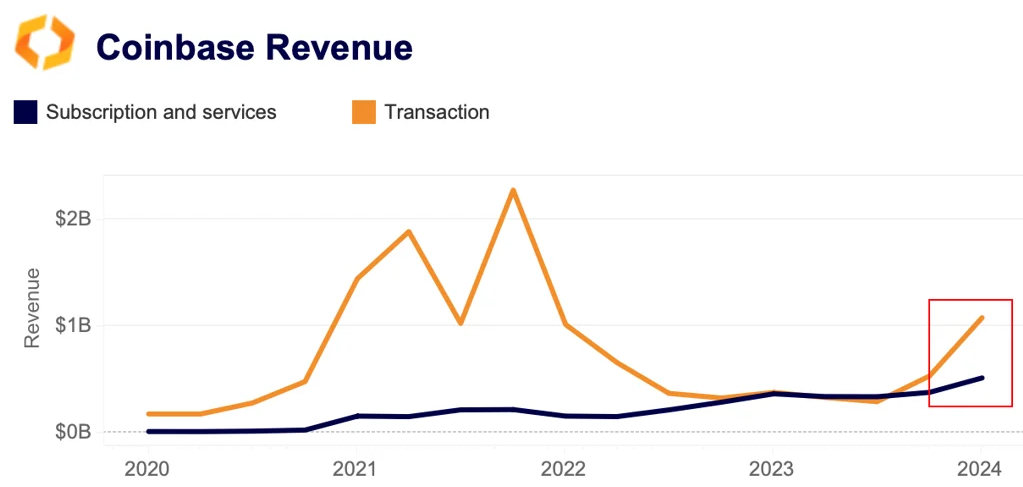
Although Coinbase's institutional Prime platform hit an all-time high amid the launch of the spot ETF, the share of revenue related to this business, which includes income from custody, institutional trading fees, and interest and financing fees, remained relatively low at 11.6% of net income.
USDC gains momentum on CEXs
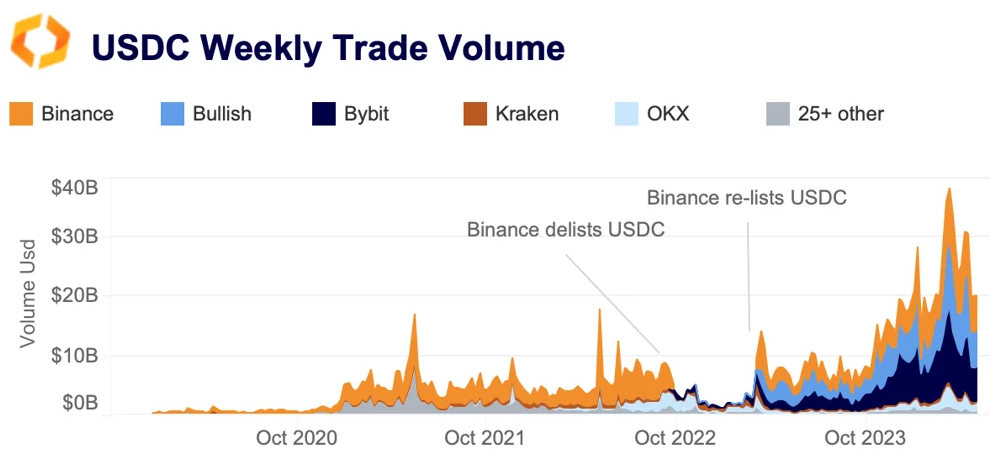
Circle’s USDC trade volume on centralized exchanges (CEXs) has surged in 2024, hitting an all-time high of $38 billion in March. USDC volume is significantly above the 2023 average of $8 billion. The increase was driven by Bybit and Bullish, which are the largest USDC markets, accounting for a combined 60% of trade volume.
Binance, which delisted USDC for several months in late 2022, has not recovered its dominant market share and currently holds around 30% of the market. One possible explanation for USDC's rising popularity could be growing adoption and preference for regulated stablecoins. The trend has been mirrored by declining dominance of its main competitor Tether’s USDT.
Meme tokens lead in leverage among top altcoins
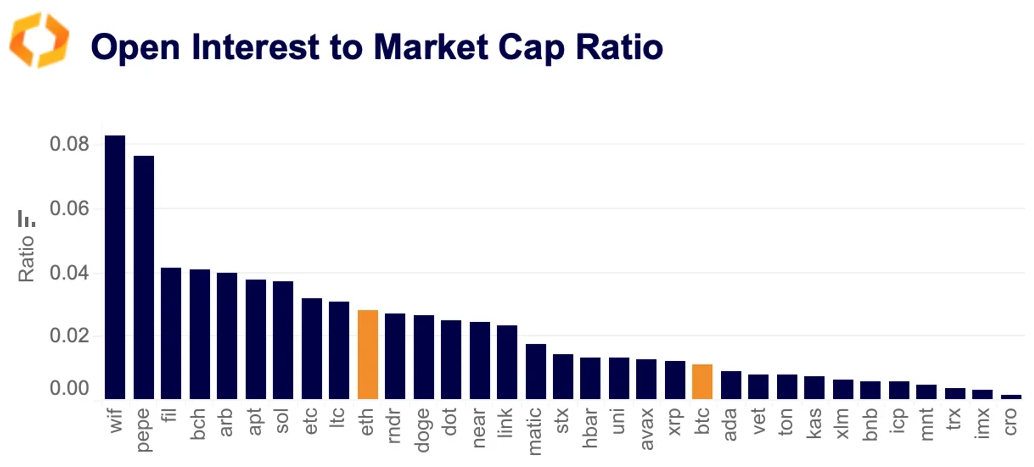
Derivative markets often have a significant influence on crypto price discovery, especially for altcoins, as crypto traders are known for their love of speculation. The open interest to market cap ratio can thus be seen as an indicator of leverage. A higher ratio indicates that the derivative market positioning for an asset is large compared to its market cap, making price discovery for these tokens more concentrated in perpetual futures markets.
Looking at the ratio for the top 30 altcoins by market cap, meme coins continue to lead the pack despite the recent market correction. Pepe (PEPE) and Dogwifhat (WIF) exhibit twice the ratio relative to other altcoins. The decentralized storage platform Filecoin's FIL token, which saw a significant rally after it integrated with Solana in mid-February, comes next in line, followed by Bitcoin Cash (BCH). While the recent correction has sent many meme tokens back to zero, others remain among the best performers this year.



Bullish bias remains for BTC options
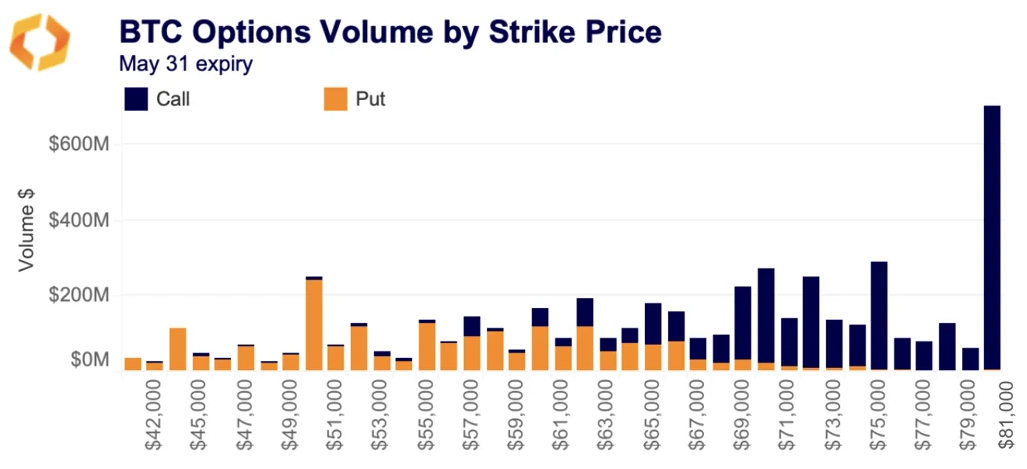
BTC’s decline last week meant put options that expire at the end of May were briefly in-the-money, or profitable. Put options in the $57,000 to $60,000 range benefited from Bitcoin’s decline amid macroeconomic headwinds.
Puts are a type of option contract that give the holder the right to sell the underlying asset at a predetermined price. These account for around 28% of volume on Deribit for the May 31 expiry. Traders holding these positions are either hedging or expect prices to fall further. Alternatively call options give holders the right to buy the underlying asset at a predetermined price.
Since the price has recovered above $64,000 these puts are no longer profitable. Instead call options in the $60,000 to $65,000 range are back in-the-money, or profitable. Over $600 million worth of call options with a strike price of $80,000 are currently out-of-the-money, or unprofitable.
Calls still outnumber puts in terms of volume, as the market remains bullish over the coming months. Bitcoin options contracts that expire on September 27 are dominated by call options, with $65,000 being the most popular strike price. This means that just over $300 million worth of call options will be profitable if Bitcoin trades above $65,000 by the end of September, suggesting traders are bullish on prices trading around all-time highs by then.