Close Menu
Crypto Valley Journal
    Facebook X (Twitter) Instagram
    Crypto Valley Journal
    • Hot Topics
      • News
      • Minds
    • Focus
      • Background
      • Blockchain
      • Legal & Compliance
      • Non-Fungible Token (NFTs)
    • Investing
      • Markets
      • Financial Products
      • Decentralized Finance (DeFi)
      • Exchange overview
    • Education
      • Basics
      • Glossary
      • Politicians on crypto
    • Statistics
      • Bitcoin-ETF-Flows
      • Ethereum-ETF-Flows
      • Crypto market data
      • On-chain data
    • Academy
      • Overview
      • Part 1: Blockchain
      • Part 2: Money
      • Part 3: Bitcoin
      • Part 4: Cryptocurrencies
      • Part 5: Decentralized Finance
      • Part 6: Investing
    • English
      • Deutsch
    Crypto Valley Journal
    You are at:Home»Hot Topics»News»Bitcoin falls below 80,000 USD, hitting lowest level since November 2024
    Bitcoin falls below 80,000 USD - the longest monthly loss streak since 2018. ETF outflows, liquidations, and Warsh weigh on crypto.

    Bitcoin falls below 80,000 USD, hitting lowest level since November 2024

    By Editorial Office CVJ.CH on 2. February 2026 News

    Bitcoin broke through the psychologically important 80,000 USD mark on January 31, 2026. The price dropped to 78,615 USD, a daily loss of over 5 percent. In illiquid weekend trading on February 1, it then slid further below 76,000 USD.

    This puts Bitcoin on track for its fourth consecutive monthly loss. Such a streak last occurred in 2018, during the ICO crash. Since the all-time high in Q4 2025, the decline totals around 40 percent. In January alone, Bitcoin lost 6 percent. The selloff has swept across the entire crypto market. Ethereum fell 8.5 percent, Solana 8.2 percent. Also, 90 of the 100 largest tokens closed in the red, with an average loss of 4.6 percent. Total market capitalization shrank from its peak of 4.27 trillion USD to 2.5 trillion.
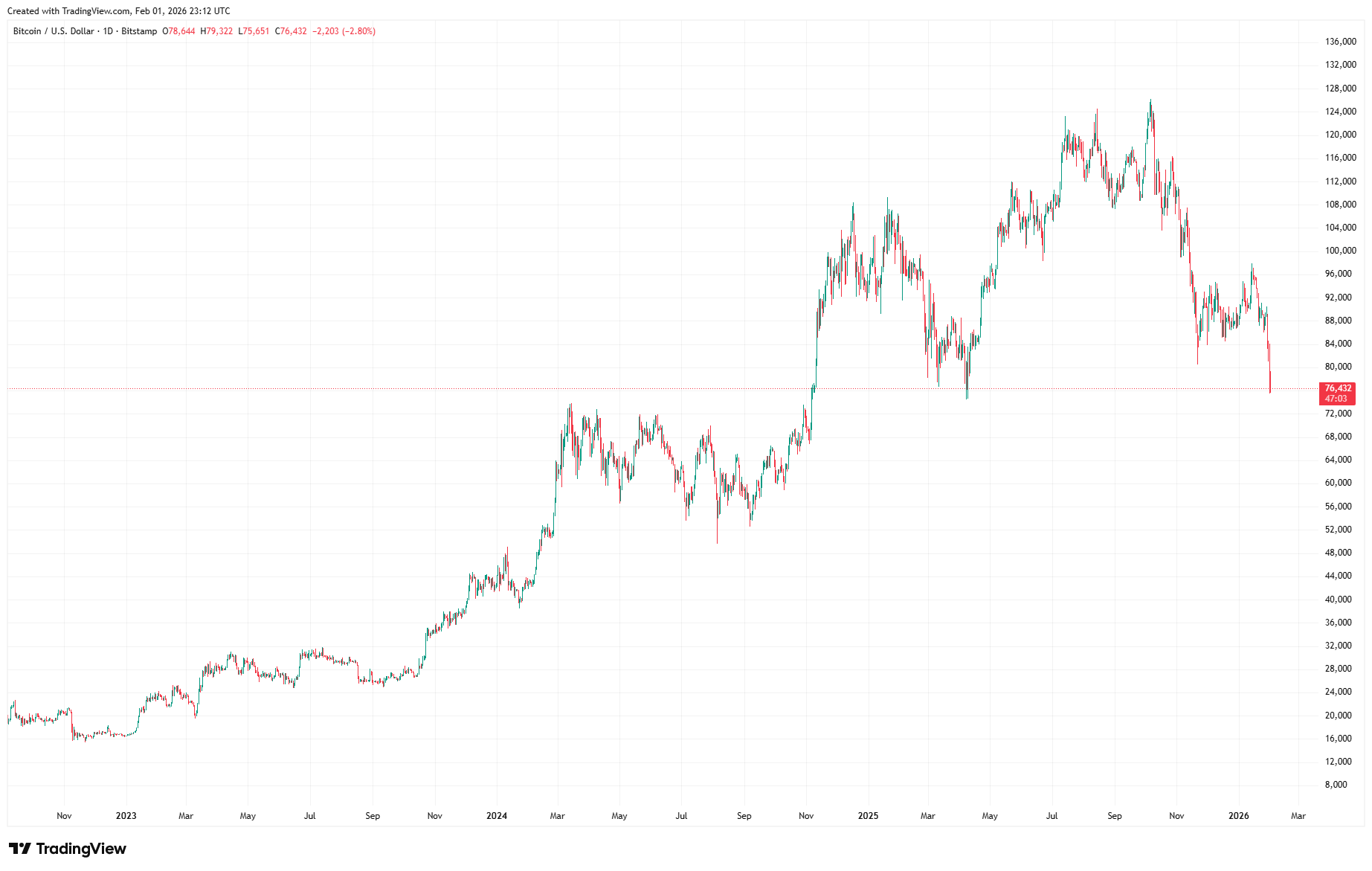
    Bitcoin BTC/USD (daily) / Chart: Tradingview

    Subscribe to our newsletter

    The best articles of the week, directly delivered into your mailbox.

    ETF outflows accelerate

    Net outflows from US Bitcoin ETFs / Source: Farside

    The institutional tailwind that propelled Bitcoin in 2024 and 2025 has turned into a headwind. US Bitcoin spot ETFs recorded net outflows of 1.6 billion USD in January 2026. These are the third-largest monthly outflows on record. On January 30 alone, roughly 1 billion USD left in a single trading session, the most since August.

    This dynamic accelerated over the course of the month. Over five consecutive trading days, outflows totaled 1.7 billion USD. On January 29, investors pulled 818 million USD from the funds. Earlier in January, a three-day outflow streak of 1.1 billion USD had already wiped out the inflows from the first two trading days entirely. And the prior months showed weakness too. In November and December 2025, a total of 4.57 billion USD left Bitcoin ETFs, a record. Since inception, the funds have still attracted 55 billion USD in net inflows. Despite substantial price losses, only 13% of assets have flowed out of the products since the highs.

    Liquidity crisis amplifies downward pressure

    Market structure is compounding the selloff. Bitcoin's market depth sits more than 30 percent below its October peak. Top-of-book liquidity on major exchanges stands at just around 500,000 USD. At the same time, spot volumes are at their lowest level since late 2023.

    This thin liquidity makes the market vulnerable to cascading sell orders. On January 29, the drop below 86,000 USD triggered 570 million USD in liquidations within 24 hours. In the most intense hour of the year, 268 million USD in positions were wiped out. Binance and Bybit accounted for 65 percent of all liquidations. And when Bitcoin subsequently fell below 76,000 USD, 2.4 billion USD in long positions were liquidated within 24 hours.

    Analysts describe this as a textbook case of phantom liquidity meeting forced deleveraging. Unlike previous crashes, there is no single trigger like the FTX collapse in 2022. Instead, demand is fading gradually, liquidity is thinning, and Bitcoin is decoupling from broader markets.


    Ray Dalio’s Bridgewater Associates Minds

    Star investor Ray Dalio considers Bitcoin inferior to gold

    Analysis by Bitget Research on Bitcoin quantum computing risks, ECDSA exposure, NIST post-quantum standards, and BIP-360 migration paths. Background

    Bitcoin quantum computing: What recent developments mean for network security

    JPMorgan warns: Recurring DeFi exploits and stagnant ETH-denominated TVL curb institutional engagement in the DeFi sector. DeFi

    JPMorgan: DeFi hacks and TVL losses weigh on institutional investors

    Basics

    Unit bias in crypto: Why cheap coins mislead investors

    Ray Dalio’s Bridgewater Associates Minds

    Star investor Ray Dalio considers Bitcoin inferior to gold

    Analysis by Bitget Research on Bitcoin quantum computing risks, ECDSA exposure, NIST post-quantum standards, and BIP-360 migration paths. Background

    Bitcoin quantum computing: What recent developments mean for network security

    Warsh nomination and Fed policy weigh on risk assets

    Monetary policy is offering no support to the crypto market right now. On January 28, the FOMC held the key interest rate at 3.50 to 3.75 percent. Only two members voted for a cut. As a result, the higher-for-longer scenario is reducing expectations for aggressive easing in the first half of 2026.

    Trump's nomination of Kevin Warsh as the new Fed chair is adding further pressure. Warsh is seen as an advocate for tighter monetary policy, higher real rates, and a smaller Fed balance sheet. Following the announcement, the dollar rose, and Bitcoin came under pressure. Yet Warsh himself struck a fairly constructive tone on the crypto market.

    He described Bitcoin as an important asset that signals when policymakers are making mistakes. In the long run, a hawkish Fed leadership could even strengthen the crypto narrative, particularly for Bitcoin as a hedge against centralized monetary control. But in the short term, fear of continued restrictive policy dominates.


    Share. Facebook Twitter LinkedIn Email Telegram WhatsApp

    About the author

    Editorial Office CVJ.CH

      The CVJ editorial staff consists of a team of Blockchain experts and informs daily and independently about the most exciting news.

      Related Articles

      CVJ.CH Weekly review calendar week

      Weekly review calendar week 17 – 2026

      Admiral Paparo confirmed to the US Senate: INDOPACOM operates an active Bitcoin node and is conducting operational tests to protect military networks.

      US military operates Bitcoin node in the Indo-Pacific

      Bitcoin fails again at the 80'000 USD mark, profit-taking weighs on ETH, SOL and XRP despite Strategy purchase and ceasefire.

      Bitcoin price climbs to 80’000 USD – profit-taking hits ETH, SOL and XRP

      CVJ.CH Weekly review calendar week
      25. April 2026

      Weekly review calendar week 17 – 2026

      JPMorgan warns: Recurring DeFi exploits and stagnant ETH-denominated TVL curb institutional engagement in the DeFi sector.
      24. April 2026

      JPMorgan: DeFi hacks and TVL losses weigh on institutional investors

      Admiral Paparo confirmed to the US Senate: INDOPACOM operates an active Bitcoin node and is conducting operational tests to protect military networks.
      23. April 2026

      US military operates Bitcoin node in the Indo-Pacific

      twitter image button instagram image button linkedin image button youtube image button

      About Crypto Valley Journal
      About Crypto Valley Journal

      On the pulse of the movement

      • Academy
      • Contact
      • Advertising
      • About us
      • Partner
      • Imprint
      • Privacy
      • Disclaimer
      Search

      Type above and press Enter to search. Press Esc to cancel.