Bybit, Binance, Bitget and MEXC have cancelled their campaigns for tokenized SpaceX shares and refunded all subscription funds. The trigger was a delivery failure: xStocks could not source the underlying shares. As a result, more than USD 1 billion in orders went unfilled.
xStocks is a platform for tokenized shares through which customers of crypto exchanges can gain price exposure to traditional securities in token form. The operator is Kraken, which had acquired the original Swiss provider Backed Finance in December 2025. Before that, Backed Finance ranked as the second-largest provider in the segment, with roughly 23% market share. By March 2026, xStocks had also recorded over USD 25 billion in trading volume across more than 100 tokenized shares. Binance alone had collected USD 557 million from around 27,700 onchain addresses ahead of the listing. The MEXC campaign, meanwhile, closed 15.5 times oversubscribed. Having started with an IPO valuation of roughly USD 1.75 trillion, SpaceX saw its market value cross the USD 2 trillion mark after the first trading day.
xStocks delivery failure on tokenized SpaceX shares hits four exchanges at once
The cancellations came on the day SpaceX began trading. Bybit went first and cited xStocks' inability to deliver the underlying assets. Binance followed shortly after, pointing to "circumstances beyond its own control" as the reason. Consequently, the campaign was wound down without any allocation whatsoever.
"Subscribers will not receive SpaceX allocations, because xStocks was unable to deliver the underlying assets." - Bybit, official statement on the cancellation
The scale of the failure was considerable. Binance had collected USD 557 million in USDC. The MEXC campaign, meanwhile, drew USD 56 million from over 38,000 participants and was 15.5 times oversubscribed. In total, therefore, more than USD 1 billion in orders went unfilled. SpaceX itself opened at USD 150 on the Nasdaq that same day, well above the issue price of USD 135. The excluded investors thus missed out on the price gain.
xStocks made no official statement on the delivery failure. A spokesperson said only that, because of overwhelming demand, requests to buy IPO access to SpaceX could not be fully satisfied. A more detailed comment, however, was not forthcoming.
Structural weakness of the centralized allocation model
The failure followed directly from the design of the model. xStocks was meant to source real shares from the IPO pipeline and pass them on to the exchange platforms. This step, however, has no direct onchain equivalent. Instead, it depends on the discretion of the underwriting banks, which hand out scarce allocations at their own judgment and typically prioritize institutional investors. At the largest IPO in history, this bottleneck grew even tighter: demand of more than USD 250 billion met a supply of USD 75 billion, which amounted to more than threefold oversubscription. For comparison, the previously largest IPO, that of Saudi Aramco in 2019, raised just USD 29.4 billion. The pre-trade also signaled the rush, because on Hyperliquid SpaceX traded ahead of the listing with substantial daily volume and open positions in the triple-digit millions.
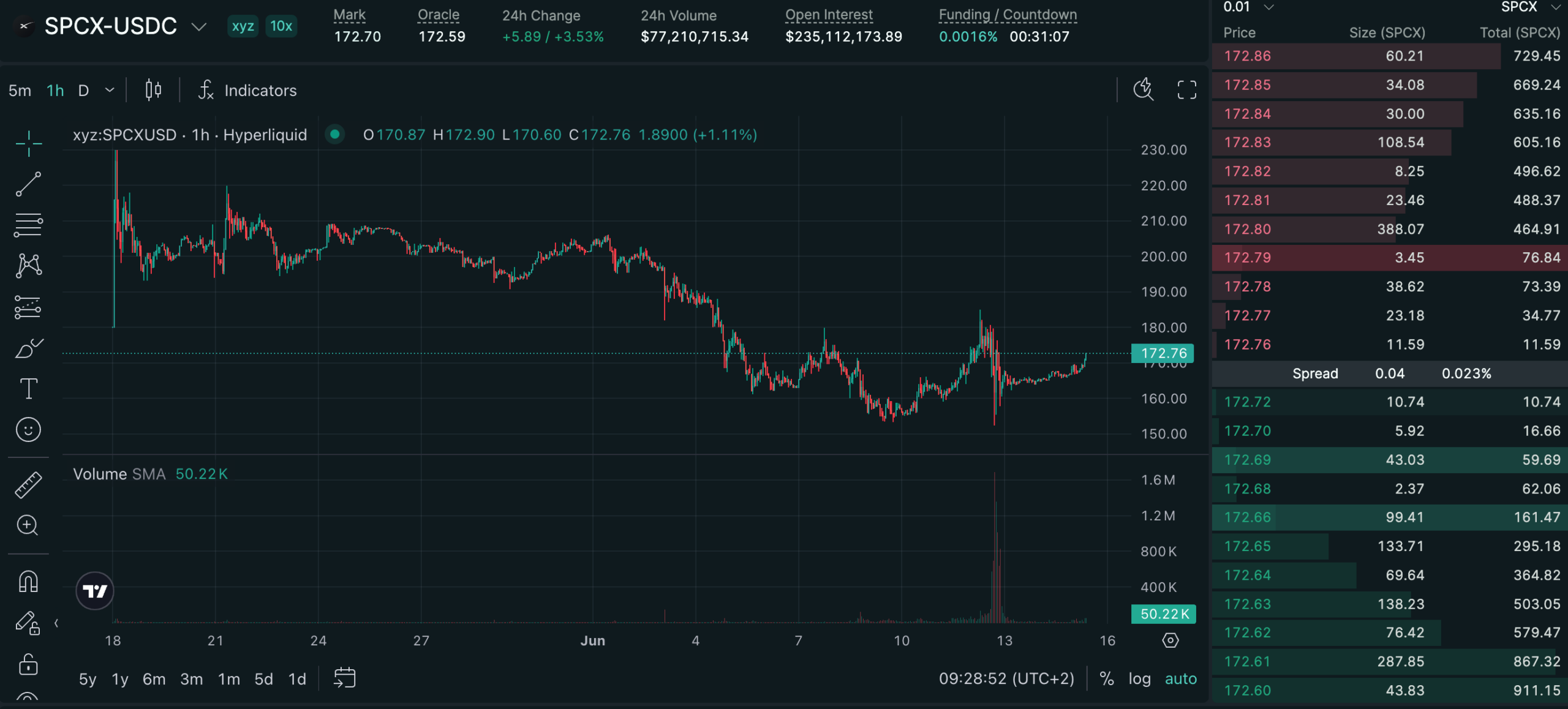
Notably, this was not a technical failure. xStocks' own disclaimers explicitly stated that the IPO tokens did not represent a guaranteed allocation, but offered price exposure alone. Indeed, the in-house DeFi token SPCXx traded on schedule on decentralized exchanges. The failure therefore affected only the delivery of physical shares to the centralized campaigns, not the onchain trading. This separation thus illustrates the difference between a price-tracking token and a real share.
For Kraken, the incident carries an additional dimension. The company had acquired Backed Finance in December 2025 to secure a strategic edge in the market for tokenized shares. Yet at the most closely watched IPO in history, the associated sourcing channel failed. As a result, the incident also weighs on Kraken's own positioning.

Ondo Finance and Backpack deliver tokenized SpaceX shares successfully
Other providers showed on the same day that the bottleneck was avoidable. Ondo Finance launched the token SPCXon simultaneously on Solana, Ethereum and BNB Chain via the Ondo Global Markets platform. The product is designed as a 1:1 total return tracker and is accessible to non-US users through MetaMask and other wallets. Within the first hour, moreover, the token turned over more than USD 1 million in volume, because its model requires no physical IPO lot.
Backpack Securities likewise issued the token SPCX on Solana, which is redeemable for an underlying SpaceX share and tradable around the clock. In the first 24 hours, this product achieved more than USD 35 million in volume. Kraken, in turn, listed SPCX through its regulated broker-dealer Payward Securities and thus independently of xStocks. However, Kraken customers too received only partial allocations because of overwhelming demand. Even regulated channels thus come under supply pressure, yet do not fail entirely.
The market for tokenized real world assets (RWAs) reached more than USD 5.5 billion in total capitalization by mid-2026. Consequently, the SpaceX IPO became a stress test for a still-young segment that had to prove its resilience for the first time at an event of this magnitude.
Exchange compensation and consequences for investors
The three large platforms responded differently to the failure. Bybit refunded the funds in full and added compensation equivalent to 10% annual interest over four days. Bitget also repaid in full, refunding the 5% processing fee and granting a gas voucher worth USD 10. Binance, in turn, tied the USDC refund to an airdrop of its in-house bStocks product worth USD 1 million. Its token SPCXB was distributed evenly among the roughly 27,700 participants.
The concrete damage can be quantified. SpaceX closed the first trading day at USD 161.11, around 19% above the issue price. This return thus escaped the excluded investors. Binance co-founder Changpeng Zhao linked the cancellation notice on X with the comment that users had to be protected when things did not go to plan. The bStocks airdrop ultimately reads more as a reassuring gesture than as genuine value compensation.