US Senators Thom Tillis (R-NC) and Angela Alsobrooks (D-MD) introduced a bipartisan compromise text on 1 May 2026 that addresses the contested stablecoin rewards provision of the CLARITY Act. The crypto exchange Coinbase has now signaled its support.
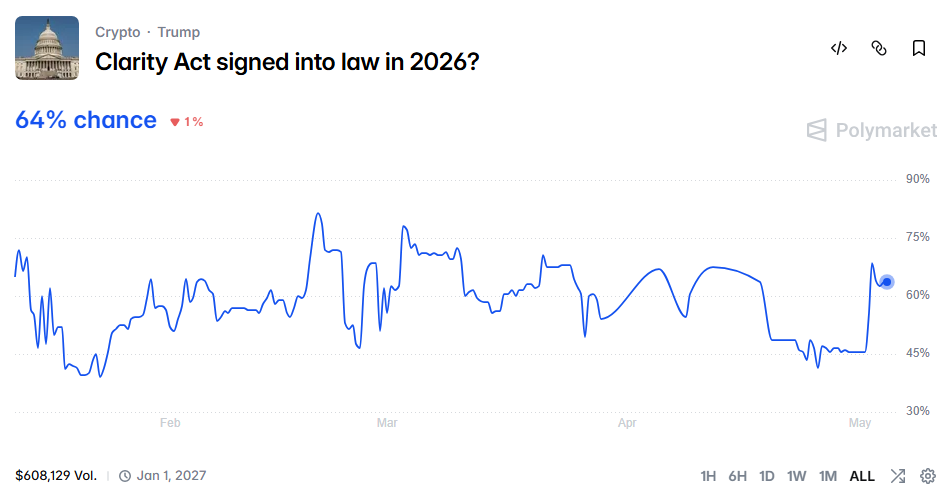
In January 2026, the company's withdrawal had stalled the original committee markup. As a result, a political deadlock that had blocked the most important US market structure law for digital assets for months is now breaking. Following the compromise, Polymarket traders put the probability of CLARITY Act passage in 2026 at 64%. This marks an increase of 15 percentage points within 24 hours. In addition, a Senate Banking Committee markup on the final version of the bill should follow in the coming weeks.
What the compromise text regulates
The new section "SEC 404. Prohibiting interest and yield on payment stablecoins" explicitly prohibits crypto firms from offering certain rewards. Specifically, the clause targets compensation "economically or functionally equivalent to the payment of interest or yield on an interest-bearing bank deposit". As a result, the Senate adopts the position of the banking lobby, which has pushed for months for a strict separation between stablecoin yields and traditional bank interest. For example, the American Bankers Association had warned of passive "buy and hold" yields that could pull customers away from bank deposits.
However, activity-based rewards remain permitted, meaning compensation tied to actual platform usage. The legal text refers to "bona fide activities". In concrete terms, the compensation model shifts from "buy and hold" to "buy and use". Furthermore, regulators must develop a new stablecoin disclosure regime and a list of permissible reward activities.
Faryar Shirzad, Chief Policy Officer of Coinbase, summarized the outcome on X:
The final rewards text in the CLARITY Act is now public.
We’ve been clear throughout this process: much of this debate was based on imagined risks, not real evidence, nor was it based on a real understanding of how crypto actually works.
Nevertheless, the crypto industry showed… https://t.co/XoQ7Zp1Y39
— Faryar Shirzad 🛡️ (@faryarshirzad) May 1, 2026
Why the deal is critical for Coinbase
In 2025, Coinbase generated USD 1.35 billion in revenue from stablecoin activities, roughly 20% of net income. The USDC rewards partnership program with Circle drives this line item significantly. Therefore, a blanket ban on all rewards would have hit this revenue pillar directly. For this reason, Coinbase withdrew its support for the original CLARITY Act version in January 2026 and brought the planned markup to a standstill.
The current deal shifts the model without destroying it. Activity-based rewards remain possible if they tie to specific platform usage. Coinbase must adjust its USDC program. However, the company retains regulatory room to compensate users for trading, staking-like activities or settlement services. Circle CEO Jeremy Allaire described the deal as a win for the entire digital asset industry.
While the Coinbase share rose only slightly, a failed compromise version in March 2026 had cost the Circle share 20% in a single day. The muted reaction suggests that investors do not yet view the political path as secure. In addition, the Crypto Council for Innovation supports the compromise. However, CCI CEO Ji Hun Kim warned of far-reaching consequences. The new language goes beyond the restrictions of the GENIUS Act of 2025.



Crypto industry accepts banking clause
Politically, the deal marks a retreat by the crypto industry. In January 2026, Coinbase had stopped the Senate Banking markup with the position that "no law is better than a bad one". Four months later, the company supports the very compromise whose core idea it had previously opposed. Above all, the fear of a lost legislative window tipped the scales.
Senator Cynthia Lummis warned on 11 April 2026 that without a markup by the end of April, a delay until 2030 was likely. The deadline passed without result, and at the end of April, Polymarket probabilities fell to 47%. As a result, the banking lobby pushes through its clause, while the crypto industry accepts a weakening of its preferred provision. The alternative scenario would have been a lost legislative window until after the November 2026 midterms.
Remaining hurdles before signature
President Donald Trump signed the GENIUS Act on 18 July 2025. The law prohibited stablecoin issuers from paying interest but left a gap open for exchanges and affiliated platforms. The CLARITY Act now closes precisely this gap with Section 404. In addition, the draft clarifies supervisory responsibility between the SEC and CFTC, regulates token classification and introduces DeFi protections.
Unresolved issues include the ethics provisions on government officials, which target Trump and his family directly, as well as detailed rules on DeFi and illicit financial flows. Senator Tillis, who is not seeking reelection, is pressing particularly hard on the ethics clause. Meanwhile, Senator Bernie Moreno expects passage by the end of May 2026. Before the presidential signature, the law must clear the 60-vote threshold in the Senate. In addition, lawmakers must reconcile it with the Agriculture Committee and harmonize it with the House version. Thanks to the compromise, however, passage of the CLARITY Act once again appears more likely.