
Aleš Michl, Governor of the Czech National Bank (CNB), became the first sitting central bank head to deliver a keynote at the Bitcoin Conference in Las Vegas. In front of roughly 40'000 attendees, he argued for adding 1% Bitcoin to his central bank's foreign exchange reserves.
The appearance carries weight in particular because the CNB Bank Board formally voted against including Bitcoin in the official foreign exchange reserves in February 2026. Michl therefore continues to advocate for a position that did not gain a majority within his own body. As a result, he also positions himself against the line taken by the European Central Bank.
One percent Bitcoin as a diversification argument
Michl's reasoning rests on portfolio theory rather than ideological Bitcoin enthusiasm. According to him, a one percent allocation would raise the expected return without materially changing the overall risk in Czech koruna terms. The basis for this is the low long-term correlation between Bitcoin and traditional reserve assets. Moreover, data covering the years 2011 to 2025 show correlations that change annually, ranging from strongly positive to strongly negative.
The Governor openly acknowledged the risks. The price could rise sharply or fall to zero. However, the same applies to equities and bonds. Conceptually, he compared Bitcoin to venture capital: similar liquidity characteristics, but significantly more accessible. The CNB currently holds around 180 billion USD in foreign exchange reserves, which corresponds to about 44 percent of Czech gross domestic product.
Since taking office in 2022, Michl has gradually restructured the CNB's reserve strategy. For example, the equity allocation rose from 15 to 26 percent. In addition, the gold share grew from virtually zero to six percent. A Bitcoin addition would therefore not be a change of course, but rather the continuation of a diversification strategy already under way.
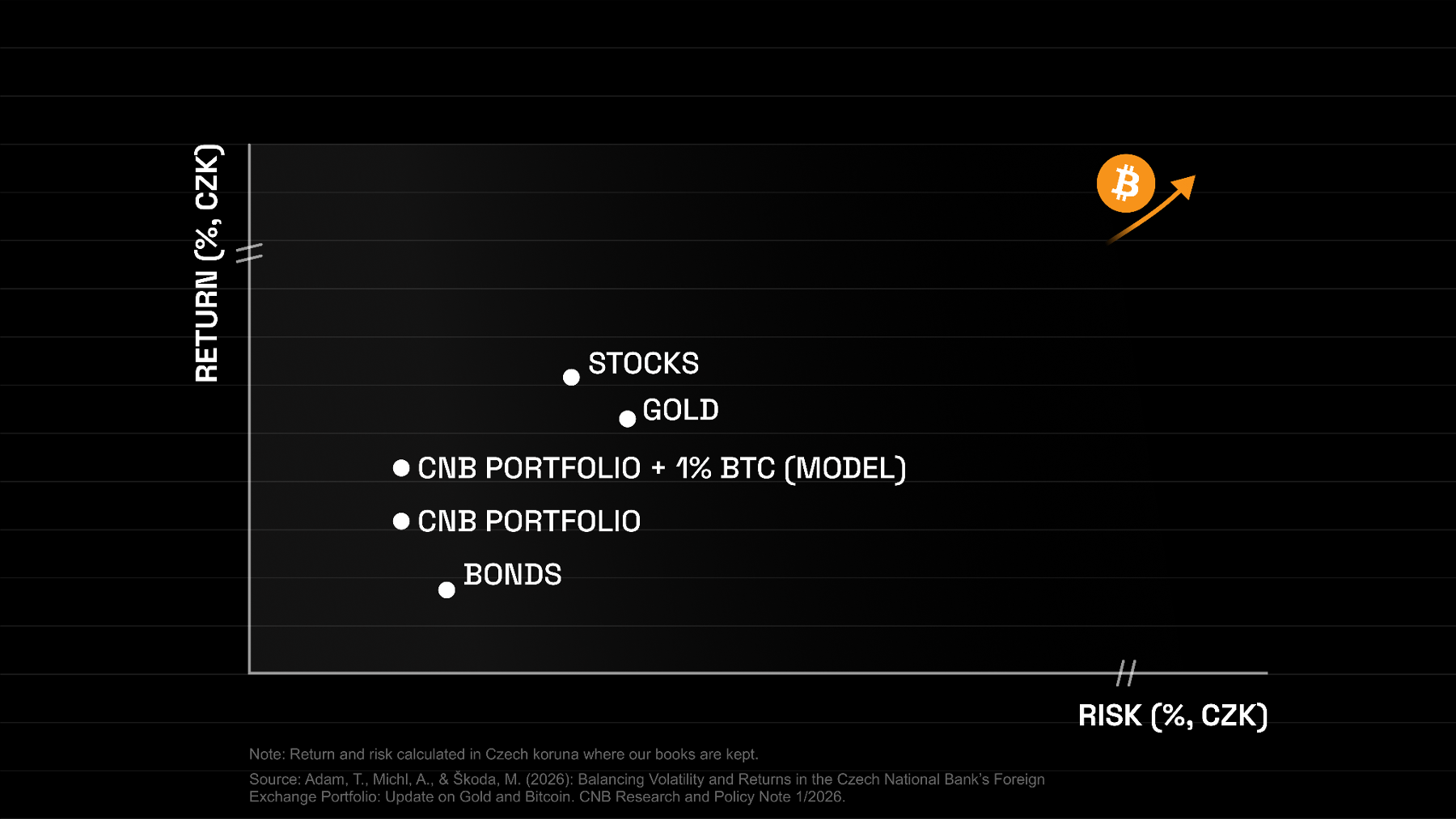
Test portfolio via CNB Lab
A test portfolio has been running operationally since October 2025. The Bank Board approved a volume of one million US dollars on 30 October 2025, around 0.0006 percent of CNB assets. Bitcoin was acquired that day at a price of 110'670 USD. In addition to Bitcoin, the portfolio also contains a USD stablecoin and a tokenised dollar deposit.
Legally, the construct is finely balanced. The CNB classifies the portfolio as an intangible asset rather than as part of the official foreign exchange reserves. As a result, the central bank avoids the European Central Bank's jurisdiction over official reserves. The term is two years, and the volume remains constant during the test phase. Operationally, the portfolio is managed by CNB Lab, the central bank's innovation hub.
This restraint stands in clear contrast to the public appearance in Las Vegas. Furthermore, a CNB study from February 2026 attested diversification benefits to a one percent Bitcoin allocation. The Bank Board nonetheless decided against an official inclusion, citing the extreme volatility and the tail risk of total loss, both incompatible with a central bank's stability mandate.


The Czech Republic's special role within the EU framework
Michl's initiative is only possible because the Czech Republic holds a special monetary policy position. The country is an EU member but has not adopted the euro. The CNB belongs to the European System of Central Banks, but not to the Eurosystem. Michl sits on the ECB General Council, not the Governing Council. As a result, the ECB has little direct influence over the CNB's reserve policy in practice.
ECB President Christine Lagarde stated on 30 January 2025 that she was confident no Bitcoin would enter the reserves of any central bank on the General Council. Reserves, she argued, must be liquid, secure, and free from any suspicion of money laundering. On the same day, Michl chose the opposite path and asked the CNB Bank Board for an analysis of a Bitcoin addition. His original proposal envisaged an allocation of up to five percent, around 7 billion USD.
The constellation could set a precedent. Five other EU countries hold the same derogation and therefore do not use the euro: Hungary, Poland, Romania, Sweden, and Bulgaria. Consequently, they could use the same legal leeway. So far, however, none of these central banks has taken a comparable step.
The international reserve context
While the ECB categorically rules out Bitcoin in reserves, the international picture has become more differentiated. For example, US President Donald Trump signed an Executive Order on 6 March 2025 establishing a Strategic Bitcoin Reserve. This stock, however, is fed exclusively from government seizures rather than from active market purchases. The holding stands at more than 207'000 BTC, which corresponded to a value of around 17 billion USD in March 2025.
El Salvador holds around 7'508 BTC in its state treasury. The Swiss National Bank rejected a similar proposal, citing volatility, low market capitalisation, and the software nature of the asset. In Switzerland, a popular initiative is currently under way seeking to anchor a Bitcoin reserve in the Federal Constitution. Federal Reserve Chair Jerome Powell pointed to legal restrictions against an active Bitcoin purchase by the US central bank.
Michl therefore occupies a middle position between passive custody of seized holdings and categorical rejection. His model buys actively, but keeps volumes small and preserves the institutional separation from the official reserve balance sheet. The test portfolio runs until the end of 2027. The CNB intends to evaluate the results afterwards and put them up for discussion again.