
Strategy reported a net loss of USD 8.22 billion for the second quarter of 2026. The loss stems almost entirely from the revaluation of its Bitcoin holdings, which nevertheless grew 11%.
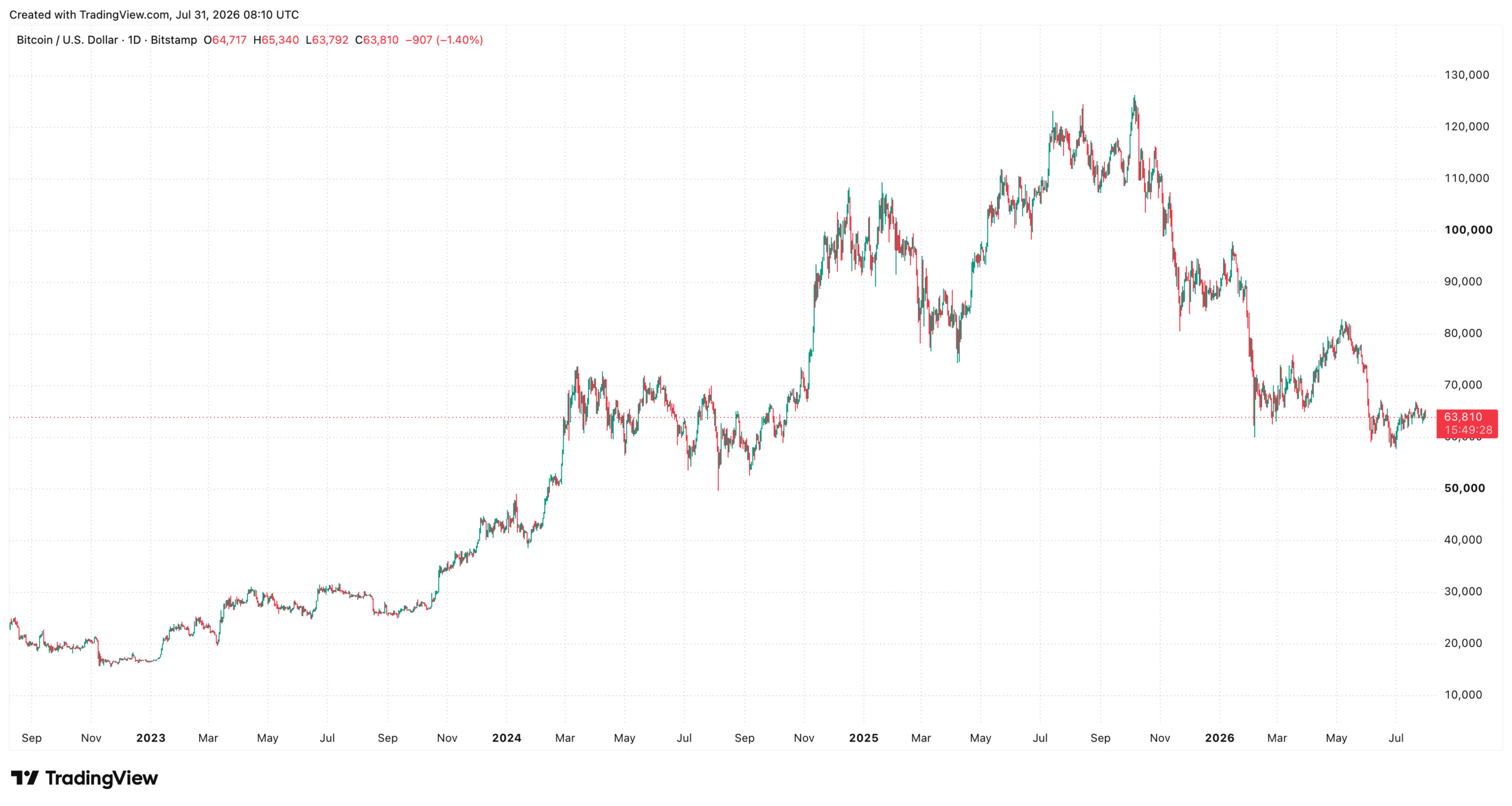
Strategy, formerly MicroStrategy, is the largest publicly listed corporate holder of Bitcoin. The company buys Bitcoin with debt and equity, then holds it permanently on its balance sheet. Its original software business contributes only a small share of revenue. So far, the group has funded its purchases through convertible bonds and common share issuance. Several preferred share classes such as STRC, STRK and STRF add to that. Moreover, since fiscal year 2025, Bitcoin holdings fall under fair-value accounting. That rule pushes price swings through the income statement every quarter. In the year-earlier quarter, Strategy therefore reported a profit of USD 10.02 billion. Now the books show a loss of USD 24.45 per diluted share. Twelve months before, the company posted a profit of USD 32.60. The Bitcoin price fell more than 40% year over year. At the end of July, it stood at around USD 65,028, well below the average cost basis of USD 75,476.
The Bitcoin loss at Strategy sits almost entirely on paper
Of the reported USD 8.22 billion, USD 8.32 billion stems from unrealised valuation losses on the Bitcoin holdings. So the paper loss exceeds the net loss. At the operating level, the group posted a result of minus USD 8.33 billion. A year earlier, that same line showed a profit of USD 14.03 billion. However, both figures say little about the underlying business, because valuation effects flow straight into the operating account. The swing from a ten-billion profit to an eight-billion loss within twelve months is thus primarily a question of price.
The software business itself stayed small. Revenue rose 6.9% in the quarter to USD 122.4 million. At a gross margin of 66.6%, gross profit came to USD 81.6 million. Measured against Bitcoin holdings worth tens of billions, however, that contribution barely registers. It cannot come close to offsetting valuation swings in the treasury position. As a result, the software unit drives neither the reported profit nor the valuation of the stock.
Behind the swing stands fair-value accounting under FASB ASU 2023-08. Since January 1, 2025, the rule has required calendar-year public companies to mark Bitcoin holdings to market each quarter. Book gains and book losses run straight through the income statement. That happens whether or not a company sells any coins. For Strategy, the quarterly result consequently tracks the Bitcoin price. In addition, the same mechanics hit every company that has copied the treasury model. Their results swing sharply in both directions.
Bitcoin holdings reach a record 846,000 BTC
Alongside the loss, Bitcoin holdings grew 11% during the quarter to a record 846,000 BTC. Later, the company trimmed the position. Most recently, Strategy reported 843,775 BTC in an 8-K filing. Year-to-date growth in holdings remains 25%, even though the price fell over the same period.
Cumulative acquisition costs add up to USD 63.7 billion. That works out to an average cost basis of roughly USD 75,476 per Bitcoin. At the end of July, by contrast, the market value of the holdings reached only around USD 54.77 billion. As a result, the position sits just under USD 9 billion below acquisition cost. Gaps of that size feed through the income statement as valuation losses, without the company selling a single coin.
Actual sales follow a fixed framework. Since the start of the year, the group has sold roughly USD 218 million worth of Bitcoin. Those sales run through the Bitcoin Monetization Program. The proceeds cover the preferred dividends. Measured against total holdings, that is comparatively little. Nevertheless, the mechanism marks a turning point. The Bitcoin holdings now also serve as a liquidity source for running obligations. Previously, the position grew largely through purchases alone.




Capital structure shifts toward the dollar reserve
Meanwhile, the change on the liabilities side runs deeper than the one in the Bitcoin holdings. Strategy cut outstanding convertible bonds by 18% to USD 6.71 billion, down from USD 8.21 billion in the previous quarter. In May 2026, the company bought back convertible bonds with a face value of USD 1.5 billion. That buyback happened at a discount of 8%. The purchase price consequently came to around USD 1.38 billion, USD 120 million below face value.
At the same time, the group is building a dollar reserve. It rose 12% to USD 2.4 billion by the end of the quarter. Afterwards, it climbed further to USD 3.75 billion. Cash and equivalents stood at USD 1.71 billion at the end of June. According to CFO Andrew Kang, the reserve covers more than 2.1 years of preferred dividends and interest obligations. The basis is the "Digital Credit Capital Framework" adopted at the end of June 2026. It requires a minimum reserve for twelve months of such obligations, roughly USD 1.76 billion at the time. Furthermore, the same framework allows Bitcoin sales of up to USD 1.25 billion. The condition is that they come cheaper than new MSTR common shares.
To fill the reserve, Strategy first paused all Bitcoin purchases in the five weeks before the report. For a company that channelled every available dollar into Bitcoin for years, that marks a break. The priority instead moves from building holdings to serving capital providers. What stands out is that the funding of the dividends now runs on several tracks. Cash reserves, issuance proceeds and, in exceptional cases, Bitcoin sales all contribute.
"We have also built a track record of 18 consecutive months of dividend payments. Despite the recent steep drop in the Bitcoin price, we have never missed a dividend." - Andrew Kang, CFO, Strategy
STRC buybacks aim to secure the dividend obligations
What triggered the shift was the performance of the STRC preferred share. The paper originally launched with an informal price target of around USD 100 and recently slipped below it. CEO Phong Le therefore announced that the company would buy back STRC below that mark regularly and with discipline. Volume should follow market price and liquidity. In the week before the quarterly report, Strategy acquired 288,930 STRC shares for USD 25 million. Each unit bought back lowers the future dividend burden, particularly as the buybacks happen at a discount.
On the issuance side, capital inflows remain high. In the year to date, Strategy raised USD 17.06 billion through its at-the-market programmes. STRC issuance alone contributed USD 7.53 billion. For STRC, that amounts to growth of 254%. In the second quarter alone, around USD 8.4 billion flowed in through the ATM programmes. Of that, USD 2.95 billion came from MSTR common shares, while USD 5.47 billion came from STRC. The authorised USD 1 billion buyback programme for the common stock, by contrast, went unused.
The stock still gained around 5% on the day of the release and traded unchanged after hours at USD 97.21. Book losses of this size reverse just as quickly when the Bitcoin price rises, while debt reduction works permanently. For the Bitcoin treasury class, the decisive question remains whether the dividends stay covered without fresh capital.