
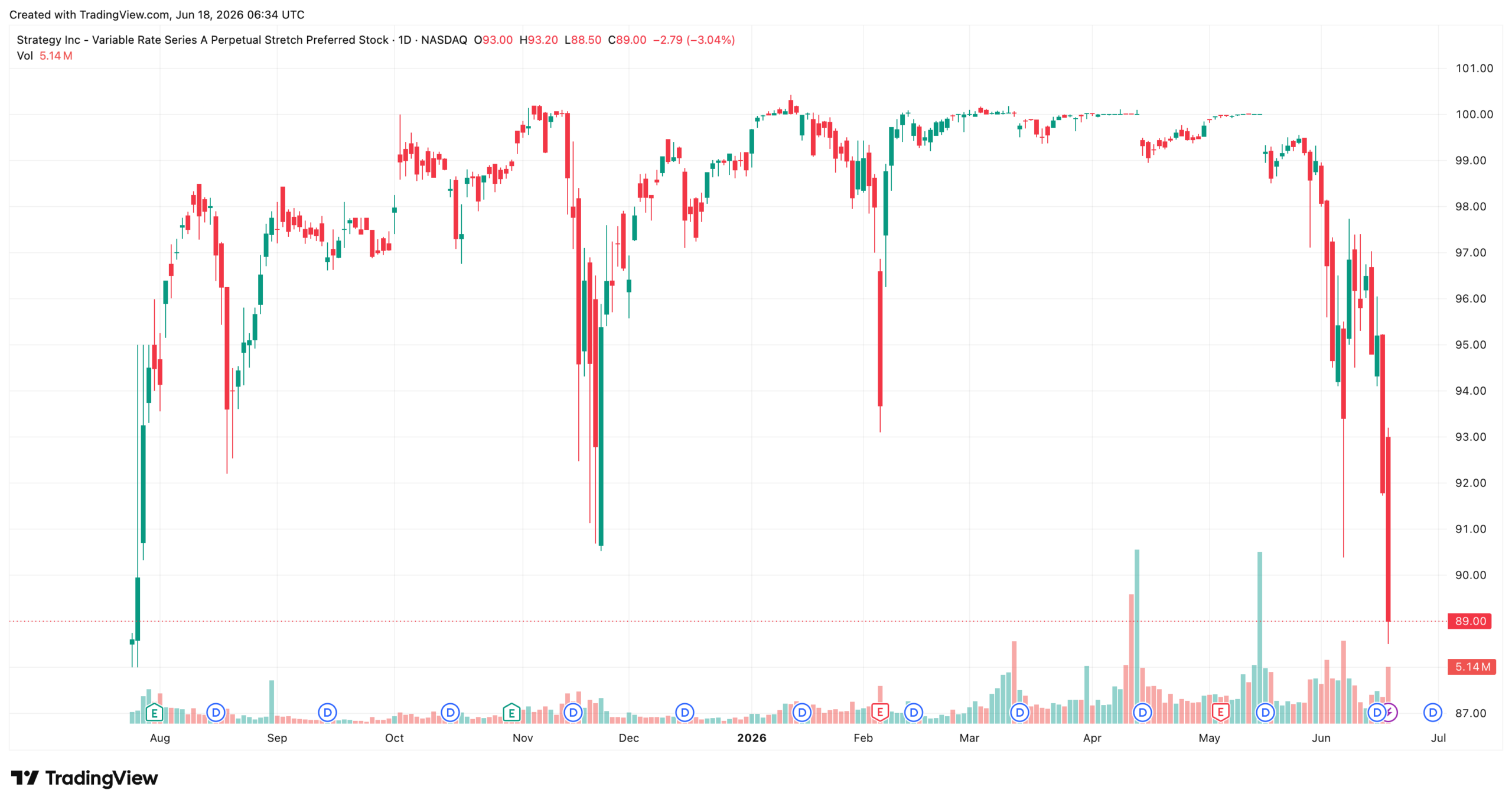
Strategy's STRC preferred stock closed at USD 89 on 17 June 2026, putting it 11% below its par value of USD 100. That marks one of the lowest daily closes since the issuance in July 2025. As a result, pressure is mounting on Michael Saylor's Bitcoin accumulation scheme.
STRC is a variable-rate preferred stock from Strategy, the largest publicly traded Bitcoin holder. The instrument is designed as a Bitcoin-backed security sitting between high-yield credit and equity, with a dividend rate adjusted through a VWAP mechanism to keep the price close to the par value of USD 100. The stock launched in July 2025 at an IPO price of USD 90, as part of Strategy's "Digital Credit" suite of instruments to finance further Bitcoin purchases. Moreover, the nominal rate has stood unchanged at 11.50% per year since March 2026. With a trading volume of USD 417.5 million on 17 June, STRC also ranks as the company's most liquid preferred stock.
STRC's VWAP mechanism and its limits
The stabilization mechanism behind STRC works through a monthly adjustment of the dividend rate. The decisive figure is the volume-weighted average price (VWAP), meaning the average share price across the observation period weighted by trading volume. When this VWAP falls below USD 95, the rate rises by at least 50 basis points. In the range between USD 95 and USD 98.99, an increase of at least 25 basis points applies. Between USD 99 and USD 100.99 the rate stays unchanged, while above USD 101 a reduction becomes possible. Specifically, the underlying logic is self-correction through price: a higher yield is meant to attract buyers once the price drops below par, thereby pulling demand back toward the nominal value. Consequently, the nominal rate climbed from 11.00% in January through 11.25% in February to 11.50% in March 2026.
However, this automatism reaches its limits during sustained Bitcoin weakness. In early June 2026, STRC fell below the USD 95 threshold and thus triggered a mandatory increase that brings annual additional costs of roughly USD 53 million. Each further decline therefore makes the instrument more expensive, because the dividend burden rises mechanically as the price drops. At the same time, the ATM program is paused, through which Strategy issues new STRC shares to finance Bitcoin purchases when the price trades above par. As long as the security trades below par, this capital source stays blocked. Notably, the built-in conflict is structural: the capital supply dries up precisely when the company would need it most. Based on the closing price of USD 89, the market yield works out to roughly 12.9%, well above the nominal rate of 11.50%.
Bitcoin's recent recovery is not enough to stabilize STRC either. The cryptocurrency traded at USD 65,000 in mid-June, after falling to a low of USD 59,000 earlier in the month. Nevertheless, this recovery has not noticeably eased the pressure on the preferred stock.
For the first time since 2022, Strategy sells Bitcoin to fund dividends
Between 26 and 31 May 2026, Strategy sold 32 BTC for roughly USD 2.5 million, which corresponds to an average price of USD 77,135 per Bitcoin. It was the first sale since December 2022 and therefore a break with the previously almost pure accumulation strategy. As the purpose, the company cited covering the STRC dividend payouts. After the sale, the group still holds 843,706 BTC at an average purchase price of USD 75,699.
The transaction falls into a phase of dwindling liquidity. The liquidity pool dropped from USD 2.25 billion at the start of the year to roughly USD 900 million in early June 2026, meaning the company burned about USD 1.35 billion in six months. In addition, Strategy bought back convertible bonds with a face value of USD 1.5 billion for roughly USD 1.38 billion in cash on 26 May 2026. The dividend coverage for STRC consequently shrank from an original 24 months to about seven months.
Chairman Michael Saylor had announced the sale in advance and presented it as a deliberate communication measure. He thereby signaled to the market that selling Bitcoin to cover dividends does not represent an emergency, but is instead part of the calculation.
"We will probably sell some Bitcoin to pay a dividend, just to get the market used to it." - Michael Saylor, Chairman, Strategy



Analysts reject the death-spiral scenario
Analysts at Benchmark and TD Cowen rejected fears of a death spiral. The core argument holds that Strategy would have to run through several buffers before a forced Bitcoin sale even came up for debate. The Bitcoin reserve of 843,706 BTC equaled a value of roughly USD 54.8 billion at a price of USD 65,000. This sum therefore exceeds the annual dividend obligations of USD 750 to 800 million many times over.
Nevertheless, a factual constraint remains that operates independently of analyst opinions. The liquidity buffer has fallen from an original 24 months to about seven months, and the dividend costs keep rising with every decline in the STRC price. During a longer-lasting Bitcoin downturn, this structural vulnerability would consequently worsen. The arguments against an immediate escalation rest on the size of the reserve, yet the shrinking liquidity buffer marks the limit of that reassurance.