
A summarizing review of what has been happening at the crypto markets of the past week. A look at trending sectors, liquidity, volatility, spreads and more. The weekly report in cooperation with market data provider Kaiko.
The last 7 days at the cryptocurrency markets:
- Price Movements: Binance's BUSD stablecoin, BNB token, and staking token bETH have had a volatile week amid mass withdrawals.
- Market Liquidity: Throughout December, BTC market depth on Coinbase has increased 46% while on Binance, depth is down 5%.
- Derivatives: Open interest for BTC and ETH perpetual futures has nearly halved since November.
- Macro Trends: A difficult macro market environment (along with plenty of crypto-induced volatility) has contributed to a surge in correlation among altcoins.
Markets trade down amid turbulent week for exchanges
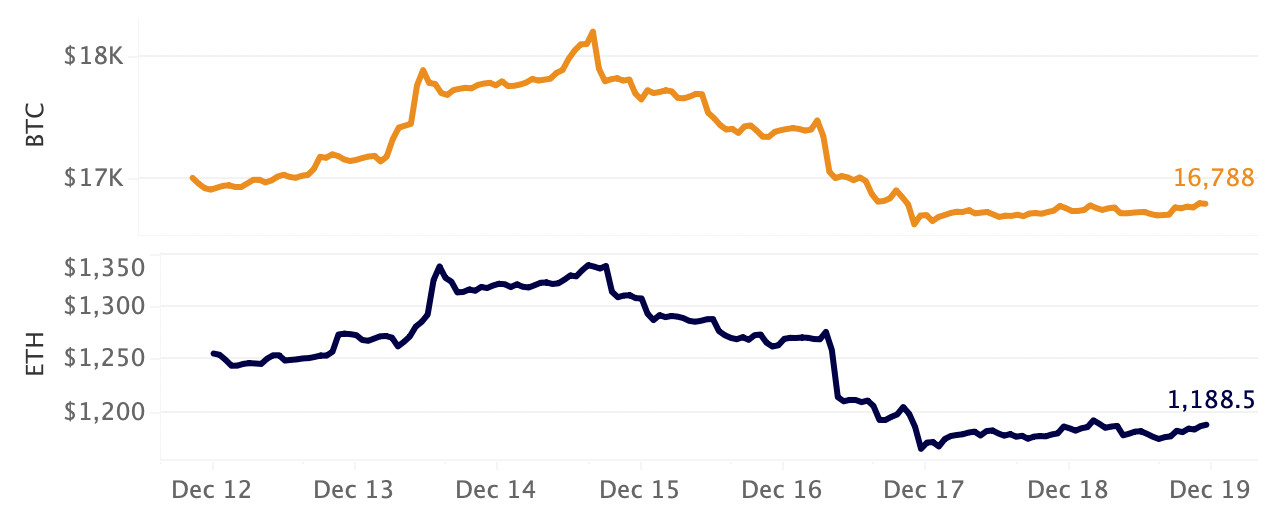
It was a tough week for centralized exchanges. Both Bitcoin's (BTC) and Ethereum (ETH) closed Sunday night down as the FTX saga reached an apotheosis: SBF was arrested and denied bail while Congress grilled the new FTX CEO in a riveting hearing that further revealed the chaotic inner workings of the exchange. Meanwhile, both OKX and Gemini experienced hours of downtime just a few days after Binance's crisis of confidence.
In other industry news, shares of the Grayscale Bitcoin Trust dipped to a record low discount of -50%, audit firm Mazars paused all work for crypto clients, and Canada banned crypto leverage. On a positive note, inflation appears to be slowing faster than expected which could be good for both crypto and equity markets.
Binance-issued tokens had a volatile week
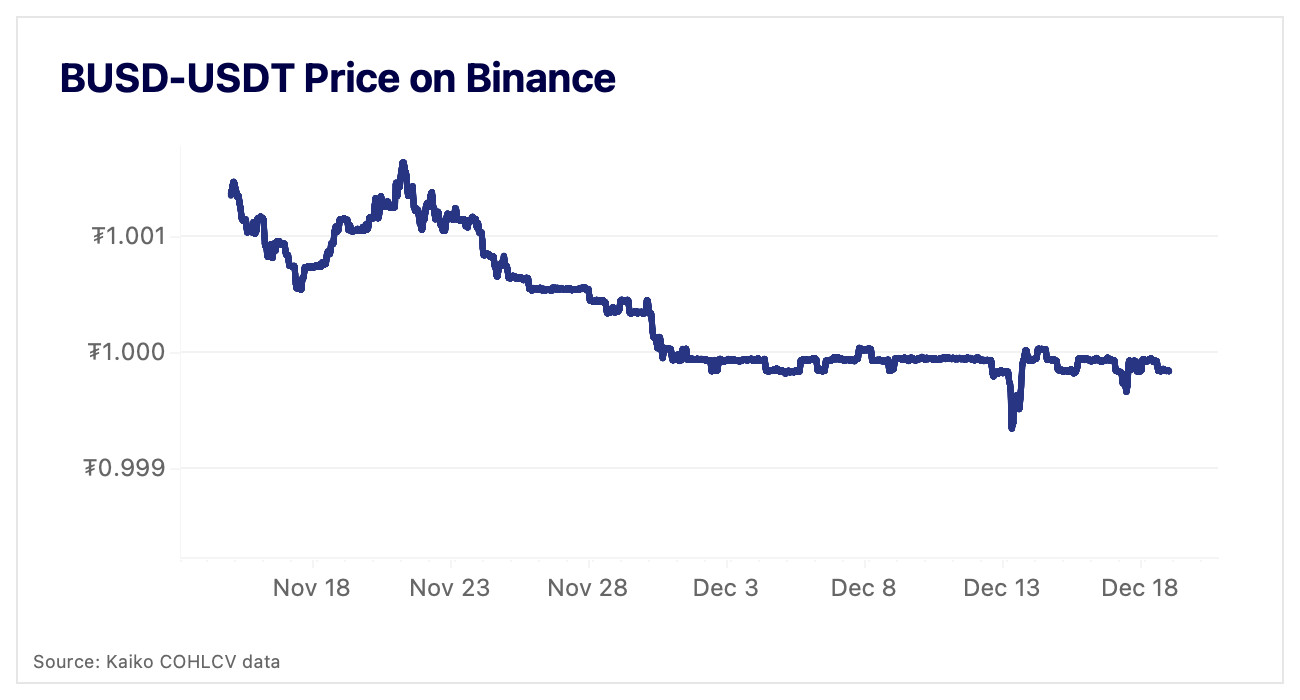
Binance's BUSD stablecoin, BNB token, and staking token bETH have all experienced volatility amid mass withdrawals from the exchange.
Since FTX's collapse, BUSD has traded at a persistent premium relative to USDT, but that trend reversed at the start of December. Now, BUSD is trading at a small discount to USDT amid mass redemptions for the stablecoin. A statement from Paxos clarified that the regulated company only issues BUSD on Ethereum, and that Binance itself issues the stablecoin on BNB Smart Chain and other chains, raising fears about its backing. On Curve, the largest BUSD Curve pool is heavily imbalanced, with 75% BUSD, 9% USDC, 9% DAI, and 6% USDT.
Meanwhile, bETH, Binance's ETH staking token, is trading at its widest discount to ETH since June, which suggests investors are pricing in risk on the exchange-issued token.
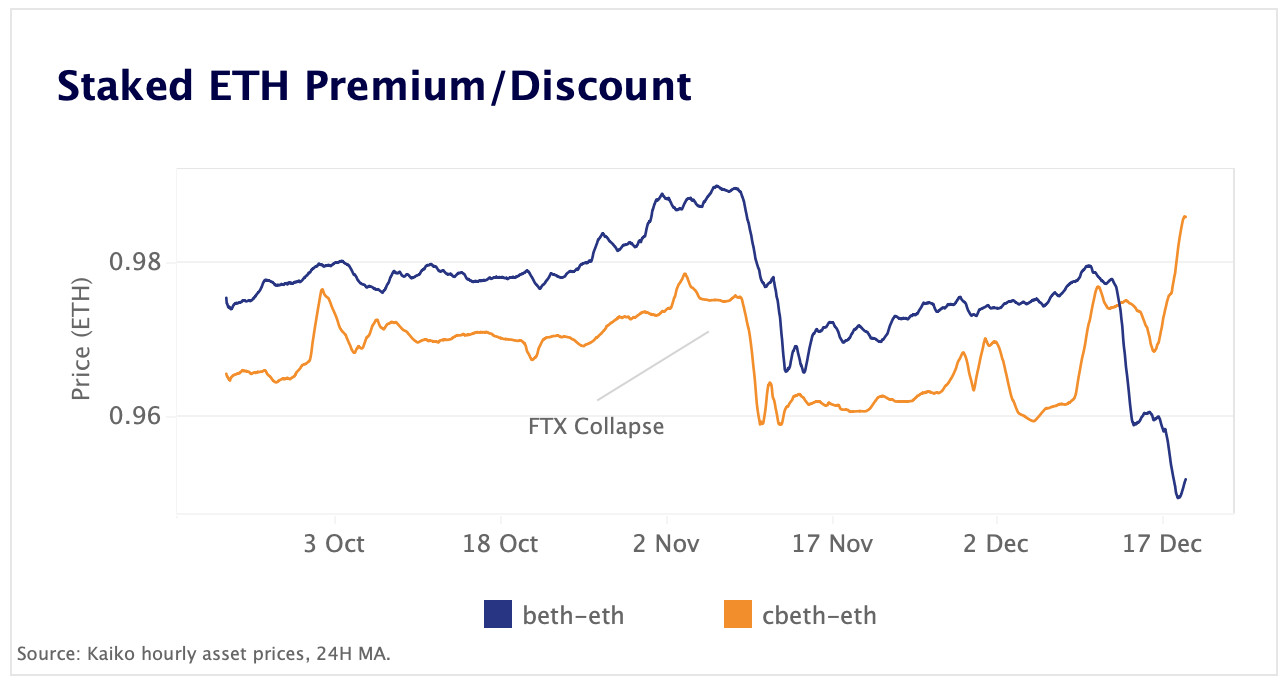
By contrast, Coinbase’s wrapped ether token cbETH has seen its discount shrink to its lowest level since its launch in August. The discount on ETH staking derivative markets will likely persist until the next Ethereum upgrade enables staking withdrawals sometime next year.
A look at BTC liquidity 5 weeks after FTX's collapse
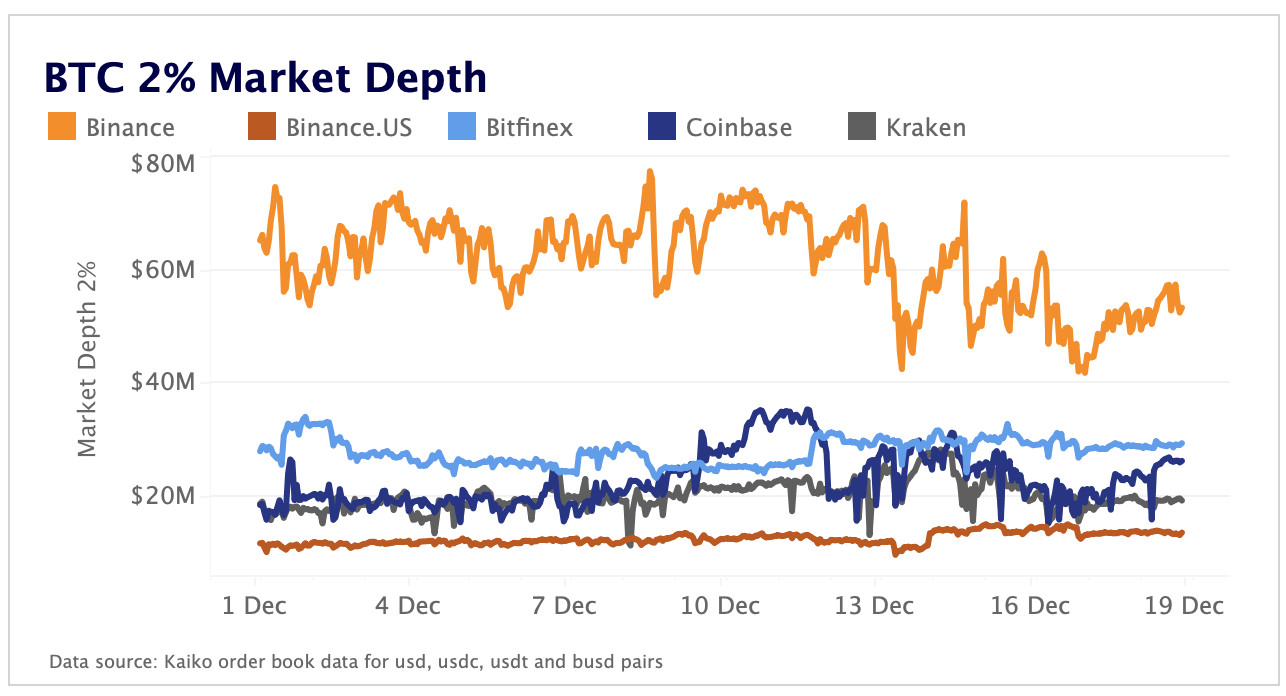
Five weeks after the FTX collapse and its aftershocks are still rippling through the industry. Market makers Jump Crypto and Wintermute were seen withdrawing millions from Binance last week, and it seems market makers will be quicker to react to exchange rumors post-FTX, as they were likely hit hard by the events last month. That being said, BTC liquidity, as measured by 2% market depth has held relatively solid on most exchanges so far this month, with depth on Coinbase, Kraken, Bitfinex and Binance.US improving since the start of December.
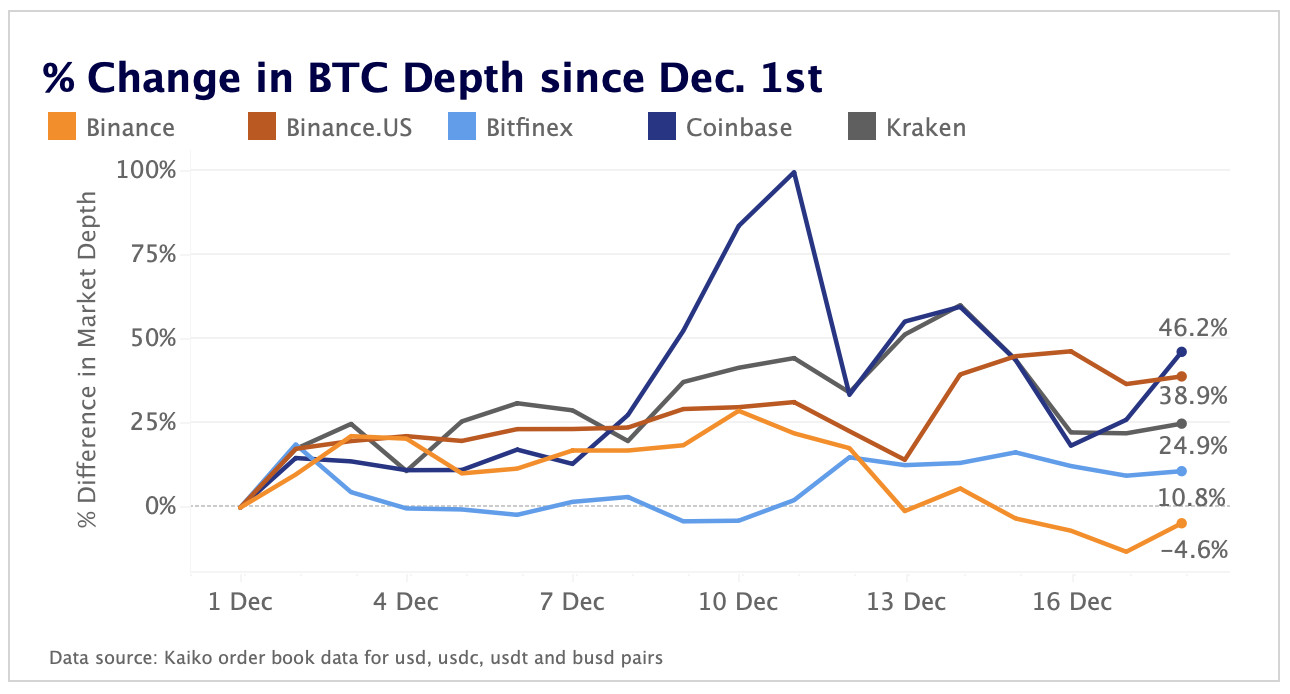
Binance, however, has seen a gradual decline in depth in December as the exchange starts to feel the impact of the withdrawals from certain market makers. 2% depth on Binance for BTC is down 5% since the start of December, whereas U.S.-regulated exchanges like Coinbase and Binance.US have improved their depth, with increases of 46% and 39% respectively. This could well be the start of a longer term trend of market makers favouring more regulated exchanges with the promise of greater safety.
Analysis of median borrow sizes on Aave and Compound
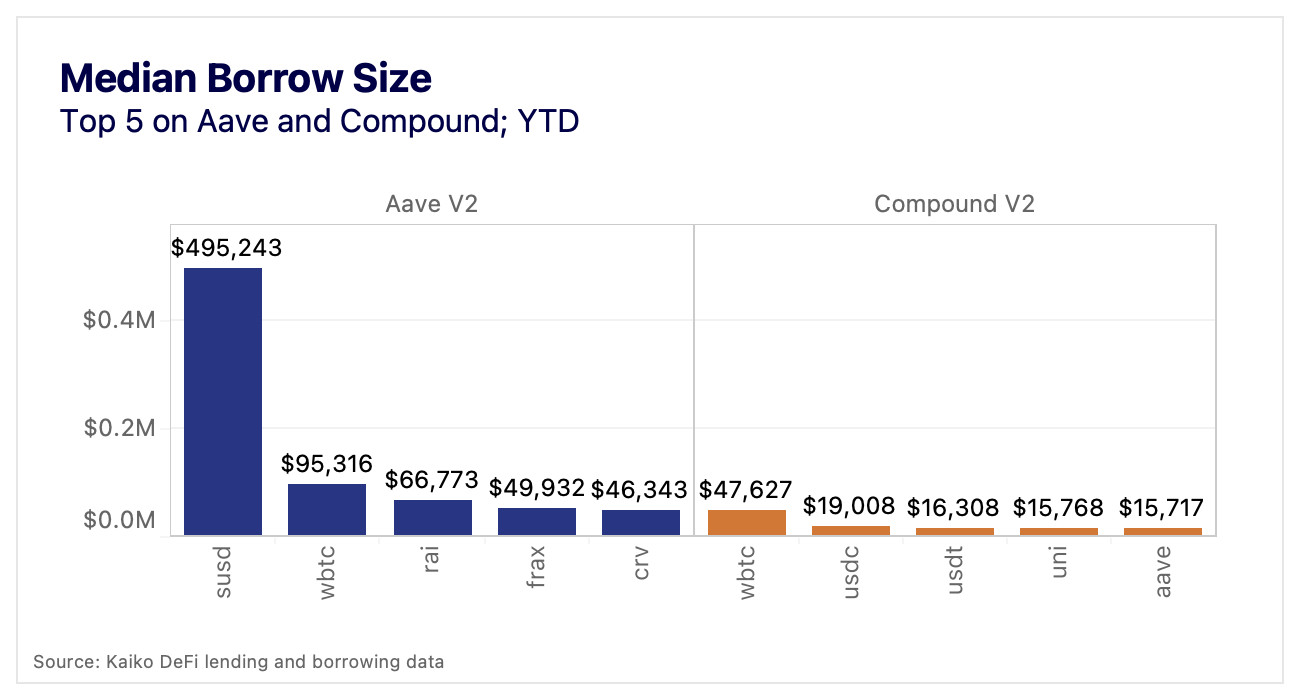
Using Kaiko’s new DeFi lending and borrowing data, and building off last week’s examination of Aave and Compound, Kaiko research continues to uncover new and intriguing trends on two of Ethereum’s largest protocols.
An examination of the median borrow size for each asset on Aave and Compound revealed that borrows of sUSD, the Synthetix ecosystem’s stablecoin, are five times larger than the next largest asset by median borrow size. The data seems to suggest that some larger users are opting to borrow sUSD from Aave rather than stake SNX (Synthetix's native token) to borrow it directly from the protocol. This may be due to greater stability on Aave, where it is possible to borrow against a stablecoin like USDC, reducing the risk of liquidation that exists when borrowing against a token like SNX.
Overall, the median borrow size on Aave is larger on average than on Compound, which suggests the distribution of Aave users skews towards larger users.
Rumours of a DCG-led sell off appear overblown
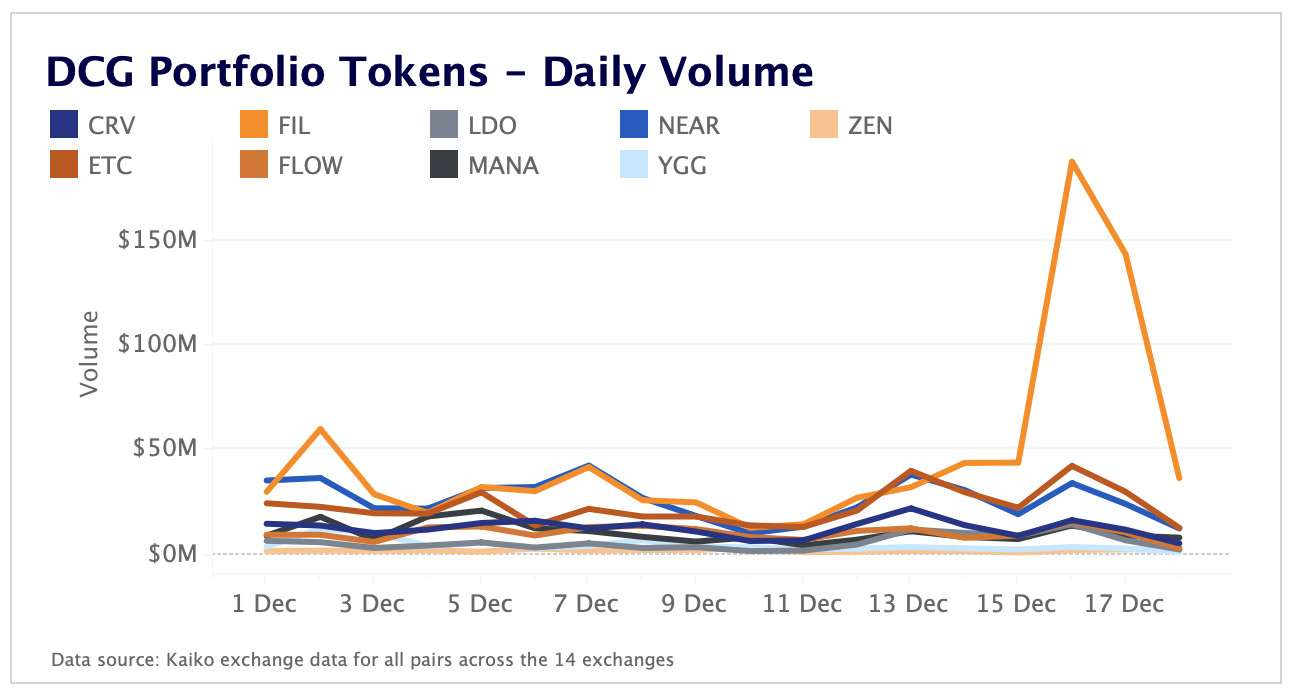
Venture capital fund Digital Currency Group (DCG), which owns Genesis Trading and the asset manager Grayscale, looks to be the rumour mill’s next target as the fallout of the contagion crisis continues. DCG owes Genesis’ lending arm $575mn that is due in May 2023, and reports are that the total figure owed by DCG to Genesis is about $1.7bn. That amount could be called from DCG in the event of a Genesis liquidation which could lead to a DCG bankruptcy. A DCG bankruptcy would have knock-on effects for the crypto industry as a whole, but none more so than those tokens in its investment portfolio. Double digit sell-offs of DCG’s token holdings led some to jump to the conclusion that this was DCG themselves selling their holdings for liquidity.
However, a look at the volumes for some of the tokens in question seems to indicate that these fears are overblown as the majority of their volumes look nothing out of the ordinary; it looks likely this was more of a market wide sell off of lower cap tokens. Filecoin (FIL) was the anomaly out of the tokens chosen as it saw a greater than 10x increase on its daily volumes and is down 28% in the last week.



Fed hikes rates again despite improving inflation numbers
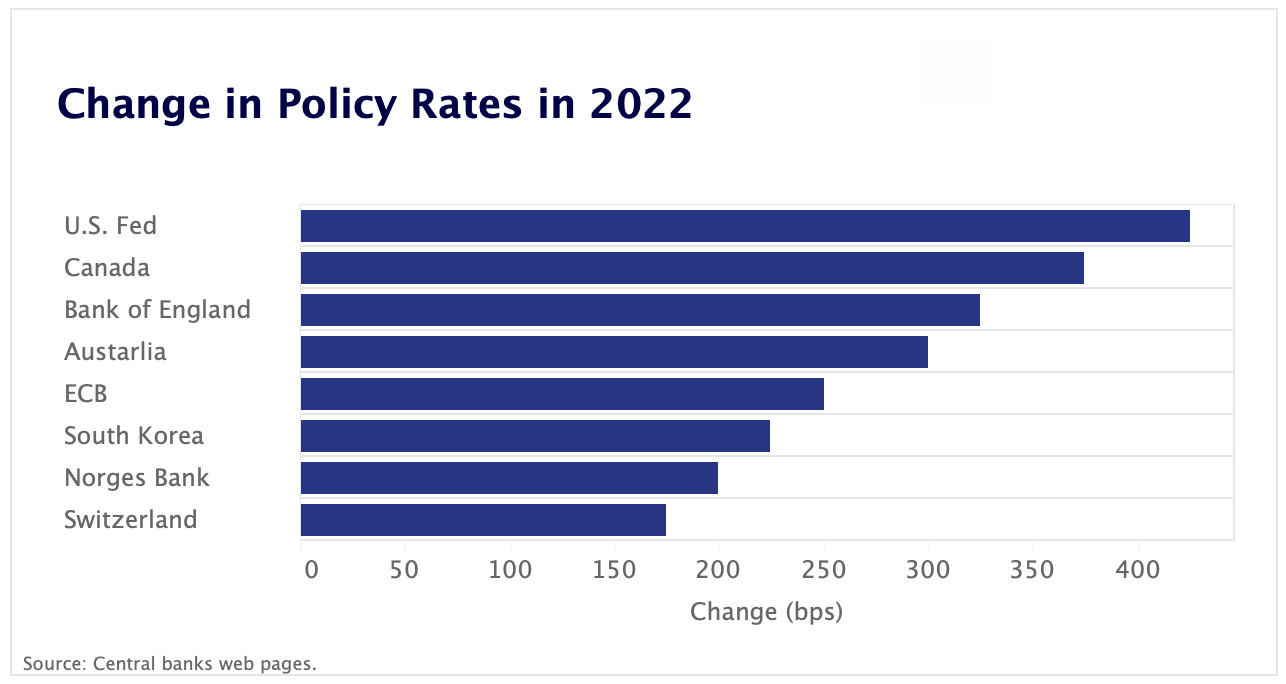
Despite softer than expected inflation data, the U.S. Fed hiked rates by half a percentage point as expected last week. The central bank also delivered a hawkish message signalling that rates will remain above 5% throughout 2023. The ECB, the Swiss National Bank, and the Bank of England followed suit with similar moves. This brings the total monetary tightening in the US this year to 425bps compared with 325bps in England, 250bps in the eurozone and 175 in Switzerland.
In addition to hiking rates at the fastest pace in decades, the Fed has also been reducing its massive balance sheet since June. The process known as quantitative tightening or QT, accelerated in September and its effects are kicking in with short-term dollar borrowing costs spiking in early December, suggesting tightening liquidity. Global monetary tightening has weighed heavily on risk assets with both crypto and tech stocks down double-digit this year.
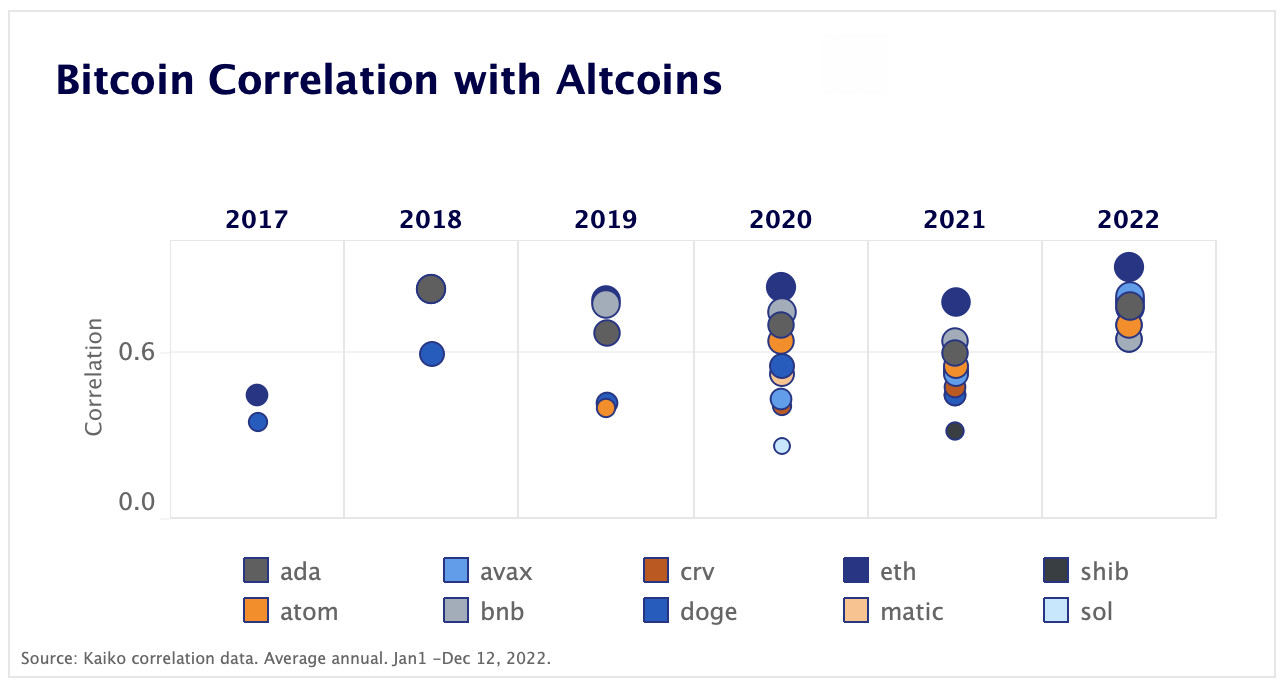
In addition to the challenging macro environment, crypto markets faced several idiosyncratic shocks which prompted a loss of confidence and a larger investors' exodus from crypto. Bitcoin’s average correlation with altcoins has increased and converged this year showcasing how broad the market turmoil has been.
Bitcoin miners underperform following a year-long bear market
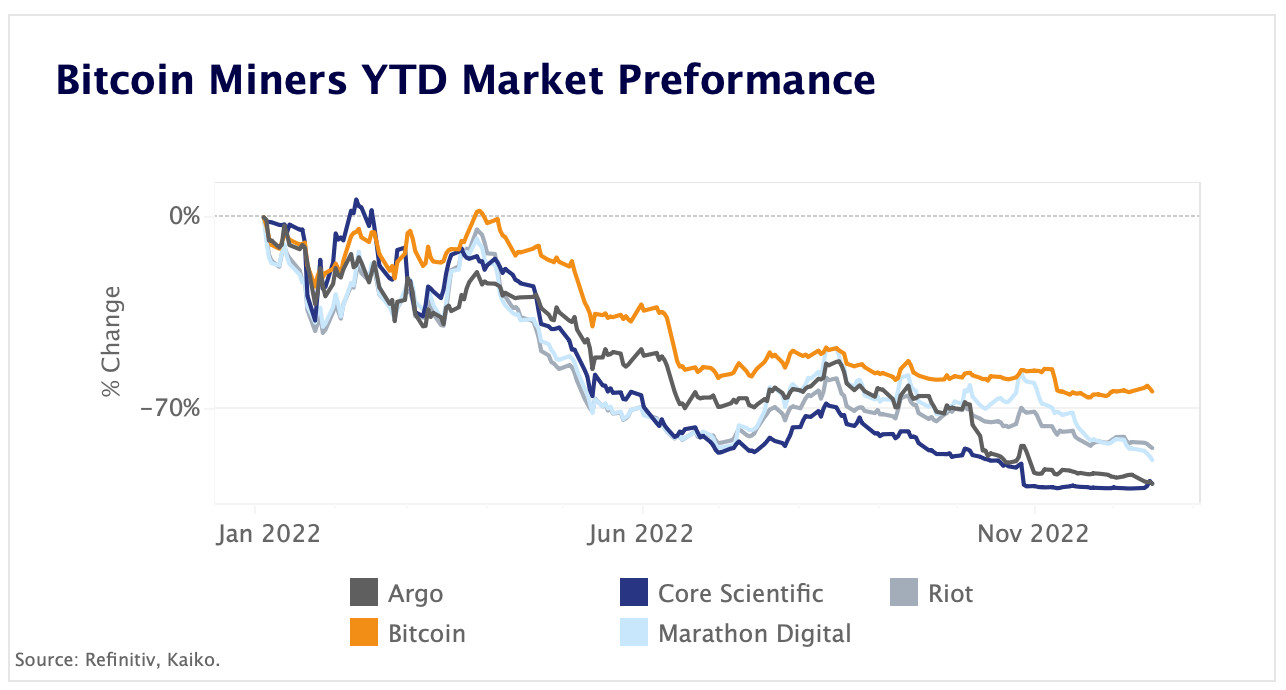
The share price of large public mining companies are down double-digits this year, underperforming BTC by a large margin. Despite last week's news that Core Scientific, one of the largest public mining companies, would receive a financial proposal from one of its current creditors, the company has lost a whopping 95% of its value YTD.
Argo Blockchain is also down by over 95% YTD. Rumors that the company is facing bankruptcy caused its shares to be briefly suspended for trading on the London Stock Exchange and Nasdaq in early December. Argo now faces delisting from Nasdaq due to its share prices falling below the $1 threshold. Marathon Digital and Riot tumbled by 88% and 84% respectively.
While Bitcoin's hash rate has retreated from its all-time high in November, fueling speculation of miners’ capitulation, it has rebounded in December. Miners’ difficulties put additional pressure on crypto lenders, who provided large amounts of rig-backed loans during the crypto bull run.