
Since the successful integration of the Ethereum mainnet with the Beacon Chain - also known as "Merge" - the Proof of Stake (PoS) consensus algorithm has secured the largest smart contract network. The Shanghai upgrade (EIP-4895) in the coming weeks will allow stakers to withdraw their Ether (ETH).
Ethereum is the largest smart-contract platform with $29.2 billion in total value locked – akin to assets under management – across decentralized applications, and 5,000+ developers across the world. As Ethereum gradually moved away from Proof of Work to Proof of Stake, investors went on an indefinite lock-up period to validate the transactions and secure the network through staking. That said, Ethereum’s liquidity event is looming and scheduled for April 12, dubbed the Shanghai upgrade. To make it a reality, Ethereum core developers simulated the withdrawal process on multiple testnets over the last several months to ensure that the withdrawal process is playing out as intended without any unforeseen vulnerabilities.
Be that as it may, Ethereum is finally ready to enable withdrawals on April 12. However, it will follow a strict schedule that we’ll expand on as part of the simulator, which will be covered later in the report. Therefore, we believe it is critical that investors and the community can actively monitor the status and health of ETH staking. For instance, it’s crucial to comprehend the processing time of withdrawals on the network to determine how fast users can unstake their assets. In addition, real-time data can also shed light on the behavior of staking providers. In fact, the Ethereum protocol restricts full withdrawals based on the total number of validators active on the network.
Background of the Shanghai Upgrade
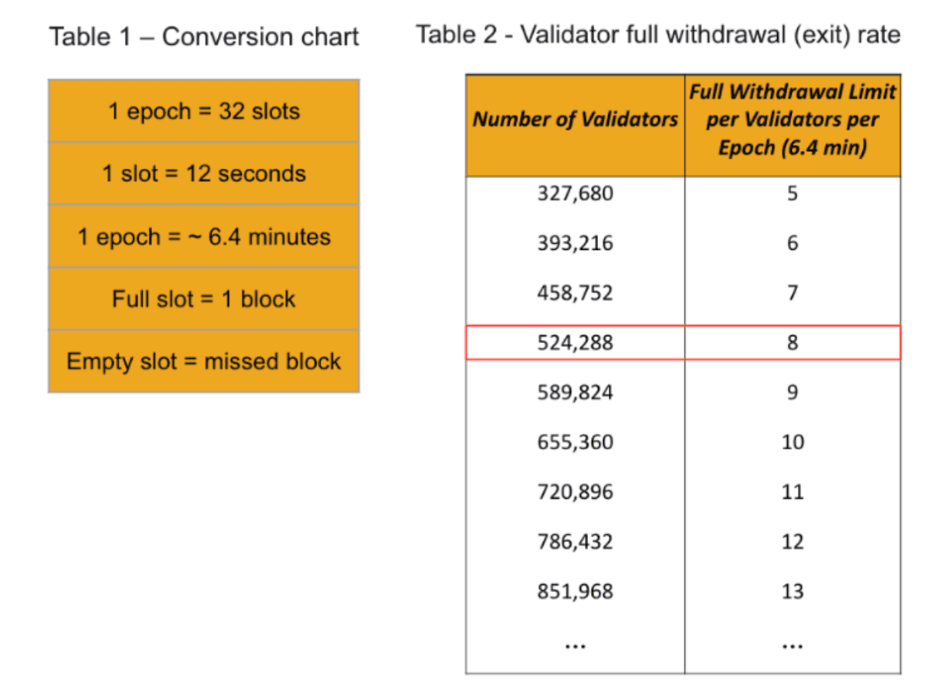
ETH staking withdrawals are transfers from Ethereum’s deposit address to one’s wallet address. This means no gas or transaction fee is required. As such, an ETH withdrawal is considered a balance increase. Per the Ethereum Foundation, there is a maximum of 16 withdrawals of Ether (ETH) per block of transactions, regardless of the amount of ETH. Given that a block is settled every 12 seconds, there are, in theory, 7,200 blocks of transactions each day (assuming no missed blocks), amounting to a maximum of 115,200 withdrawals per day.
To become an Ethereum validator, one needs 32 ETH. Withdrawals are considered partial if the validator balance stays equal to or above 32 ETH. In contrast, to maintain network security and prevent bank runs, the Ethereum protocol limits the number of validators that can perform a full withdrawal (i.e., stop validating the network). As of today, the exit limit is restricted to 8 validators per epoch every ~6 minutes or ~512 withdrawals. For reference, an epoch refers to the frequency to which a given validator is randomly selected by the protocol to validate transactions every ~6 minutes. As such, full withdrawals form part of the same queue as partial withdrawals but get processed much slower.
Methodology of our Staking Simulation
We consider the number of missed blocks per day to estimate the waiting time for withdrawals accurately:
- Extract historical data for the number of missed blocks per day on the Ethereum network from Dec 1, 2020 to Mar 22, 2023.
- Calculate the frequency distribution of days according to the number of missed blocks.
- Establish three scenarios for the total number of days it will take to withdraw the entire validator set.
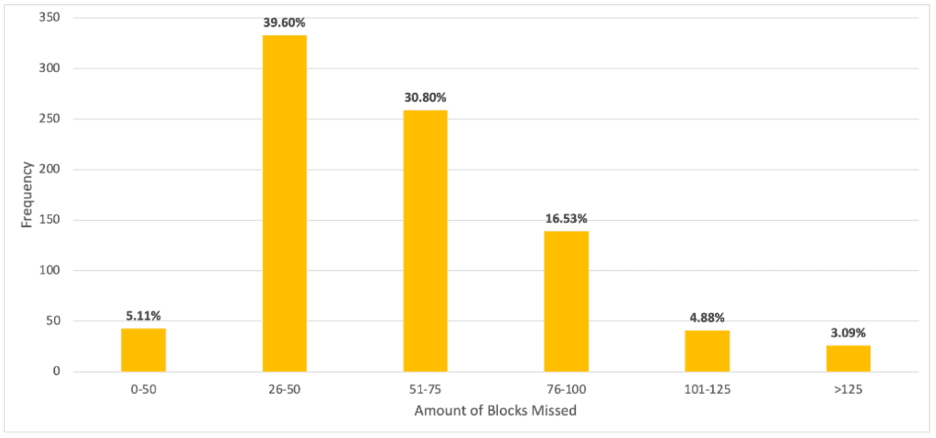
- Best Case: To be conservative, we use the average number of missed blocks per day. This is 61 missed blocks per day and happens to be ~58% of the time in the measured time period.
- Base Case: The number of missed blocks per day that has historically been observed 90% of the time. This amounts to 100 missed blocks per day.
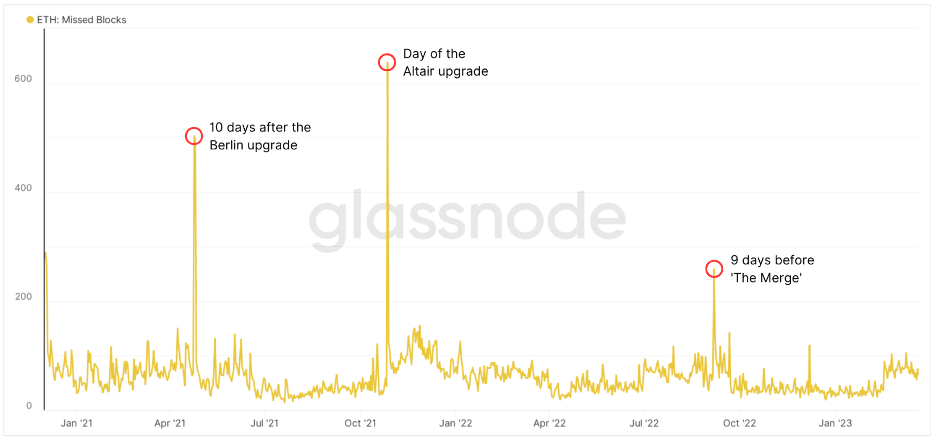
- Worst Case (Stress Test): Assuming 2x the highest historical number of missed blocks in a day. This accounts for 1,276 missed blocks per day. On Oct 27, 2021 – the day of the Altair upgrade – we saw the highest number of missed blocks, 638.
Based on the staking data as of Mar 22, 2023, and historical growth, we estimated the staking data at Shanghai (April 12, 2023). We can expect ~579k validators to have deposited ~18.52 million ETH by April 12, 2023, assuming no slashing.
Current market landscape of ETH staking
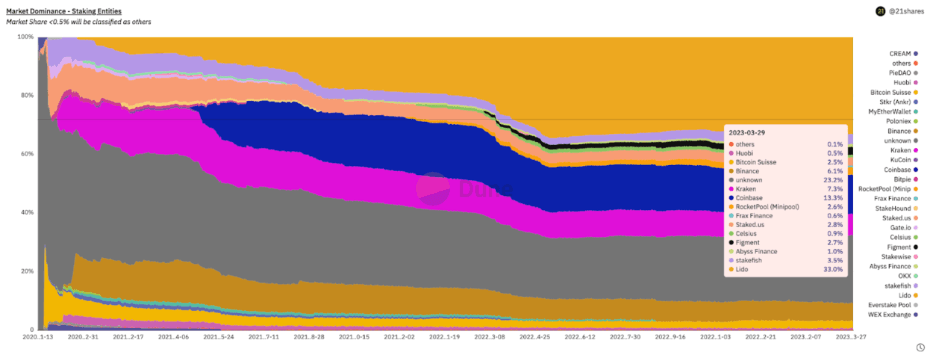
Considering the limitations of staking ETH, investors looked into alternative solutions that allowed them to take advantage of ETH staking yield without locking their capital away for years. In this regard, so-called “liquid staking” providers Lido and Rocket Pool proliferated over the last 18 months as they generated yield for their users in the form of a staking derivatives token that compounded the rewards on a daily basis.
Although users couldn’t redeem the staking derivatives tokens for ETH, they were still tradeable on secondary markets. In addition, due to the composability of stETH and rETH, users can take out loans across the DeFi landscape using those tokens as collateral.
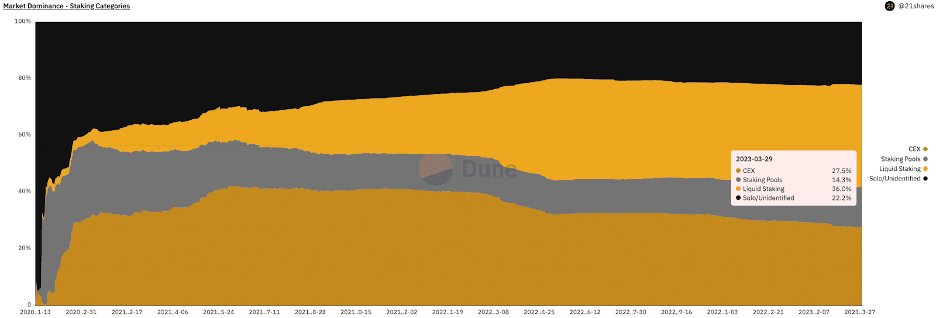
Although exchanges lost a lot of confidence from their users as the death spiral of LUNA took place, it wasn’t until the demise of FTX that users felt a massive breach of trust and accordingly started removing their assets from centralized platforms like BlockFi, Celsius, Voyager, and others. The systemic failure reminded everyone of the truth contained in the expression, ‘not your keys, not your coins,’ leading users to look for alternative solutions that didn’t entail giving up ownership of their assets. As shown above, centralized exchanges began losing market share after the FTX debacle, falling from 31.1% in November last year to 27.5% in March 2023.
On the other hand, staking pools such as Staked.Us, Stakefish, and Figment offer non-custodial staking mechanisms, which are considered safer than sending assets to CEXs. As such, these platforms became the preferred provider as we inch closer to the activation of withdrawals and the freeing up of liquidity.




Ethereum lowest staking ratio compared to other PoS networks
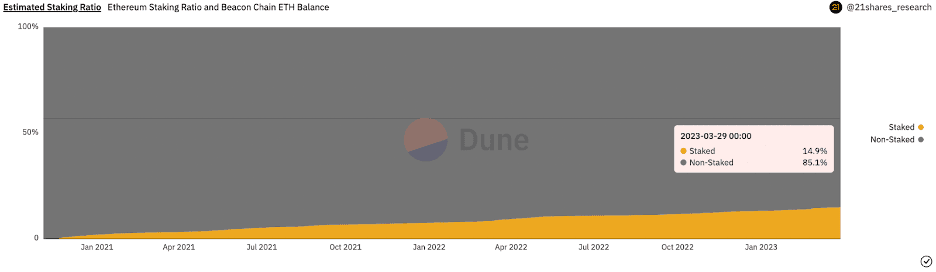
As users are unable to withdraw their staked ETH before the 12th of April, validating the Ethereum network had an implicit liquidity constraint. Investors who wanted to capitalize on the ETH yield must have tolerated long-term commitment, as their capital would be locked away until the Shanghai upgrade. Thus, we expect the ratio of staked ETH to rise significantly from the current 14% figure once withdrawals are enabled and users can remove their staked ETH from the beacon chain.
Enabling users to withdraw their locked ETH will mark a significant milestone in the evolution of Ethereum as it is the last critical piece of the Proof of Stake transition. In that view, investors and the broader community can begin treating ETH as a productive asset that generates cash flow for the validators securing the network. Soon, we’ll enter a new era that will put Ethereum on par with bonds and capital goods, guaranteeing the right to a revenue stream.