
Bitcoin's energy consumption has been a hotly debated topic since its original discovery. Founder Satoshi Nakamoto himself has already been confronted with the issue. A recent report from crypto asset manager CoinShares provides an overview of which facts are actually true.
Bitcoin is a peer-to-peer (P2P) network that brings with it countless advantages. From censorship resistance to permissionlessness to transaction transparency, Bitcoin is superior to conventional networks in many ways. Still, not everyone is convinced by the underlying technology. One often-criticized point of contention is the high energy consumption of the proof-of-work algorithm used to generate new blocks. Especially at a time when awareness of climate change and CO2 consumption is growing, Bitcoin's controversial climate footprint represents a significant barrier to entry for new companies.
Emergence of bitcoin energy consumption
To understand Bitcoin's energy consumption, a few things about the network's technology need to be clarified. Bitcoin is a decentralized network for the direct transfer of value. It uses blockchain technology to prevent the so-called double-spending problem. The underlying proof-of-work algorithm enables transaction verification without a third-party authority that prevents double-spending in traditional systems. Network participants must solve specific cryptographic problems to verify the validity of transactions. Miners accomplish this with customized computers that compute hashes around the clock. This requires real resources (computing power and energy), making a malicious takeover of the network extremely costly.
As of December 2021, there are around 5 million hardware devices in use to verify transactions on the Bitcoin blockchain. After the mining ban in China, there was a brief dip of an estimated 30 to 40%, but the number of mining devices quickly recovered. As expected, newer computers are more efficient than old ones, creating a race toward efficiency. As can be seen from the graph, this results in higher network efficiency over the years.
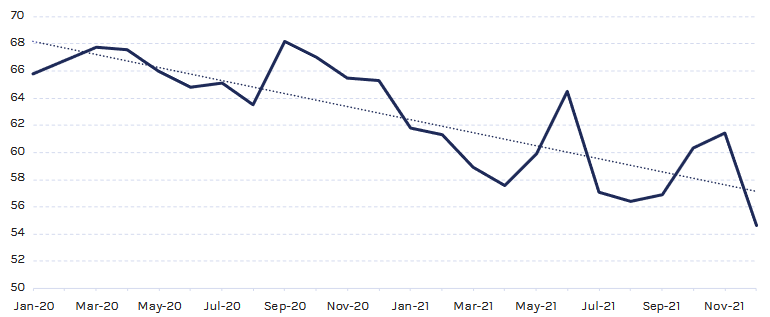
In fact, the graph also correlates with the price of Bitcoin. When Bitcoin prices rise rapidly, older, less efficient units - previously rendered unprofitable by the rise in mining competition - can become profitable again, so they are added back to the network. The Bitcoin blockchain thus always finds a natural floor of computing power to support the network and secure it from malicious actors.
Bitcoin power consumption in numbers
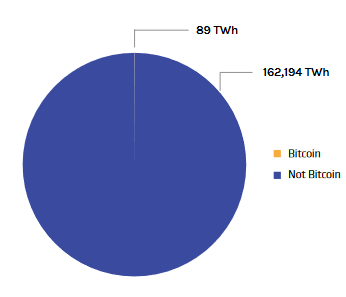
First, the CoinShares report goes into concrete numbers. For now, Bitcoin's electricity consumption is compared to the total energy consumption elsewhere. The annual average for Bitcoin (as of December 2021) is 89 terawatt hours (TWh). This is a negligible portion (around 0.05%) of global energy consumption.
For general Bitcoin critics, of course, any energy consumption is a "waste," but the benefits of the Bitcoin network should not be forgotten. Millions of people already use blockchain technology, and Bitcoin has the potential to provide countless people in third-world countries with open access to a fair market. Thus, Bitcoin's energy consumption should be put in relation to the diverse qualities of the network.
CO2 emissions caused
With comparatively low energy consumption compared to the rest of the world, it is easy to conclude that CO2 emissions are also relatively small. The estimated emission of CO2 caused by Bitcoin mining was a scant 36 megatons (Mt) of CO2 in 2020 and 41 megatons in 2021. This is the equivalent of about 0.08% of annual emissions worldwide. Compared to the traditional financial sector, Bitcoin's footprint doesn't look bad. Printing our fiat currencies alone causes about 8 Mt per year, according to the report. That's leaving out the myriad skyscrapers, computer rooms and other CO2 emissions of traditional banks. Meanwhile, the gold industry emits an average of 100 to 145 Mt of CO2.
CoinShares breaks down the Bitcoin network's approximately 40 Mt of CO2 further to identify potential improvements. It quickly becomes apparent that CO2 emissions can be drastically reduced by a large-scale switch from coal. Of all the energy sources that currently keep the network running, coal provides between 35 to 50% of the energy. Other energy sources such as nuclear power (5 to 11%) or renewables (4 to 8%) such as hydropower are not yet used as much.
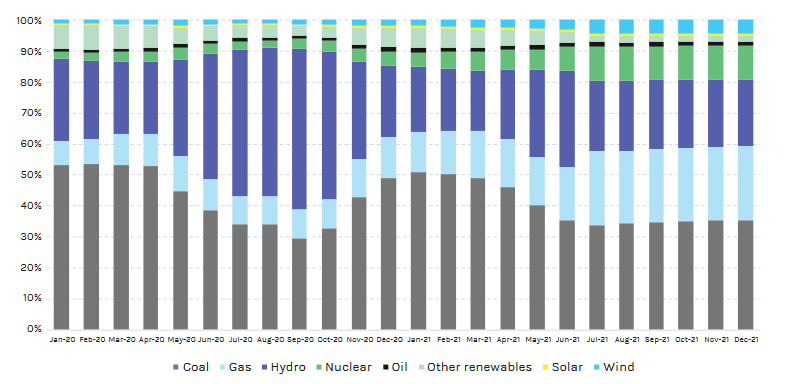
If this ratio of coal to alternative energy sources were improved, the 40 Mt of emissions would also be rapidly reduced. Coal power alone accounts for over 90% of all CO2 emissions from the Bitcoin mining network in certain months. According to CoinShares, once some of the coal power is replaced with nuclear power and renewables, the issue of "CO2 emissions" would no longer be an issue at all. After all, the share is already relatively low.
Bitcoin as a future profit
As early as 2010, shortly after the first transaction on the Bitcoin network, the pseudonymous inventor Satoshi Nakamoto commented on the solution to the problem. It was the same situation as with gold and gold mining. The marginal cost of gold mining is usually close to the price of gold. Gold mining is a "waste," but that waste is far less than the benefit of having gold as a medium of exchange.
"I think this will also be the case with Bitcoin. The benefits of the exchanges enabled by Bitcoin will far exceed the cost of power consumption. Therefore, it would be a waste not to have Bitcoin." - Satoshi Nakamoto, founder of the Bitcoin network
On the whole, CoinShares also concludes that the net benefits of Bitcoin dwarf the drawbacks of power consumption. The whole system is the only way for hundreds of millions of people to gain access to a fair, devaluation-protected, and censorship-resistant monetary network in the near future. To continue to maintain this, we must be willing to accept the relatively small amount of additional emissions.