The International Monetary Fund published a research paper on the role of Bitcoin in cross-border capital flows. The IMF found that countries with large capital inflows tend to have lower Bitcoin inflows, and vice versa. Interestingly, Bitcoin's cross-border flows respond differently to key variables that are indicators of fiat flows.
The International Monetary Fund (IMF) was born out of a post-World War II economic crisis with a mission to support a stable global economy. Due to it's role and vast resources of several hundreds of billions of USD captured in the fund, the IMF has considerable influence in establishing guidelines. Historically, the International Monetary Fund was rather critical of Bitcoin. Now it recognizes the disruptive potential of the technology. Here is a breakdown and analysis of the IMF report on Bitcoin as a cornerstone for cross-border financial flows. Here's a breakdown and analysis of IMF's report on Bitcoin as a primer for cross-border flows.
Bitcoin’s advantages as a currency for cross-border transactions
Cross-border transactions are becoming increasingly important with the progressing globalization. However, exchanging between currencies, transacting in different jurisdictions and having different legal systems complicates payment processing. This leads to various problems such as high fees, especially for smaller transaction amounts, long transaction times and lengthy KYC processes. Bitcoin, on the other hand, with its decentralized nature (no governing authority) and global reach, has emerged as a competitor to the status quo.
Bitcoin transactions are recorded on a public ledger that can be viewed online by anyone using block explorers. Because the Bitcoin network is automated and transactions are automatically verified and settled by so-called miners, there is no entity that performs verification confirmations. Bitcoin transactions are settled in minutes and 24/7 with a universal fee based on network usage. This is particularly beneficial for sending money quickly and is also useful for smaller payment sizes, as intermediary banks are eliminated. Bitcoin transcends borders. Anyone with an Internet connection can open a Bitcoin wallet to send or receive Bitcoins anywhere in the world.
According to the IMF, cross-border flows of bitcoin have not yet replaced existing capital flows. However, the IMF mentions the difficulty of properly measuring and identifying the residency of individuals due to the partial pseudonymity that Bitcoin offers. Given the above advantages of Bitcoin, it is highly likely that Bitcoin will be preferred over fiat for cross-border transactions in the future.
Global Bitcoin flows between jurisdictions
The IMF used three approaches to measure global Bitcoin flows. First, by measuring cross-exchange flows based on centralized exchange wallets. Second, by also analyzing the web traffic of exchange wallets to provide an indication of user location. Third, by measuring Bitcoin flows based on fiat currencies, done with data from the peer-to-peer (P2P) exchange LocalBitcoins (the P2P exchange has ceased operations as of February 2023). The results of these approaches were complemented with Chainalysis, a blockchain analysis company from transaction tracing that has developed software for investigating financial crimes.
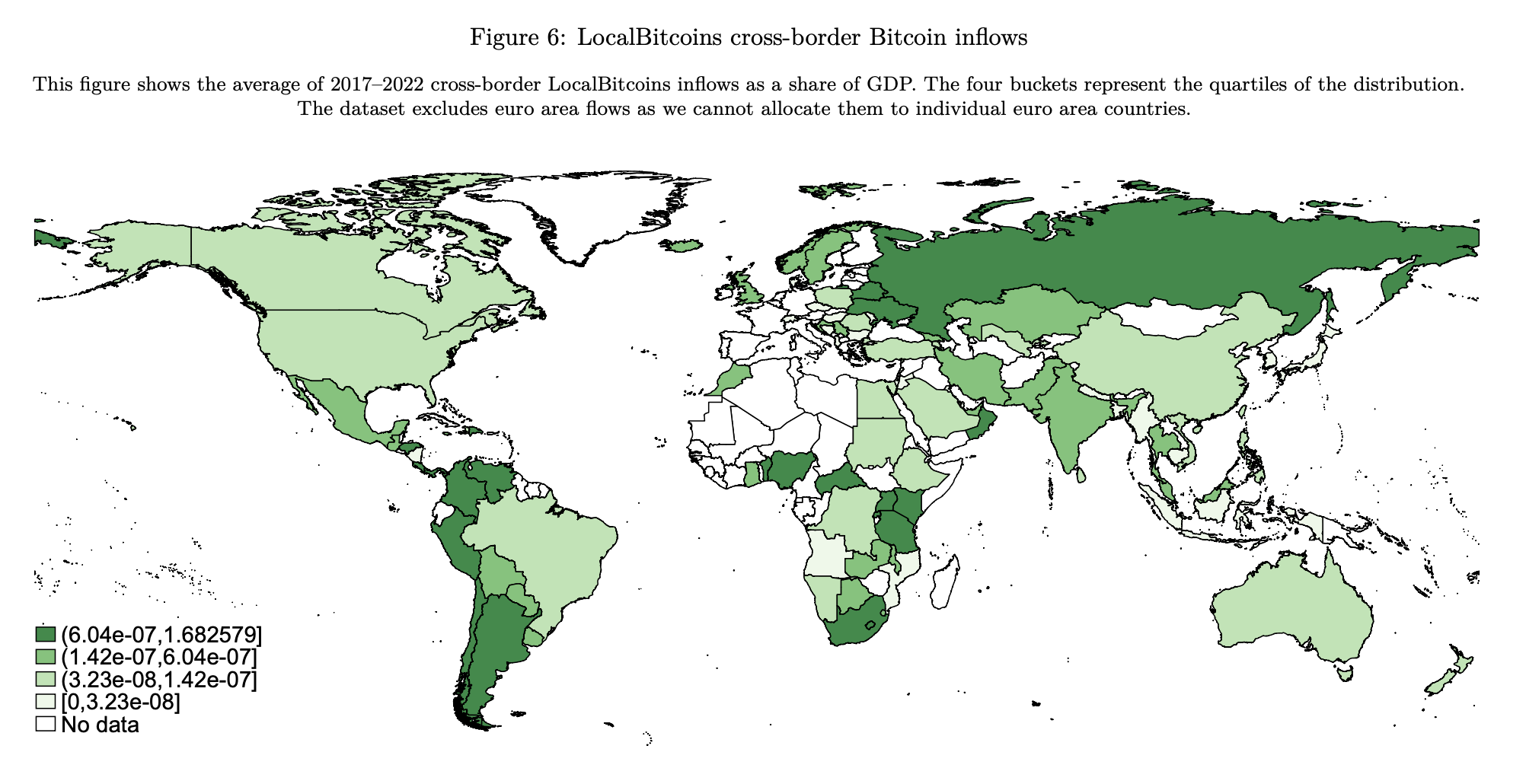
Bitcoin inflows registered on the LocalBitcoins P2P marketplace / Source: IMF report: A Primer on Bitcoin
Cross-Border Flows
Comparing the global Bitcoin inflow amount on the LocalBitcoins shows that some South American countries like Argentina, Venezuela or Peru among others rank in the top quartile for inflows. Some African countries also mark inflow hotspots such as Nigeria, South Africa or Kenya. Interestingly, Eastern Europe and China are also represented.
China experiencing high Bitcoin inflows despite crypto bans
Off-chain transaction data and movements in CNY (Chinese Yuan Renminbi) to USD were used to identify bitcoin inflows into mainland China. The results show that Bitcoin has become an important medium to send remittance payments, circumventing capital controls. Other literature cited by the IMF shows how off-chain Bitcoin transactions facilitate cross-border capital flight. This is interesting in that China has often made headlines for its crackdown on the crypto industry.
China banned cryptocurrency-related transactions and mining in 2021 and even censored online searches for crypto. This strong anti-crypto stance makes it increasingly difficult to trade cryptocurrencies within China. It has also been noted that despite the recent approval of Bitcoin and Ethereum ETFs in Hong Kong, this would have no impact on the Chinese markets as individuals and companies are prohibited from entering this market segment. Apparently, individuals still have the option to use Bitcoin or exchange the cryptocurrency for the local CNY.



Will the IMF enforce further bitcoin regulation?
The IMF seems to see Bitcoin as a legitimate solution for cross-border flows, indicating that the use of cryptocurrencies for such transactions is likely to increase in the future. However, the IMF also expresses the need to evaluate and design appropriate policy responses in the future. The institution criticized the high degree of pseudonymity, as individual users are not well identified. It also acknowledges that increasing regulations such as the 5th Anti-Money Laundering Directive in the European Union may have been a factor in the closure of LocalBitcoins.
While the IMF serves as a crucial institution in the global financial landscape, it's significance lies in its role as a global lender, providing financial assistance to member countries facing monetary difficulties. The IMF's resources are held in Special Drawing Rights (SDR), an international type of reserve currency created by the IMF in 1969. The Fund currently holds about SDR 982 billion and has a lending capacity of about SDR 695 billion (about US$932 billion as of December 2023, according to the IMF Factsheet). Given this immense access to funds and its function as a lender, the IMF has a strong interest in regulating financial markets in its favor.
History and function of the IMF in the context of Bitcoin
IMF was established in 1944 at the Bretton Woods Conference in the USA with the mission to: “ (…) to foster global monetary cooperation, secure financial stability, facilitate international trade, promote high employment and sustainable economic growth, and reduce poverty around the world.” The decisions made at Bretton Woods had an economic impact on the global economy and laid the foundation for a new monetary system using the US dollar as the reserve currency to which other countries' currencies were pegged. The US dollar, in turn, was tied to gold, which meant that any country holding US dollars could exchange them for gold. Gold backing of the US dollar was gradually phased out in the 1970s.
The IMF promotes exchange rate stability and facilitates international trade by working to foster global monetary cooperation and ensure financial stability. The IMF focuses on stabilizing and promoting the economies of its 190 member countries through policy advice and surveillance activities. It collects and analyzes economic statistics, evaluates members' economic policies, and provides guidance on how to achieve macroeconomic stability and sustainable growth. Despite the antagonistic history regarding Bitcoin, the IMF acknowledges that the traditional economy has its weaknesses and the use of cryptocurrencies is a symptom of the imbalances.