
Close Menu
Crypto Valley Journal
    Facebook X (Twitter) Instagram
    Crypto Valley Journal
    • Hot Topics
      • News
      • Minds
    • Focus
      • Background
      • Blockchain
      • Legal & Compliance
      • Non-Fungible Token (NFTs)
    • Investing
      • Markets
      • Financial Products
      • Decentralized Finance (DeFi)
      • Exchange overview
    • Education
      • Basics
      • Glossary
      • Politicians on crypto
    • Statistics
      • Bitcoin-ETF-Flows
      • Ethereum-ETF-Flows
      • Crypto market data
      • On-chain data
    • Academy
      • Overview
      • Part 1: Blockchain
      • Part 2: Money
      • Part 3: Bitcoin
      • Part 4: Cryptocurrencies
      • Part 5: Decentralized Finance
      • Part 6: Investing
    • English
      • Deutsch
    Crypto Valley Journal
    You are at:Home » Education » Basics » What is the Bitcoin Halving?
    Was ist das Bitcoin-Halving?

    What is the Bitcoin Halving?

    By Editorial Office CVJ.CH on 24. January 2024 Basics

    In a few months, the Bitcoin inflation rate will be reduced through another "halving" event. This event, which occurs every four years, is a central pillar of Bitcoin's monetary policy. But what exactly is Bitcoin halving, and how does it impact the price of digital gold?

    Bitcoin represents a groundbreaking development in the financial world and is the first successful implementation of a decentralized digital currency. The distributed payment system allows for secure and direct transfer of digital money without the need for a third party. As part of this vision of an independent network, Bitcoin's monetary policy is programmatically defined. The inflation of "digital gold" decreases every four years and will stop around the year 2140 when the maximum supply of 21 million Bitcoins is reached. Therefore, Bitcoin halving is essential to perceive Bitcoin as an alternative monetary system.

    Subscribe to our newsletter

    The best articles of the week, directly delivered into your mailbox.

    What is the Bitcoin Halving?

    Currently, there are approximately 19.4 million Bitcoins in circulation. Newly created Bitcoins are rewarded to miners who contribute computing power to secure the blockchain system. This block reward is halved every four years, known as "halving." As a result, the number of newly created Bitcoins decreases exponentially until the theoretical maximum of 21 million Bitcoins is reached. With an average block time of 10 minutes, this number is expected to be reached around the year 2140. The next Bitcoin halving is projected to take place in April 2024.
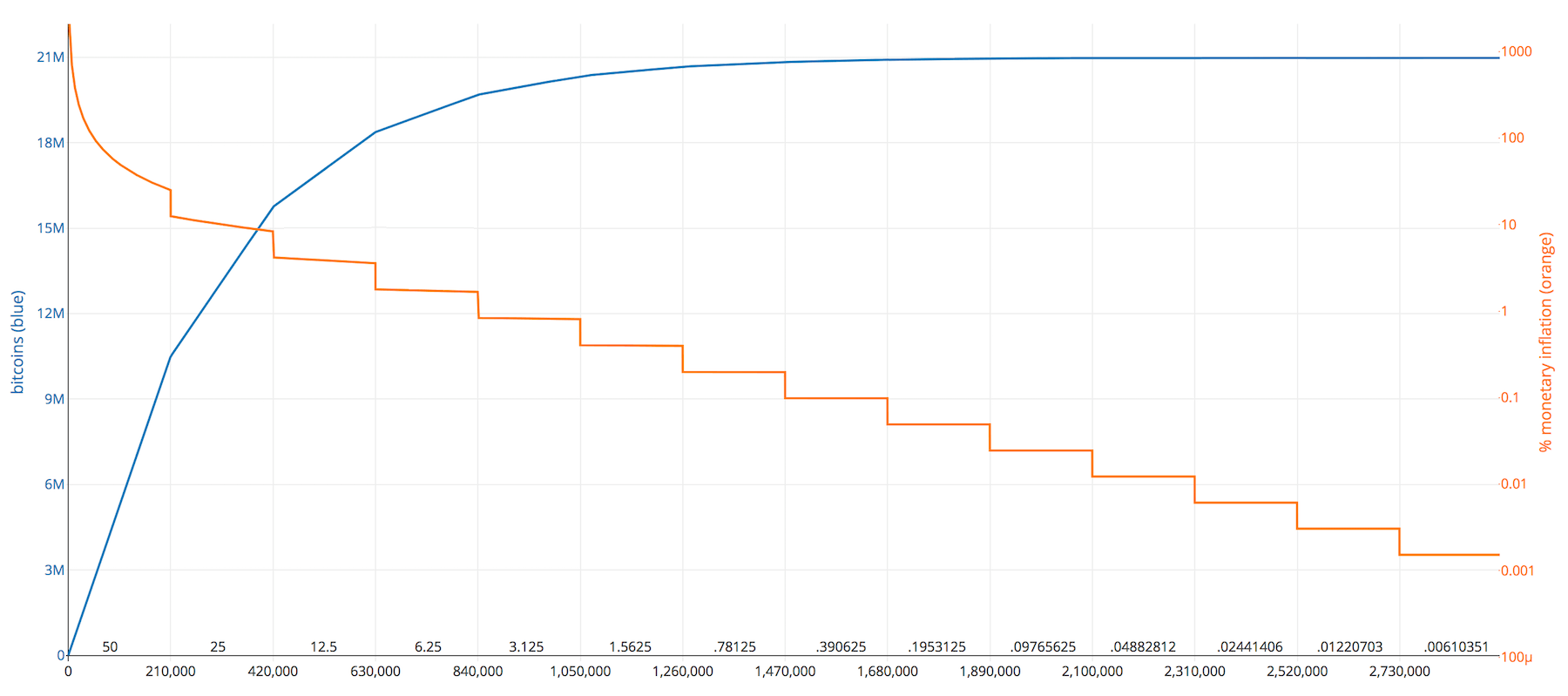
    Estimates of Bitcoin inflation (orange) and total supply (blue) by block height / Source: Coin Central

    We are now approaching the fourth halving in Bitcoin's history, and we can look back on a comprehensive history. Initially, the mining reward was 50 BTC per block. In November 2012, it reduced to 25 BTC, and in July 2016, it further decreased to 12.5 BTC. Since May 11, the reward has been 6.25 BTC for each newly mined block, soon to be reduced to 3.125 BTC.


    Ray Dalio’s Bridgewater Associates Minds

    Star investor Ray Dalio considers Bitcoin inferior to gold

    Tokenization opens up new ways for companies to engage investors flexibly and structure financing efficiently. Background

    Tokenized equity shares: a tax-efficient alternative to traditional equity?

    VanEck lists VBNB, the first US spot BNB ETF on Nasdaq. Sponsor fee 0.39%, custody at Anchorage Digital, no staking at launch. Financial Products

    VanEck launches first US BNB ETF (VBNB) on Nasdaq

    Digital finance transparency relies on Proof of Reserves, Merkle trees, MPC custody and 24/7 monitoring to verify solvency and user assets. Basics

    Transparency as the foundation of security in digital finance

    Ray Dalio’s Bridgewater Associates Minds

    Star investor Ray Dalio considers Bitcoin inferior to gold

    Tokenization opens up new ways for companies to engage investors flexibly and structure financing efficiently. Background

    Tokenized equity shares: a tax-efficient alternative to traditional equity?

    What are the effects of halving on the Bitcoin price?

    Bitcoin was designed as a limited digital asset. Similar to commodities like silver or gold, its price is influenced by the dynamics of supply and demand. Through halving, the number of newly issued Bitcoins is reduced every four years, making the supply scarcer and decreasing the inflation rate. Currently, around 900 new Bitcoins, worth $36 million, are created and distributed to miners daily. Miners usually sell a significant portion of these rewards to finance their operations. With the upcoming halving, this newly created supply will be halved, theoretically resulting in only $18 million worth of Bitcoins entering the market daily.

    In the past, halving cycles have established recurring price patterns for Bitcoin. Market participants often price in the effective reduction in inflation months in advance, and this impending momentum has historically propelled Bitcoin into a prolonged bull market. Ultimately, the fundamental changes in Bitcoin's supply are real and play a crucial role in defining Bitcoin as a scarce digital asset. In crypto circles, there is often talk of four-year cycles characterized by rapid price increases and decreases over two-year periods.
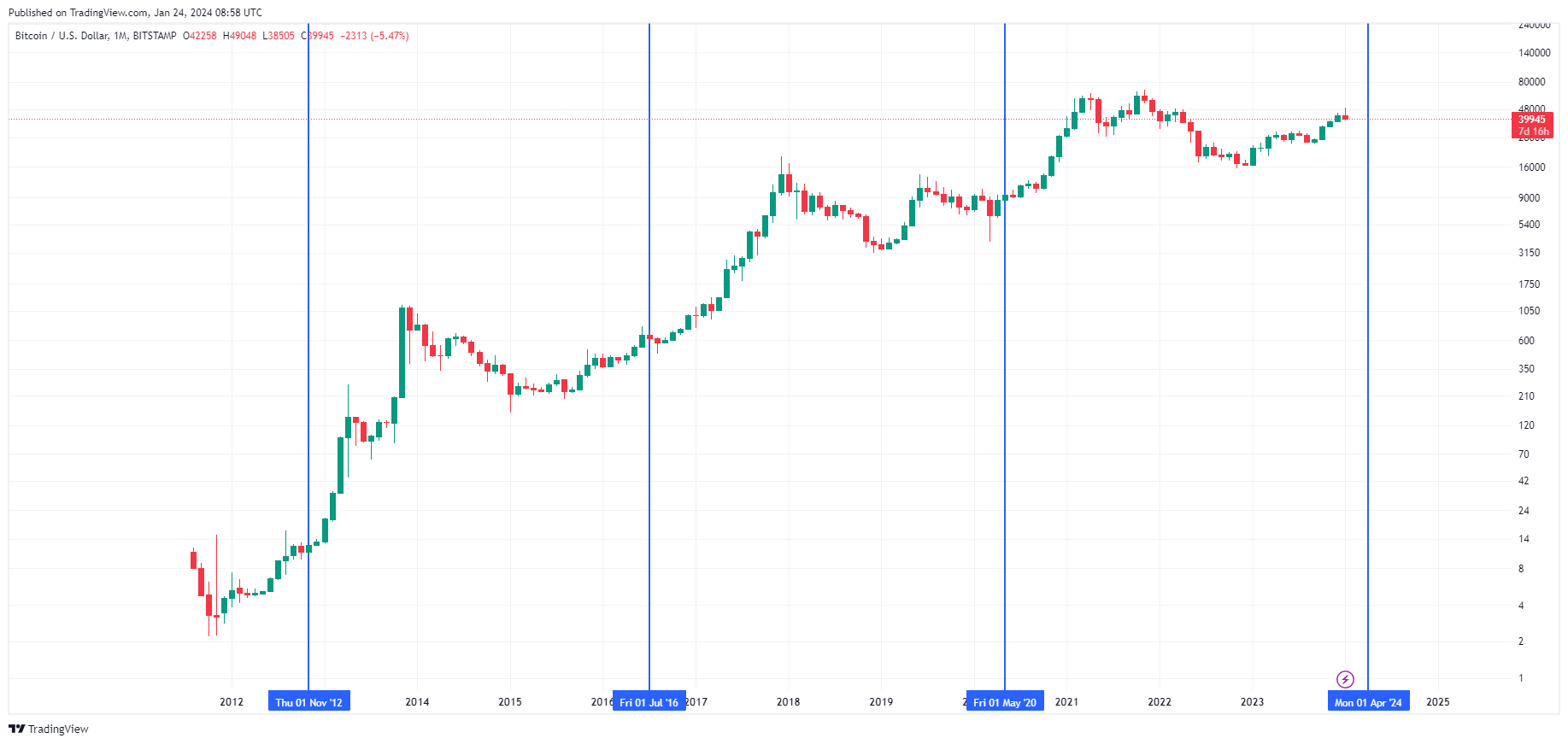
    Price developments after the last three Bitcoin halvings / Chart: Tradingview

    Impact of the Bitcoin Halving on the mining industry

    Bitcoin mining requires a considerable amount of energy for both computational tasks and cooling the involved computers. As a result, the mining industry tends to favor locations with cheaper electricity. The costs of Bitcoin mining also depend on expenses related to equipment, electricity, and the facilities housing the hardware. When miners' rewards are halved, the Bitcoin price must double to achieve similar profitability as before halving. Despite the last two halvings and setbacks in China, the total computing power available to the network continues to steadily increase and is at an all-time high.
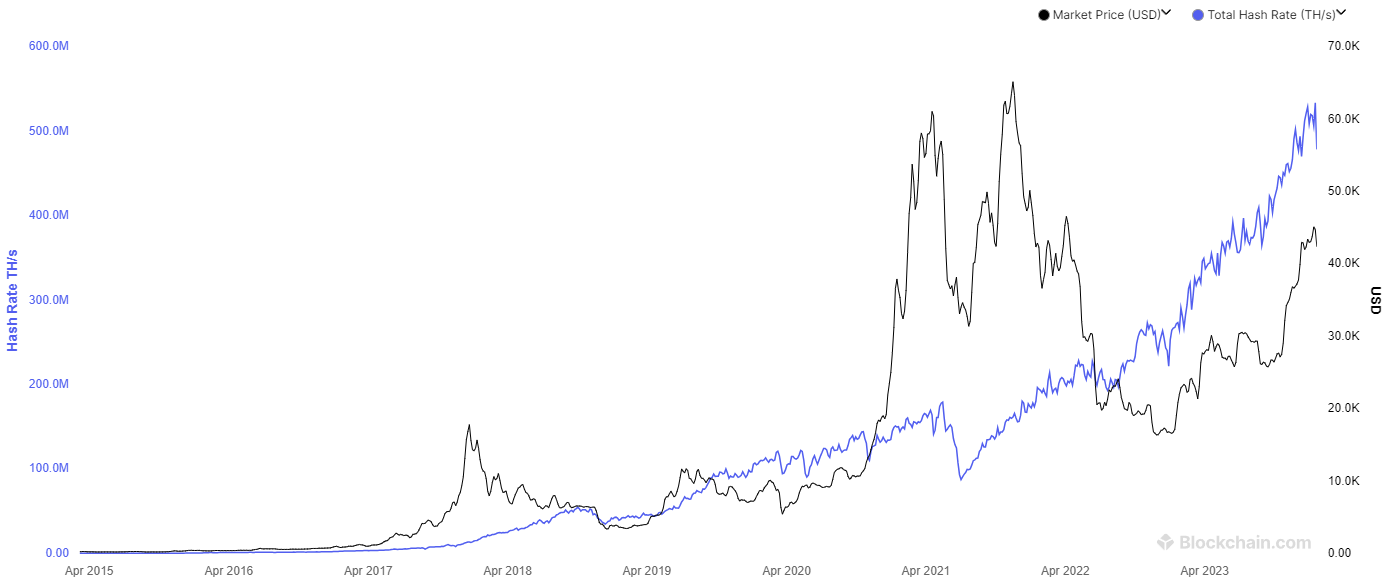
    Bitcoin hash rate and price since 2015 / Quelle: Blockchain.com

    The mining industry is in constant competition, which is undoubtedly intensified by halving. In comparison to the last halving in May 2020, some significant observations can be made: there are more significant players in the mining sector, more efficient mining equipment, and stronger competition than ever before. While a majority of mining activities took place in China until a few years ago, the United States now leads globally. Canada, Kazakhstan, and Russia are also significant players. Following the halving of Bitcoin inflation, some miners may temporarily shut down their machines due to reduced profitability. However, if the Bitcoin price rises in the future, more miners are likely to reenter the market.


    Share. Facebook Twitter LinkedIn Email Telegram WhatsApp

    About the author

    Editorial Office CVJ.CH
    • Website
    • Twitter
    • LinkedIn

    Since 2018, the editorial team at Crypto Valley Journal has been reporting from Zug - the heart of Switzerland’s Crypto Valley - on Bitcoin, cryptocurrency, blockchain, and regulatory developments in digital assets. Behind the publication’s collective editorial voice is a team of writers with backgrounds in financial markets, law, and technology.

    Related Articles

    Bitcoin ETF outflows hit record levels: BlackRock's IBIT lost $527.84 million on Wednesday, Bitcoin fell below $73,000.

    Bitcoin falls below 73,000 USD: BlackRock ETF posts second-largest outflows since launch

    Mark Cuban sold most of his Bitcoin and now calls it a failed inflation hedge after the Iran crisis undercut his gold thesis.

    Mark Cuban sells most of his Bitcoin holdings, keeps Ethereum

    Strategy pauses Bitcoin purchases and redeems its own convertible notes worth 1.5 billion USD. Saylor also speaks of the charging BitVac.

    Strategy pauses Bitcoin purchases and redeems convertible notes worth 1.5 billion USD

    Cardano Summit vote failed: the treasury vote missed the two-thirds majority by 1.46 points. The Foundation cancels the 2026 event.
    1. June 2026

    Cardano Summit vote fails: Foundation cancels 2026 event

    Jamie Dimon attacks Coinbase CEO Armstrong and fights for the banks' stablecoin yield rule in the CLARITY Act lobbying battle.
    31. May 2026

    Jamie Dimon vs. Coinbase: JPMorgan escalates CLARITY Act dispute

    cvj-weekly-review
    30. May 2026

    Weekly review: Raiffeisen enters the crypto business

    twitter image button instagram image button linkedin image button youtube image button

    About Crypto Valley Journal
    About Crypto Valley Journal

    On the pulse of the movement

    • Academy
    • Contact
    • Advertising
    • About us
    • Partner
    • Imprint
    • Privacy
    • Disclaimer
    Search

    Type above and press Enter to search. Press Esc to cancel.