
Avalanche is a Proof-of-Stake blockchain using its own consensus mechanism. It is a blockchain network that promises a high transaction throughput with negligible transaction fees compared to the most dominant smart contract platform Ethereum.
Avalanche is a high-performance, scalable, customizable and secure blockchain platform targeting building application-specific blockchains, scalable decentralized applications and complex digital smart assets. It was launched by Ava Labs in 2020. In this report, we will offer an exhaustive overview of the Avalanche network, AVAX as a crypto asset, and discuss the various risks associated with it.
How Avalanche works
The Avalanche network comprises multiple blockchains and employs a proof of stake consensus mechanism to achieve the high throughput of over 4,500 transactions per second (TPS). Each chain in the Avalanche architecture represents its own virtual machine, with support for numerous custom virtual machines like EVM and WASM. This allows chains to include case-specific functionality. Each of these virtual machines is connected to a subnet with its own set of incentives to keep validators honest, it is a custom blockchain network made up of a dynamic set of validators working together to establish consensus. As a result, Avalanche might be regarded as a "platform of platforms", made up of thousands of subnets that work together to build a single interoperable network.
The Avalanche Consensus Protocol is a family of four mechanisms - Slush, Snowflake, Snowball, and Avalanche. These build upon each other and become more secure in the process. In short, the Avalanche Consensus Protocol is a unique voting protocol that relies on “repeated random subsampling”. In this process, validator nodes randomly query other validators until the network reaches a consensus and decides whether to accept or reject an incoming transaction.
Block validation
All validators are members of the Primary Network consisting of three blockchains: the Exchange Chain (X-Chain), Contract Chain (C-Chain), and Platform Chain (P-Chain). In a given round, each validator randomly selects K nodes from the entire validator list (probability of selection is weighted by stake amount) to query for their preferred decision. Each queried validator responds with their preferred decisions, and if the majority of responses returned in a round differ to the node performing the query then it will update its own preferred decision to reflect that and respond to other nodes with that answer.
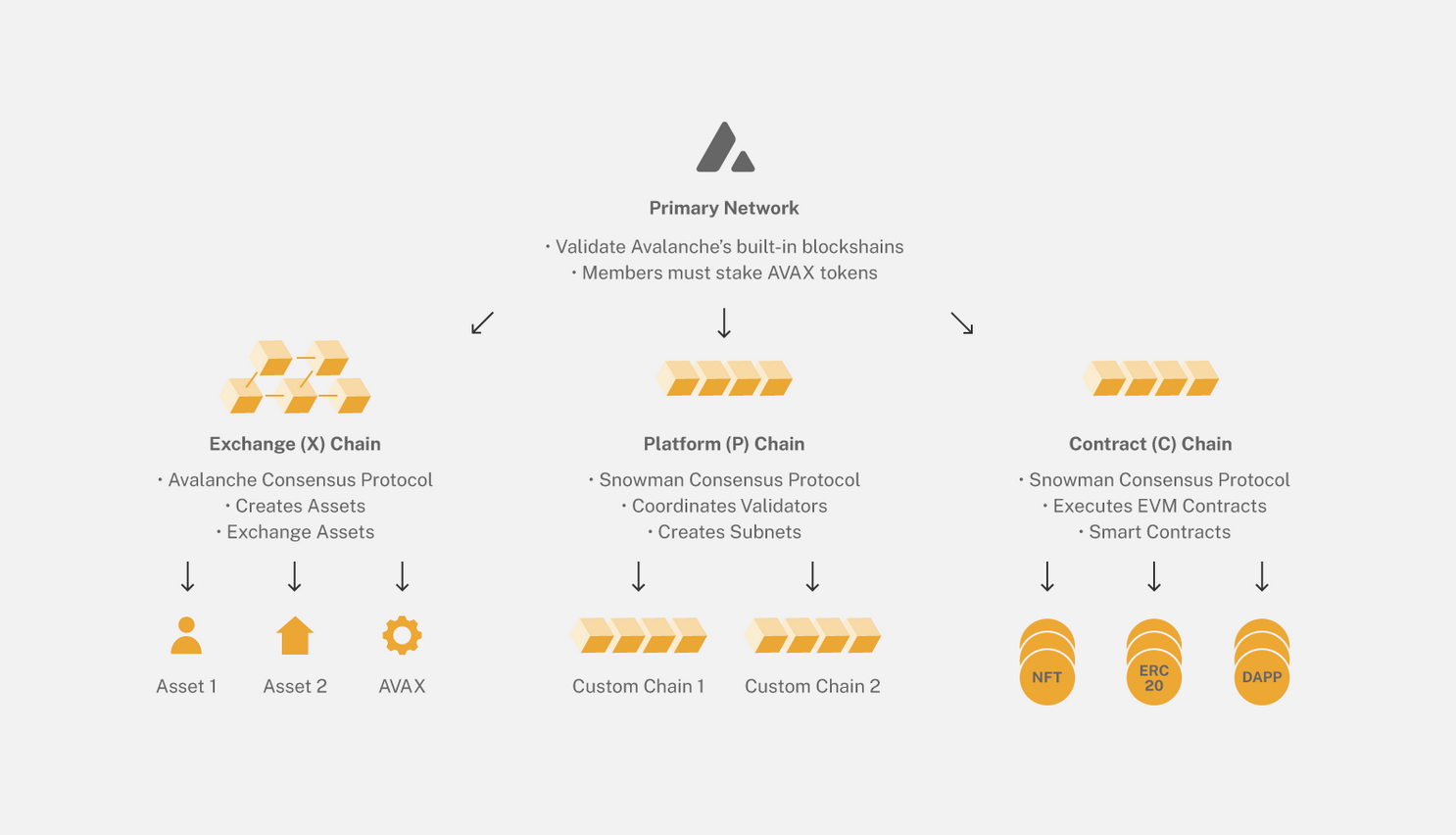
By having every validator randomly select other validators in order to ask them what their preferences are, participants in Avalanche build confidence in the correct decision shared by all nodes in the network. While one node does not query every other node like in classical consensus, each node performs their own sample of randomly selected nodes, thus is able to scale to hundreds of thousands or millions of nodes without adding lots of additional overhead on each node, as they are querying the same number of nodes. With enough confidence, a decision is finalized immediately. This process happens so quickly that Avalanche rivals major payment systems in its ability to process and clear transactions in the network.
The state of Avalanche
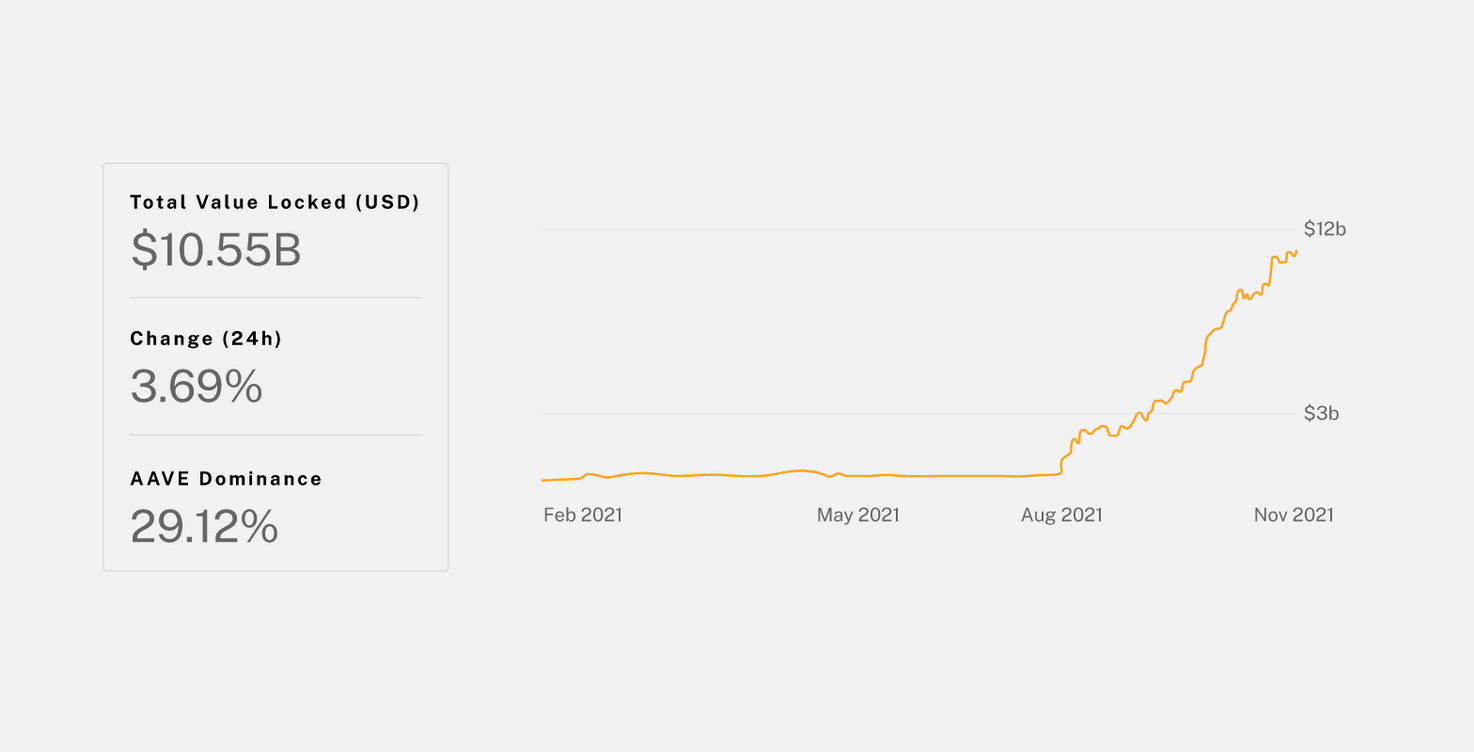
The Avalanche ecosystem experienced exponential growth in the first half of 2021 with assets under management in DeFi or total value locked (TVL) peaking at $10.55 billion at the end of October. Avalanche’s TVL growth trajectory was accelerated by the Avalanche Foundation’s announcement of Avalanche Rush, a $180 million liquidity-mining incentive program to attract applications and assets to the DeFi ecosystem.
The Avalanche Bridge (AB) is the key infrastructure piece used to transfer ERC20 tokens from Ethereum to Avalanche’s C-Chain and vice versa. The Avalanche bridge received several upgrades in Q3 for additional chain support and optimization for faster clearing and settlements. Relatively user friendly, Ethereum transactions take 10 to 15 minutes and Avalanche transactions take only a few seconds, so far $5.62 billion has been transferred from Ethereum on the official AB. The speed of Avalanche’s bridge puts the network in a competitive advantage over networks like Polygon PoS which takes up to one hour and Optimism and Arbitrum which take seven days for asset withdrawals.
Broad ecosystem
The Avalanche ecosystem currently has +100 dapps spanning DeFi, gaming, NFTs, exchanges and cross-chain solutions. The rise of Avalanche dapps is widely attributed to the EVM compatibility of the native programming language, reducing the barriers of existing Ethereum developers. Trader Joe, the largest decentralized exchange (DEX) on Avalanche, boasts daily trading volumes of 100+ million dollars. This clearly demonstrates how Avalanche’s affordable transaction fees allow less friction and reduce the barriers to entry for DeFi and the long tail of Web 3 users.
Outside of DeFi, Q3 of 2021 also saw Avalanche’s first Initial Litigation Offering (ILO) go live after its introduction in December 2020. The first of its kind token is a blockchain-enabled litigation financing product open to anyone. Legal financing or third-party litigation funding provides individuals who might otherwise lack the necessary funds to litigate or arbitrate a civil claim with the resources they require. An ILO not only raises the funding to pursue litigation, but also tokenizes an economic right in such claims and can represent a legal claim to a portion of the financial recovery as a digital asset. The use of Avalanche’s blockchain technology to democratize financial products in the $10B asset class of litigation financing will allow individuals and small organizations to assert their legal rights against well-funded corporations.
Last but not least, Ava Labs and Amazon Web Services (AWS) partnered in January to accelerate blockchain adoption across enterprises, institutions, and government agencies. As such, AWS is promoting Avalanche's infrastructure and dApp ecosystem, including one-click provisioning of nodes through its own marketplace. In addition, Ava Labs became a member of the AWS Partner Network (APN), enabling the company to help customers deliver customized offerings connected to more than 100,000 partners in over 150 countries.



The future of Avalanche
Looking forward, we expect to see four key areas of growth across the ecosystem, DeFi, enterprise applications, NFTs and culture applications. This will be primarily driven by the Avalanche Foundation’s fund, Blizzard, consisting of $200M worth of contributions dedicated to development, growth and innovation on the network. The fund was announced in early November 2021 and was raised from Ava Labs, Polychain Capital, Three Arrows Capital and Dragonfly Capital to name a few.
Perhaps the most bullish case for any Layer 1 is its ability to integrate real-world use cases for social-economic benefit. Deloitte announced their strategic partnership with Ava Labs to leverage Avalanche’s blockchain technology in the Federal Emergency Management Agency’s new disaster recovery platform. The Close As You Go (CAYG) platform will help state and local governments to demonstrate their eligibility for federal funding and was designed by first responders, public works departments and grant-making agencies. Blockchain technology allows the platform to operate in a decentralized, transparent and cost-efficient manner for authorizing funds to recipients.
In addition, it utilizes Avalanche’s security features to gather, process and authenticate documentation accurately to prevent fraud, waste and potential systemic abuse. The ability for Avalanche to streamline recovery efforts, simplify documentation and minimize administrative costs is a clear demonstration of how the integration of blockchain technology will fundamentally change and help build resilient modern financial systems.
Largest risks
Avalanche has a limited operating history and has not been validated over the long run. The network launched the genesis block in late September 2020. Despite rigorous audits, the crypto network is still developing and making significant decisions that will affect the design, functionality, and governance. These factors may adversely affect public perception.
For example, in February of 2021, the Avalanche network, under heavy load, experienced a trigger of a non-deterministic bug related to state verification. An increase in network traffic due to the launch of a DEX caused the number of processing blocks to increase concurrently. The event caused validators to accept invalid mint transactions, as the rest of the network refused to honour these transactions. The problem was quickly identified and although the easiest method to fixing the problem was to rewrite the blockchain and undo accepted transactions, the decentralized nature of the network meant that this was not feasible. Instead, an incrementally deployable patch disabled the cache and introduced the notion of special blocks which respected the invalid mints.
Although the code was patched, and the technical bug never had the possibility of losing funds, it was a blatant reminder that blockchain technology is still in its infancy. The rapid rate of development and the relative experience of developers in the space means that no smart contract is immune to flaws despite extensive auditing by third-party firms. The health and integrity of the network will therefore continue to depend on a strong and supportive community.