
Ethereum’s long-awaited London hard fork is expected to launch on Aug. 4th, with block 12,965,000. This is according to Tim Beiko, one of the Ethereum developers, who submitted and received approval on the proposed launch date.
The release of Ethereum 2.0 aims to replace Ethereum’s current proof-of-work consensus mechanism with proof-of-stake. The release has produced an extensive roadmap of upgrades, with the London hard fork being implemented through various testnets. The London hard fork is an update to Ethereum, which includes five Ethereum improvement proposals (EIPs).
EIP-1559
EIP-1559 is both an upgrade to the Ethereum network and an economic upgrade to ETH as an asset. Currently, a user who wants their transaction to be picked up by a miner must essentially bid for their transaction to be included in a block. This puts upward pressure on gas prices during periods of high demand. The proposal will introduce fixed prices (or base fees) for network transactions, which will abolish these auctions.
The new fee structure aims to make ETH deflationary over time if more ETH is burned in base fees than is generated in mining rewards. It is also expected to reduce the congestion on the network through more effective use of block capacity. Block capacity will be increased and altered according to network usage, making fees either increase or decrease.
Fixed Fees
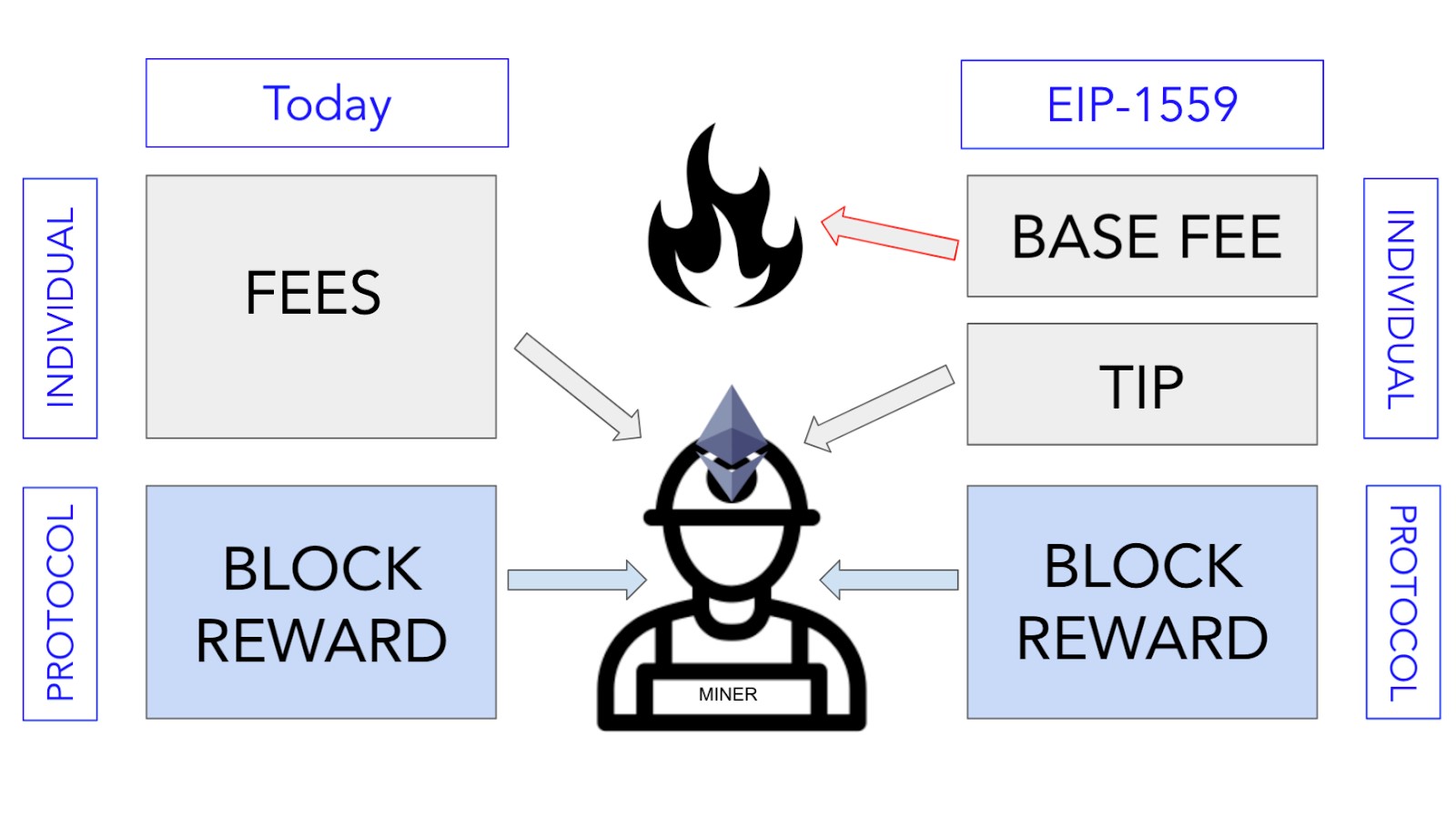
The protocol will quote a fixed per unit gas price. This will be a base fee per transaction, which will be burned rather than paid to miners. It is important to note that gas fee prices will become predictable due to less volatility and block limits (blocks are bundles of transactions, and each block has a limit amount of transactions it can fit).
Maybe you are now thinking to yourself: “But what about the miners?” Miners will receive an optional tip from the transaction submitter, and still receive the block reward subsidies (block subsidies are standard ETH rewards awarded to a miner for every successful block they produce). This allows users that need a transaction submitted quickly, e.g. for an arbitrage trade, to pay more and receive a confirmation quicker. It is still unclear whether a miner’s total revenue will be reduced or not. This transition prepares the miners for a full migration from proof-of-work to proof-of-stake, where miners will become obsolete. In a proof-of-stake consensus mechanism, the tip and block subsidy will be rewarded to users staking their ETH on 2.0.
One common misconception is that EIP-1559 will lower fees. It will not necessarily lower fees, but it will optimise the fee model by smoothing fee spikes and limiting the number of overpaid transactions. ETH 2.0 and layer 2’s scaling solutions are the drivers to decrease fees on the Ethereum network.
Increased Network Capacity
Block gas limit capacity will be increased by a factor of two from the pre-London upgrade block limits: from 12.5 million to 25 million. Also, block capacity has an effect on the fees. If the network utilisation reaches more than 50% capacity, the base fees will increase in the next block, and if utilisation is below 50%, the base fees will decrease. The aim is to achieve equilibrium at 50% network capacity. If subsequent blocks are at 100%, fees will continue to increase. At some point, fees will be high enough to drive away users, which causes the network capacity utilisation to decrease, lowering the fees. Fees can increase or decrease by a maximum of 12.5% per block, smoothing out fee spikes.
Improved User Experience
User experience should be greatly improved. Fees will be more predictable and can be calculated by wallets based on information from the last block. A user will be able to set a fee cap when sending ETH from their wallets, meaning that their transaction will only go through once the fees drop. Users therefore will not overspend on transactions, which has been common due to the explosion in DeFi application usage. Hopefully, the network will be more efficient thanks to less congestion.
There are currently multiple forecast models that calculate the future value and inflation rate of ETH. However, predictions are tricky because future network usage and base fees are roughly approximated according to past figures. According to EthHub.io, the current yearly network issuance is approximately 4.5%. One prediction is that EIP-1559 could reduce issuance by 2%, and proof-of-work activation could further reduce issuance by 4%, meaning ETH issuance would be -1.5% (and therefore deflationary). However, we will only really be able to measure its inflation rate, and possible deflationary status, once EIP-1559 takes full effect, and the amount of ETH mined and ETH burned is calculable. Should releases go to plan, and network usage keep up, we could see ETH acting as a capital asset in addition to a consumable commodity in the near future, competing closely with BTC for the top spot.
You can follow the current fee burning on the Ethereum testnet via watchtheburn.com (you need to be logged in to your Metamask wallet to view it). You can also follow the countdown to the EIP-1559 implementation on ultrasound.money.