Ordinals are a new concept in the blockchain space. They can be seen as a form of non-fungible token (NFTs) on the Bitcoin blockchain. A Bitcoin upgrade made it possible to store information on the Bitcoin blockchain such as image files, text or audio, which a developer then used to create tradeable tokens.
The release of Ordinals in December 2022 sparked controversy within the Bitcoin community. Many Bitcoin enthusiasts pointed out severely impacted transaction times and were against the idea of using Bitcoin for other means than a digital currency. Despite this, the protocol represents a novel method of NFT creation with potential applications beyond the NFT space.
Bitcoin Taproot upgrade lays the foundation for Ordinals
The Bitcoin Taproot upgrade in November 2021 sparked the idea of inscribing meta data onto denominations of Bitcoin. Unlike traditional NFTs, the so called "inscriptions" involve a process that embeds data into the record of a Bitcoin transaction. This is possible by using Satoshis or "Sats", the smallest unit of Bitcoin. Each Satoshi is assigned a serial number, known as an Ordinal which can be inscribed with data. The serial number is based on its mining order, when the Satoshi was mined during the proof of work process of validating transactions.
Ordinal rarity and value does not only rely on the inscribed artwork or scarcity of supply. The value of some Ordinals is due to their time of creation or in other terms their specific serial number. Sats with early inscription dates or whose serial number marks certain moments in Bitcoin history are more valuable than others.
The difference of Ordinals and NFTs
While both are non-fungible, Bitcoin Ordinals differ from traditional NFTs in their method of storing the meta data. Traditional NFTs typically store data off-chain with URL pointers directing to typically an image or video file. Ordinals use inscriptions to store content directly on the blockchain. This design increases decentralisation and resistance to censorship. However, it comes with increased costs for creation and transactions costs as well as size limitations for the inscriptions.
Another notable difference lies in the method by which these NFTs are added to their respective blockchain networks. Bitcoin ordinals use proof of work (PoW) in the mining process, contributing to the significant energy requirements of the Bitcoin network. In contrast, NFTs on smart contract blockchains use Proof of Stake (PoS) and generally offer faster transactions.
Billions of transaction volume
According to Ordiscan, the first Ordinal was inscribed in December 14th 2022 and there are a little over 49.5 million Satoshi inscriptions at the time of writing. The total trading volume across the biggest Ordinal marketplaces has passed $1.2bn as can be seen on a Dune Analytics dashboard. The biggest contributor to the trading volume is the OKX Ordinals Market. In terms of unique users, the bulk stems from Magic Eden and unisat shortly followed by OKX.
Ordinals have even made it into Sotheby's. The world famous auction house had made $17m with its first NFT auction in 2021, is now exploring Bitcoin Ordinals with BitcoinShrooms. This is an Ordinals project created by the pseudonymous artist Shroomtoshi. The collection features pixel art pieces that draw inspiration from Bitcoin's history.
We're thrilled to present our inaugural Bitcoin Ordinals sale, featuring @BitcoinShrooms 🍄 pic.twitter.com/UkX5jsfKLh
— Sotheby's Metaverse (@Sothebysverse) December 6, 2023
Ordinals caus a rise in transaction costs
One noticeable consequence of the inscription trend has been the rise in BTC fees and an ongoing congestion of the mempool due to unconfirmed transfers. Beginning of December 2023 the average transaction fee was around $30. Before this, the average transaction fee was around 1-2 dollars.
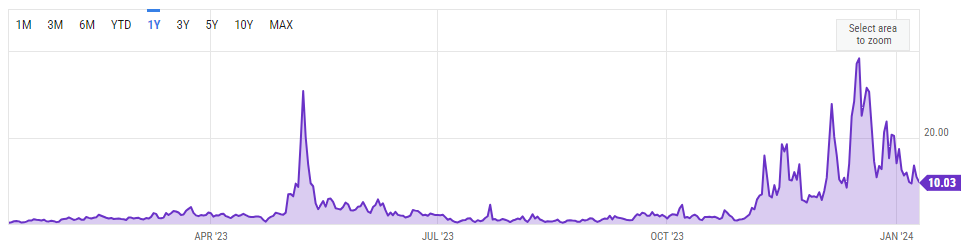
Because of this, the Ordinals debate has gained quite some momentum, especially since Luke Dashjr's Ocean Pool began excluding ordinals from mined blocks. Some miners are rejecting transactions that contain inscriptions out of principality in the belief that Bitcoin should exclusively be used for financial transactions. Advocats of Ordinals argue that the free market should decide what people pay to fill blocks with, not centralized mining pools.