
Close Menu
Crypto Valley Journal
    Facebook X (Twitter) Instagram
    Crypto Valley Journal
    • Hot Topics
      • News
      • Minds
    • Focus
      • Background
      • Blockchain
      • Legal & Compliance
      • Non-Fungible Token (NFTs)
    • Investing
      • Markets
      • Financial Products
      • Decentralized Finance (DeFi)
      • Exchange overview
    • Education
      • Basics
      • Glossary
      • Politicians on crypto
    • Statistics
      • Bitcoin-ETF-Flows
      • Ethereum-ETF-Flows
      • Crypto market data
      • On-chain data
    • Academy
      • Overview
      • Part 1: Blockchain
      • Part 2: Money
      • Part 3: Bitcoin
      • Part 4: Cryptocurrencies
      • Part 5: Decentralized Finance
      • Part 6: Investing
    • English
      • Deutsch
    Crypto Valley Journal
    You are at:Home » Focus » Background » Bitcoin hits all-time high at $70,000 USD: Where will the journey lead?
    Dank starkem Verkaufsdruck aus der Wall Street knackte Bitcoin sein Allzeithoch um 70'000 USD. Steht der nächste Gipfelsturm bevor?

    Bitcoin hits all-time high at $70,000 USD: Where will the journey lead?

    By Editorial Office CVJ.CH on 11. March 2024 Background

    For the past year, Bitcoin has been on a steady upward trajectory. The failures of centralized service providers such as FTX, Celsius, and others have been left behind by the industry. Some of the world's largest financial institutions have stepped in to fill the void. As a result, the price of Bitcoin doubled in a matter of months, surpassing its all-time high.

    Today, for the first time, Bitcoin surpassed its all-time high of $70,000 for more than a few minutes. This milestone underscores the continued relevance and growing confidence in the cryptocurrency. However, the latest surge is not only a continuation of the upward trend, but also a reinforcement of the case for Bitcoin as a permanent fixture in the global financial landscape.

    Subscribe to our newsletter

    The best articles of the week, directly delivered into your mailbox.

    Institutional FOMO sets in

    For six months, various product providers sought approval for the first spot-based Bitcoin ETFs. Financial giants such as BlackRock, Fidelity and others submitted dozens of regulatory filings to the U.S. Securities and Exchange Commission (SEC). Finally, on January 10, the SEC gave the green light. The products shattered ETF records with $4.6 billion in first-day trading. Two months later, net inflows are close to $10 billion. On average, more than $239 million per day flowed into Bitcoin ETFs, despite billion-dollar selling pressure from insolvent players.
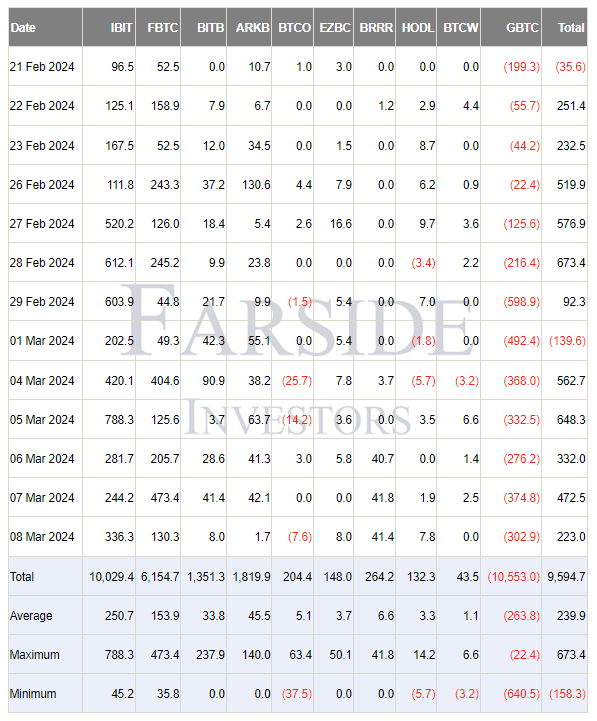
    Spot Bitcoin ETF Breakdown / Source: Farside Investors

    There's a palpable fear of missing out (FOMO) on Wall Street. It's not just individual clients of the world's largest financial institutions who want to invest in Bitcoin through ETFs. The big banks themselves will soon be adding the asset class to their funds. Morgan Stanley and BlackRock have already filed with the SEC to do so. The sheer volume of products is accelerating this trend. BlackRock's IBIT is consistently among the top 10 ETFs by trading volume. The pressure on other financial institutions is growing dramatically.


     

    Ray Dalio’s Bridgewater Associates Minds

    Star investor Ray Dalio considers Bitcoin inferior to gold

    Most crypto cards hide who issues them. After mapping the licensed issuers, here is why Switzerland's self-issuing model reads differently. Background

    The bank you never chose: who really issues Switzerland’s crypto cards

    Robinhood Perpetual Futures in Europe now cover commodities and currencies, and the broker plans a crypto launch in the United Kingdom. Financial Products

    Robinhood Perpetual Futures expand to commodities in Europe

    Digital finance transparency relies on Proof of Reserves, Merkle trees, MPC custody and 24/7 monitoring to verify solvency and user assets. Basics

    Transparency as the foundation of security in digital finance

    Ray Dalio’s Bridgewater Associates Minds

    Star investor Ray Dalio considers Bitcoin inferior to gold

    Most crypto cards hide who issues them. After mapping the licensed issuers, here is why Switzerland's self-issuing model reads differently. Background

    The bank you never chose: who really issues Switzerland’s crypto cards

    A safe haven in an uncertain world

    The value of cryptocurrencies is based on a fixed monetary policy. Similar to physical gold, there's only a limited number of Bitcoin in the world: 21 million. No central bank can artificially create new supply. The mining process creates only 900 new Bitcoins per day, which requires significant energy to support the network. Currently, this results in an annual inflation rate of about 1.7%. By comparison, the supply of gold will increase by 3% in 2023, while many Western currencies are experiencing higher inflation.

    In addition, every four years there's a halving of Bitcoin inflation. As a result, the number of newly created Bitcoins decreases exponentially until the fixed maximum of 21 million is reached. With an average block time of 10 minutes, this is expected to happen in 2140. The next Bitcoin halving is scheduled for April 2024. Therefore, extraordinary demand is meeting a diminishing supply, which is reflected in the price of the cryptocurrency. Today, Bitcoin has once again surpassed its all-time high.
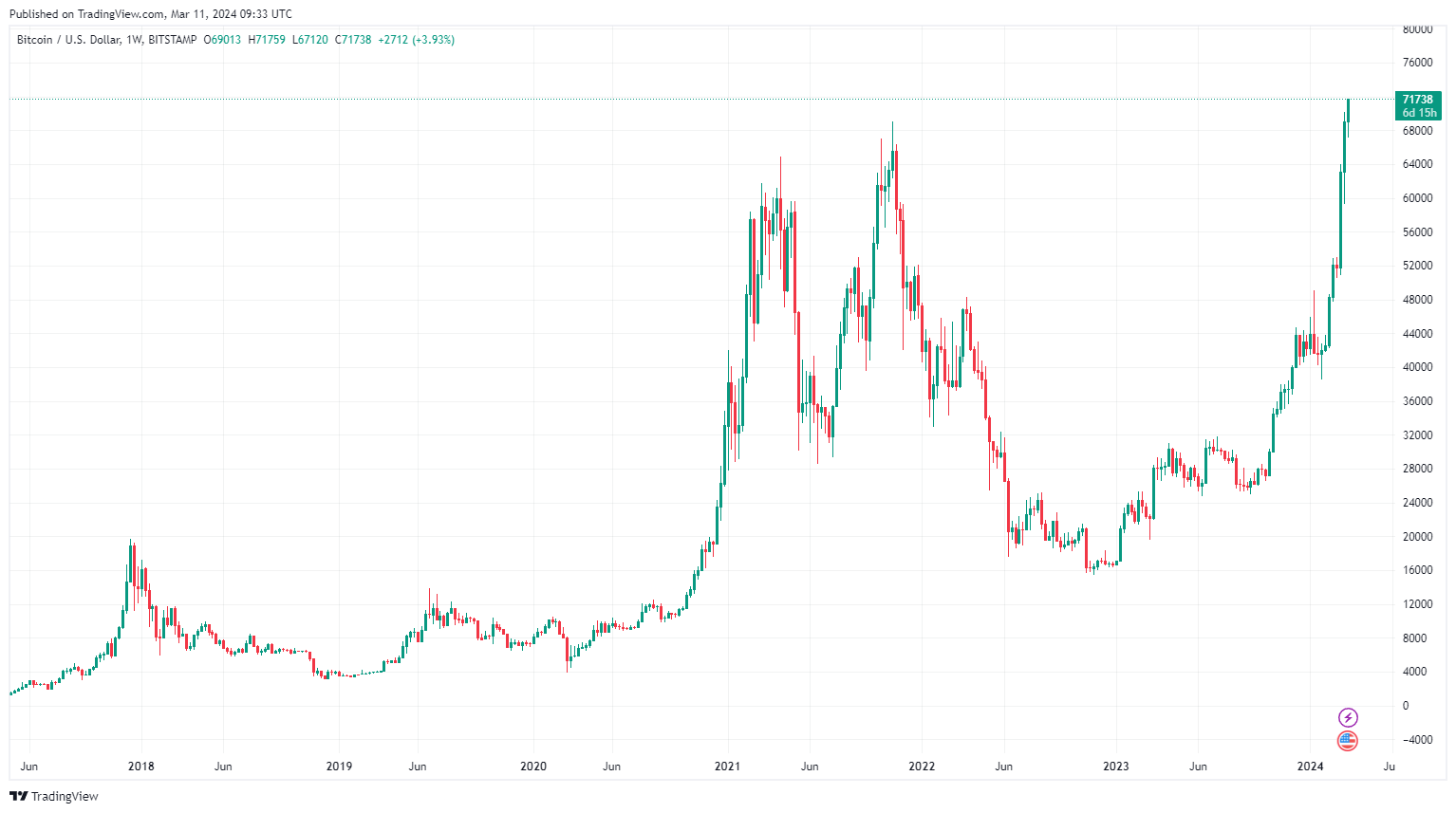
    Bitcoin BTC/USD (weekly) / Chart: Trading View

    In terms of price action, Bitcoin's current rally is very similar to the one that took place after the Covid crash in 2020. Most indicators point to overheating, but strong demand does not allow for deep corrections. Predicting future price movements would require a crystal ball. However, one thing has always been true in past market cycles: a new all-time high in Bitcoin is likely just the beginning. Alternative cryptocurrencies ("altcoins") are still over 30% away from their old highs.


    Share. Facebook Twitter LinkedIn Email Telegram WhatsApp

    About the author

    Editorial Office CVJ.CH
    • Website
    • Twitter
    • LinkedIn

    Since 2018, the editorial team at Crypto Valley Journal has been reporting from Zug - the heart of Switzerland’s Crypto Valley - on Bitcoin, cryptocurrency, blockchain, and regulatory developments in digital assets. Behind the publication’s collective editorial voice is a team of writers with backgrounds in financial markets, law, and technology.

    Related Articles

    JPMorgan ranks Strategy's sales below the bigger Bitcoin risk and names tokenization beyond public chains as the real threat.

    JPMorgan sees biggest Bitcoin risk beyond Strategy

    Germany's federal cabinet plans to scrap the one-year Bitcoin holding period and tax private crypto gains at 26.375% regardless of duration.

    Germany plans to scrap its one-year Bitcoin holding period

    Most crypto cards hide who issues them. After mapping the licensed issuers, here is why Switzerland's self-issuing model reads differently.

    The bank you never chose: who really issues Switzerland’s crypto cards

    CVJ Weekly review
    11. July 2026

    Weekly review: 80mn bank customers in Germany gain access to crypto

    The US banking regulator OCC grants Circle National Trust final approval to operate as a federal trust bank for digital assets.
    10. July 2026

    OCC grants Circle National Trust a bank license

    JPMorgan ranks Strategy's sales below the bigger Bitcoin risk and names tokenization beyond public chains as the real threat.
    10. July 2026

    JPMorgan sees biggest Bitcoin risk beyond Strategy

    twitter image button instagram image button linkedin image button youtube image button

    About Crypto Valley Journal
    About Crypto Valley Journal

    On the pulse of the movement

    • Academy
    • Contact
    • Advertising
    • About us
    • Partner
    • Imprint
    • Privacy
    • Disclaimer
    Search

    Type above and press Enter to search. Press Esc to cancel.