Bitcoin miners are facing financial challenges, with decreased block rewards since this year's halving and an all-time low hash price putting pressure on the ecosystem. This decline raises concerns about the sustainability of mining operations and the potential security risks as miners stop contributing and the system becomes more centralized.
Several factors have contributed to this challenging environment, such as an unstable month triggered earlier this month or reduced block rewards after the halving earlier this year. The halving is programmed into bitcoin's source code. It states that after 210,000 blocks have been mined, or about four years, the block rewards for miners will be cut in half. This year, the mining reward was reduced from 6.25 BTC to 3.125 BTC per block. The only other source of income for bitcoin miners, transaction fees, are becoming more and more substantial.
All time low revenue for bitcoin miners
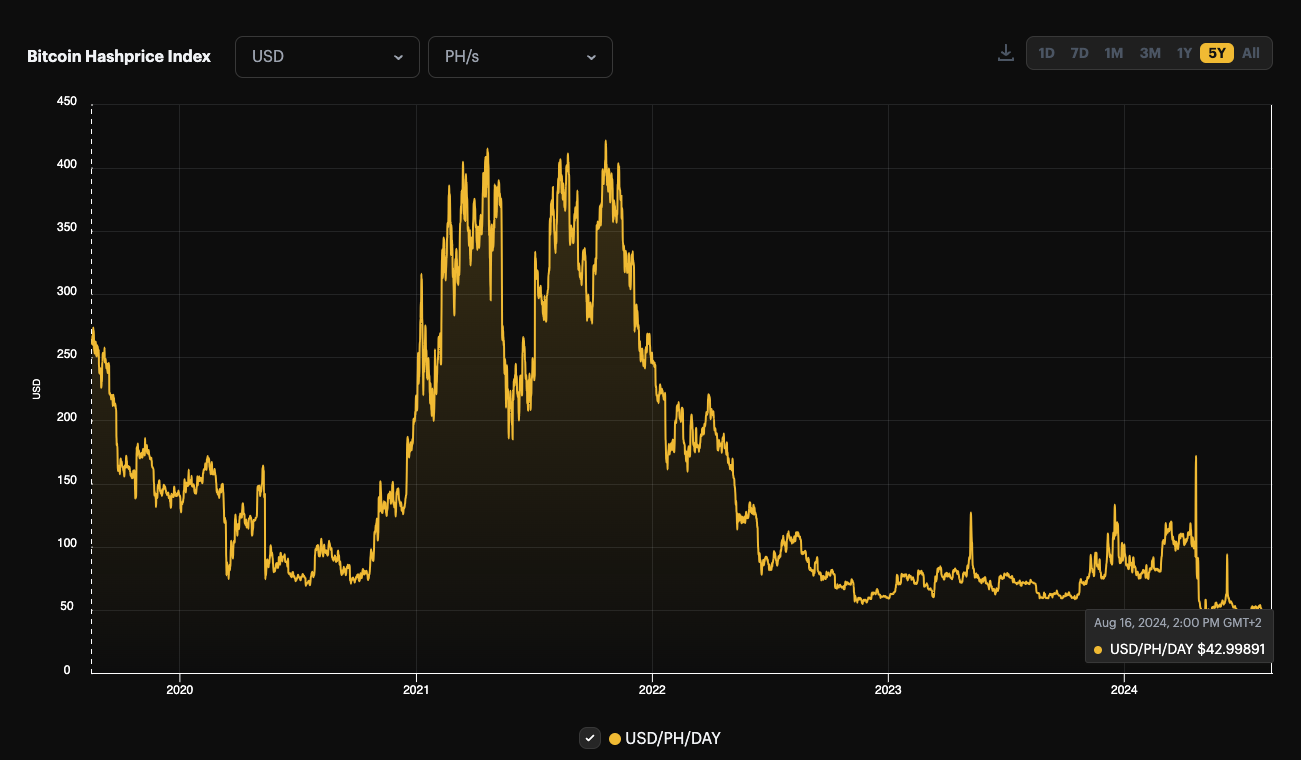
Miner profitability can also be expressed in terms of hash price. The hash price represents the reward per hash rate and is calculated using the current bitcoin exchange rate, the block reward plus fees, and the network's hash rate. The hash price is currently at an all-time low. While transaction fees spiked after the April 2024 halving, the impact was short-lived and fees have been trending lower since. The spike can be attributed to the launch of the Runes protocol, which coincided with the halving and was expected to increase activity on the bitcoin blockchain.
Since only those miners who successfully calculate bitcoin transactions are rewarded, competition among miners is high. To increase their chances of securing the block reward, miners invest in more specialized hardware to gain an edge over the competition. However, this is capital intensive and drives out smaller competitors and makes it harder to enter the space. This development leads to a centralization of computing power and thus a less decentralized network, weakening one of the main arguments for bitcoin as an independent currency.



Industry response and consolidation
In response to declining revenues, major players in the bitcoin mining industry are reevaluating their strategies. This can be seen in the behavior of miners. Many of them sold part their Bitcoin holdings prior to the halving, with the selling accelerating afterwards. Miners are also looking at other business areas such as artificial intelligence (AI). It has been reported that major miners such as Texas-based Applied Digital are moving into AI using their existing infrastructure. While the mining hardware itself cannot be used directly for AI computing, miners have a professional setup required for large-scale computing, such as cooling systems, security, and access to cheap energy that can be used.
Meanwhile, there is strong internal rivalry and competition to increase control of the hash rate. Riot Platforms, the third largest publicly traded bitcoin mining company, has increased its stake in rival Bitfarm by an additional 1 million shares, bringing its total ownership to nearly 19%. This follows an earlier proposal by Riot to acquire Bitfarm for $950 million, which was rejected. This reflects a trend of consolidation and competitive realignment in the cryptocurrency mining industry.
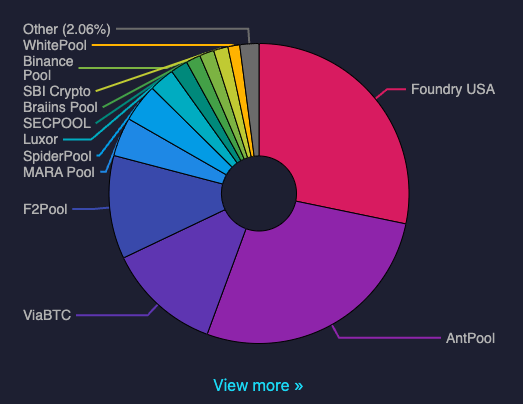
Mining pool centralization is also a growing concern, with just four pools controlling over 75% of the Bitcoin network’s hash rate. While joining a mining pool doesn’t inherently weaken the network, the pool operators can access sensitive data like IP addresses. This presents security risks, particularly in surveillance-heavy countries like China, where Antpool, the second-largest pool, is based. China’s dominance in the sector is driven by low electricity costs and its control over a significant portion of chip manufacturing. Notably, Bitmain, a major producer of Application-Specific Integrated Circuits (ASICs), controls 80-90% of the global chip supply.
Long-term viability
The block reward reduction raises the question how a sustainable and long term operation of the network can be achieved. Growing adoption and utility of the bitcoin network brings adequate transactions to sustain a fee market which can replace the block rewards. Rewards will hit zero around 2140, by then the bitcoin network will have to be significant enough to have miner revenue and network security rely solely on fees.
Also the network is facing increasing centralization risk. Single entities are controlling chip production, mining pools are consolidating and publicly traded mining companies are in takeover mode without new competitors in sight. These developments could impact Bitcoin’s security and decentralization. Further mining companies are turning to alternative areas such as AI, indicating waning belief and revenue. These financial difficulties, and decentralization threats currently facing the bitcoin ecosystem are significant challenges that require answers for a sustainable long-term adoption.