
For over a year, so-called Ordinal Inscriptions have allowed developers to create fungible tokens (BRC-20s) and non-fungible collectibles (NFTs) directly on the Bitcoin blockchain. On the day of the Bitcoin Halving, the creator of Ordinals will release his new, improved standard for fungible tokens: Runes.
Bitcoin (BTC) was the first blockchain-based system to transfer value across the internet in a decentralized manner. The Smart Contract functionality that lead to a wide array of applications (dApps) wasn't introduced until 2015, when the Ethereum network launched. As such, Bitcoin wasn't optimized for the creation of tokens built on top of it. This changed in December 2022, when developer Casey Rodarmor introduced the Ordinals protocol. In a similar vein, Rodarmor came up with an improved standard to create fungible tokens on top of Bitcoin, the Runes protocol. Unlike the existing BRC-20 standard, which imposes restrictions on token transfers, Runes promises greater simplicity and security. Its key feature is the ability to simultaneously transfer multiple tokens in a single transaction, ultimately improving the user experience and reducing complexity.
Will Runes have a similar effect on the Bitcoin network as Ordinals?
Rodarmor's previous project, Ordinals injected a fresh sense of innovation and sparked creativity within the Bitcoin ecosystem. The first cryptocurrency's blockchain is known to be more traditional and conservative, sticking to its core function of acting as a store of value. Ordinals are often compared to non-fungible tokens (NFTs) because they represent a unique object. The main difference with NFTs is that the smallest denomination of BTC currency, called Satoshis or "Sats", are tagged with metadata, typically an image file. This process is on-chain and does not rely on smart contracts or tokens other than Bitcoin.
Ordinals led to a massive increase in transactions on the Bitcoin blockchain, congesting the network. It did however have a positive effect on miners, who are responsible for verifying blocks of transactions, resulting in a $256 million revenue spike. Transaction fees are the second source of income for miners after block rewards. While network users experienced slow transaction times and high fees, miners earned more fees. With the upcoming launch of the Runes protocol, a similar effect on the Bitcoin network is expected.
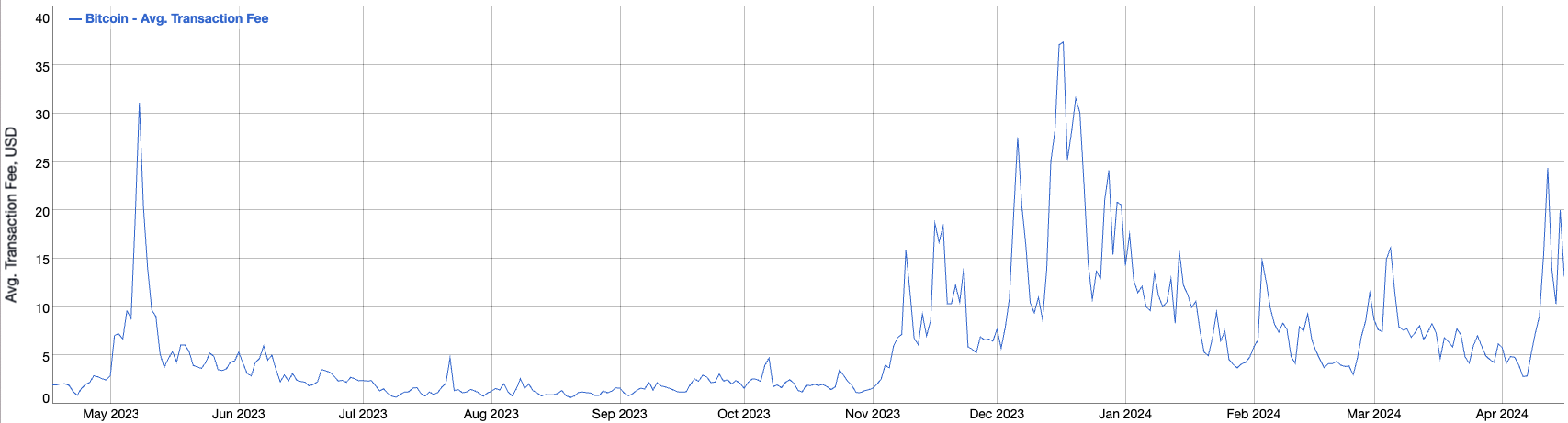
Average Bitcoin transaction fees / Source: bitinfocharts
Since its inception in December 2022, almost 70 million inscriptions have been minted on the Bitcoin network, generating nearly 4,000 Bitcoins in fees. High fees are necessary to keep miners active on the network, it's the motivation to support and protect the Bitcoin network. Since the upcoming halving reduces miners' block reward by 50%, the incentive for miners to secure the network becomes increasingly dependent on transaction fees. As Rodarmor put it: "Bitcoin's destiny is high fees." Increased activity on the Bitcoin blockchain would reduce the limited 1MB block space, thereby driving up fees and strengthening network security by incentivizing miners to validate transactions.



How the Rune protocol works
In a blog post from September 2023, Rodarmor lays out an initial framework for the Runes protocol. It allows the creation of cryptocurrencies on top of bitcoin. Similar to altcoins that are released on other chains such as Ethereum and Solana. According to Rodarmor, creating a fungible token protocol for Bitcoin can significantly increase transaction fee revenue and attract developers and users to Bitcoin, overall strengthening the platform. According to the developer, runes are mainly built for memecoins, indicating no utility. Given the Solana memecoin craze from the beginning of 2024, this could attract a large amount of liquidity to Bitcoin, but accounts for a more speculative, less technical investor group.
Runes were built for degens and memecoins, but the protocol is simple, efficient, and secure. It is a legitimate competitor to Taproot Assets and RGB.
The protocol is self contained and has no dependencies on ordinals or inscriptions, making it extremely simple.
Balances are…
— Casey (@rodarmor) April 1, 2024
The Rune protocol uses Bitcoin's so-called Unspent Transaction Outputs (UTXOs). UTXOs are a fundamental concept in cryptocurrencies and are used by Bitcoin, Litecoin, Cardano, Dogecoin and others. These unspent transaction outputs can be compared to loose change or bills in a physical wallet. To make a payment in BTC, you would use a combination of these UTXOs, just like using different bills and coins to get the exact amount you need. With the Runes protocol, these UTXOs can be used to generate tokens. A single UTXO can hold a balance of any number of Runes tokens, making it a UTXO-based fungible token protocol.
The pros and cons of Bitcoin Runes
Runes have the opportunity to shape post-halving trends. While they could build on the success of Ordinals, they also represent a potential breaking point in the Bitcoin community. Not everyone shares the same enthusiasm and excitement for future developments. Ordinals, for example, had led to some miners refusing to accept transactions containing inscribed Satoshis. These miners believed that Bitcoin should only be used as a currency, and that any other innovations to the network dilute its value and poses a threat to the network.
In general, it can be said that Runes would positively impact the Bitcoin blockchain in the following ways:
- Increase functionality: Runes pave the way for the development of custom tokens on top of Bitcoin, similar to what exists on blockchains like Ethereum and Solana. This opens the door for new use cases within the Bitcoin ecosystem.
- Increased popularity: With the new technology and use cases new investment products can be built on top of Bitcoin. This would increase the inflow of funds into the Bitcoin ecosystem and cause a price increase in addition to what has already been observed in the spot BTC ETF inflows.
- Financial reward for miners: The popularity of Ordinals led to a an increase in income for Bitcoin miners. Runes could have a similar effect, further incentivizing miners to secure the network.
While these are exciting possibilities, some potential drawbacks could be:
- Network congestion: Just like Ordinals, Runes could lead to network congestion, impacting transaction speeds and increase fees.
- Security concerns: As a new protocol, Runes are not battle tested and could hold potential vulnerabilities.
- Dividing the Bitcoin community: Introducing functionality beyond being a payment token, and thus deviating from Bitcoin's original vision, could cause the Bitcoin community to split apart.