
Nodes lie at the heart of the Bitcoin network, just as they do in any blockchain. They are essential for ensuring that the network functions in a decentralized, secure, and reliable way.
Bitcoin nodes are mentioned right from the opening of the Bitcoin whitepaper, published by Satoshi Nakamoto on October 31, 2008: “The system is secure as long as honest nodes collectively control more CPU power than any cooperating group of attacker nodes.” By entrusting the control and security of the Bitcoin network to a vast number of independent node operators distributed across the globe, Nakamoto found a way to prevent any single entity from taking over the system.
What is a node in Bitcoin?
A Bitcoin node is any computer that participates in the Bitcoin network by running the Bitcoin software and connecting to other nodes. There are several types of Bitcoin nodes: full Nodes, lightweight nodes (also known as SPV nodes, or Simplified Payment Verification nodes), and miner nodes. Full nodes are responsible for verifying and validating transactions and blocks, making them essential for maintaining the network’s security and decentralization.
They reject invalid transactions that don’t adhere to protocol rules and accept valid ones, then relay them to other nodes. For example, when someone sends Bitcoin, full nodes ensure that the sender’s wallet holds the necessary funds and isn’t attempting a double spend. Each full node stores the entire transaction history of the Bitcoin blockchain, which amounts to 500 GB as of 2025, and keeps up-to-date information on recent transactions. This allows them to validate new transactions based on historical data. Lightweight nodes, on the other hand, download only a portion of the blockchain and rely on full nodes for transaction validation. Additionally, the Bitcoin blockchain relies on miner nodes to create and propose new blocks.




The Block Size War: a defining moment for Bitcoin's decentralization
During the notorious Block Size War (2015–2017), full nodes played a central role, highlighting the importance of Bitcoin’s decentralized nature. This pivotal conflict centered on a proposed increase in Bitcoin’s block size to boost transaction throughput and scalability. While the idea had support from major industry players - including miners and executives from 58 prominent crypto companies who reached a private agreement known as the "New York Agreement" - it faced strong resistance from the broader community.
A large portion of full node operators rejected the proposal, refusing to run modified versions of the Bitcoin software that would implement the change. This episode underscored the importance of full nodes as the final arbiters of Bitcoin’s rules, defending the protocol from centralizing influences and safeguarding its foundational principles. The Block Size War cemented Bitcoin’s decentralized governance model, ensuring that protocol changes reflect the will of the wider community and strengthening the network’s resilience against external pressures.
Distribution of Bitcoin nodes and their role in censorship resistance
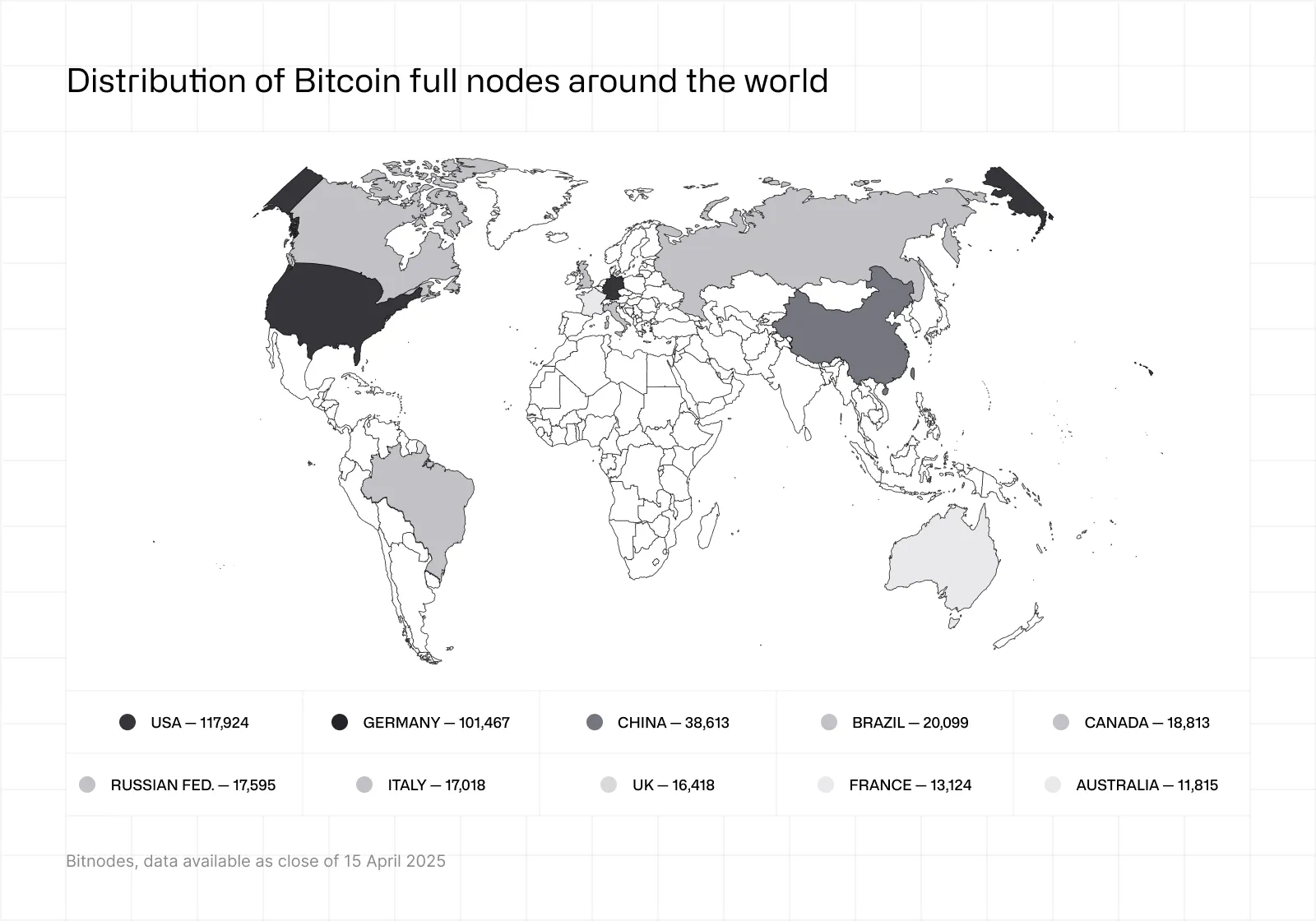
As of April 15, 2025, the reference site Bitnodes reported 543,025 active Bitcoin nodes over the previous 90-day period, with this number fluctuating daily. They were spread across no fewer than 181 countries - virtually the entire world, given that there are 197 countries on the planet. The United States had by far the highest number of active nodes, with 117,924, followed by Germany, China, Brazil, Canada, and Russia. At the city level, German cities dominated the top four spots, with Berlin leading, followed by Munich, Hamburg, and Frankfurt.
Interestingly, some countries had only a single known node, including Peru, Algeria, Cambodia, Uzbekistan, and perhaps most surprisingly, El Salvador - the first country to officially adopt Bitcoin as legal tender. However, It’s important to note that these figures may underestimate the true number of nodes. Many nodes may be private, hidden, or unresponsive, meaning they are not visible on public trackers.
How do I run a node?
The good news is that anyone can run a node, as it requires only a decent laptop or desktop hardware and a minimal level of technical knowledge. It is possible to get set up for under 150 USD or simply use your regular computer. All you need is 4GB of RAM, 500GB of storage, and, most importantly, a reliable internet connection without a data cap to get started.
One of the most popular devices among node operators is the Raspberry Pi, which is one of the cheapest options on the market. And there's no need to be an IT expert, as many tutorials are available online. In terms of time, running the node requires a minimum of 6 uptime per day, although continuous operation is ideal. Most full nodes operate Bitcoin Core, the reference client developed and maintained by Bitcoin's core developer community. This not only helps standardize network rules but also ensures protocol consistency across the entire network.
Conclusion
The distribution of nodes across a blockchain network is a critical factor in ensuring its integrity and security. In the Bitcoin ecosystem, one of the most feared scenarios is a 51% attack - an event where a single entity gains control of the majority of the network’s computational power or nodes. Such dominance would enable the attacker to censor or reverse transactions, and potentially rewrite parts of the blockchain’s history, severely undermining its credibility and trust. A well-distributed node network provides a strong defense against these risks. It strengthens the blockchain’s resilience, promotes transparency, and upholds decentralized governance. Ultimately, widespread node distribution is what enables the blockchain to deliver on its foundational promise: a system free from centralized control.