
Close Menu
Crypto Valley Journal
    Facebook X (Twitter) Instagram
    Crypto Valley Journal
    • Hot Topics
      • News
      • Minds
    • Focus
      • Background
      • Blockchain
      • Legal & Compliance
      • Non-Fungible Token (NFTs)
    • Investing
      • Markets
      • Financial Products
      • Decentralized Finance (DeFi)
      • Exchange overview
    • Education
      • Basics
      • Glossary
      • Politicians on crypto
    • Statistics
      • Bitcoin-ETF-Flows
      • Ethereum-ETF-Flows
      • Crypto market data
      • On-chain data
    • Academy
      • Overview
      • Part 1: Blockchain
      • Part 2: Money
      • Part 3: Bitcoin
      • Part 4: Cryptocurrencies
      • Part 5: Decentralized Finance
      • Part 6: Investing
    • English
      • Deutsch
    Crypto Valley Journal
    You are at:Home » Focus » Background » Crypto at US banks: plenty of momentum, but no mass-market offering yet
    Krypto bei US-Banken: Viel Bewegung, aber noch kein Massenangebot

    Crypto at US banks: plenty of momentum, but no mass-market offering yet

    By Editorial Office CVJ.CH on 14. January 2026 Background

    In recent months, headlines about Bitcoin ETFs, institutional inflows, and new crypto initiatives by major US banks have become increasingly frequent. At first glance, this creates the impression that cryptocurrencies are on the verge of being fully integrated into the traditional banking system. A closer look, however, reveals a different picture: custody and trading services remain highly limited - and are typically reserved for a very small client segment.

    Despite growing regulatory clarity and an expanding range of ETF products, most major US banks still do not offer broad-based crypto custody or active trading. Where services do exist, they are almost exclusively aimed at wealthy or institutional clients. For the mass market, access via banks remains the exception rather than the rule.

    Subscribe to our newsletter

    The best articles of the week, directly delivered into your mailbox.

    How many banks actually offer crypto custody?

    An overview of the 25 largest US banks clearly illustrates how limited the current offering remains. Only a handful of institutions provide crypto custody at all, and even then usually in a restricted form. PNC is among the few banks that have already actively rolled out custody services. Other institutions such as Citi, Fifth Third, or State Street are still in the review or announcement phase. At many large banks - including JPMorgan, Bank of America, Wells Fargo, or Goldman Sachs - crypto custody is either not available at all or is restricted exclusively to ultra-high-net-worth clients. For retail customers, there is virtually no direct access in practice.

    A similar picture emerges in crypto trading. While some banks have announced that they are exploring or planning related services, the user base remains very small. Citi, Wells Fargo, Goldman Sachs, and Morgan Stanley primarily provide crypto exposure through structured products or limited trading offerings - almost exclusively for very wealthy clients. Even at JPMorgan, which is publicly evaluating the option of offering direct crypto trading to institutional clients, these remain assessments rather than a broadly available product. For the majority of bank customers, direct trading of cryptocurrencies continues to sit outside the traditional banking offering.
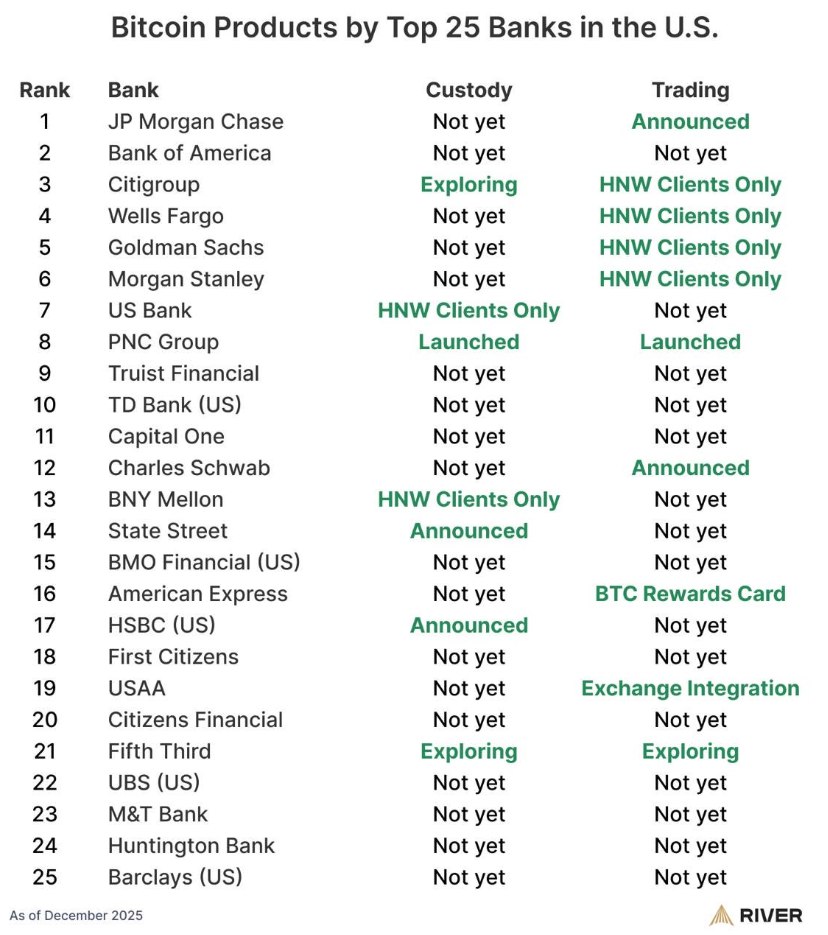

    Bitcoin adoption among the top 25 US banks Source: River
    Ray Dalio’s Bridgewater Associates Minds

    Star investor Ray Dalio considers Bitcoin inferior to gold

    Most crypto cards hide who issues them. After mapping the licensed issuers, here is why Switzerland's self-issuing model reads differently. Background

    The bank you never chose: who really issues Switzerland’s crypto cards

    Robinhood Perpetual Futures in Europe now cover commodities and currencies, and the broker plans a crypto launch in the United Kingdom. Financial Products

    Robinhood Perpetual Futures expand to commodities in Europe

    Digital finance transparency relies on Proof of Reserves, Merkle trees, MPC custody and 24/7 monitoring to verify solvency and user assets. Basics

    Transparency as the foundation of security in digital finance

    Ray Dalio’s Bridgewater Associates Minds

    Star investor Ray Dalio considers Bitcoin inferior to gold

    Most crypto cards hide who issues them. After mapping the licensed issuers, here is why Switzerland's self-issuing model reads differently. Background

    The bank you never chose: who really issues Switzerland’s crypto cards

    ETFs create access - but not infrastructure

    A key driver behind the perceived momentum is the launch of spot Bitcoin and Ethereum ETFs. While these products provide regulated exposure for institutional and retail investors, they do not replace custody or trading infrastructure within banks themselves. ETFs are balance-sheet investment products, not operational crypto services. Banks can offer them without having to deal with wallet custody, on-chain risks, or operational processes. This explains why ETF inflows are rising while custody and trading offerings show little growth.

    Even in a macroeconomic context, crypto remains small. The total cryptocurrency market currently stands at around USD 3 trillion. By comparison, real estate markets are estimated at USD 400 trillion, the global bond market at roughly USD 145 trillion, and gold at around USD 30 trillion.
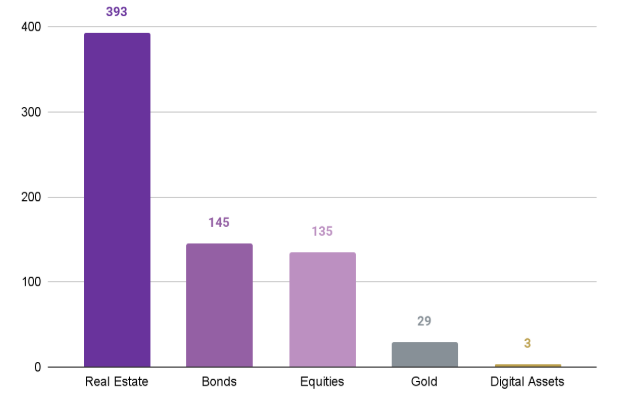
    Market capitalisation of leading asset classes / Source: Digital Asset Solutions AG

    Why banks are hesitant

    The reluctance is not primarily technical in nature. Instead, regulatory uncertainties, liability issues, custody risks, and capital requirements play a central role. From a banking perspective, custody is significantly more complex than ETF distribution, as it involves operational responsibility and direct interaction with on-chain assets.

    Despite growing attention, ETF success, and political debate, the crypto market has not yet reached the mainstream within the US banking system. Custody and trading are either not offered at all by most major banks or are limited to very wealthy clients. Current developments are less a sign of immediate mass adoption and more indicative of a gradual, cautious process of engagement.


    Share. Facebook Twitter LinkedIn Email Telegram WhatsApp

    About the author

    Editorial Office CVJ.CH
    • Website
    • Twitter
    • LinkedIn

    Since 2018, the editorial team at Crypto Valley Journal has been reporting from Zug - the heart of Switzerland’s Crypto Valley - on Bitcoin, cryptocurrency, blockchain, and regulatory developments in digital assets. Behind the publication’s collective editorial voice is a team of writers with backgrounds in financial markets, law, and technology.

    Related Articles

    Most crypto cards hide who issues them. After mapping the licensed issuers, here is why Switzerland's self-issuing model reads differently.

    The bank you never chose: who really issues Switzerland’s crypto cards

    18 percent hold crypto assets in Switzerland, an IFZ and LUKB study shows. Banks see potential for up to 1 million advisory clients.

    HSLU and LUKB study: 18% of the Swiss population hold crypto assets

    The four-year Bitcoin cycle remains intact

    CVJ Weekly review
    11. July 2026

    Weekly review: 80mn bank customers in Germany gain access to crypto

    The US banking regulator OCC grants Circle National Trust final approval to operate as a federal trust bank for digital assets.
    10. July 2026

    OCC grants Circle National Trust a bank license

    JPMorgan ranks Strategy's sales below the bigger Bitcoin risk and names tokenization beyond public chains as the real threat.
    10. July 2026

    JPMorgan sees biggest Bitcoin risk beyond Strategy

    twitter image button instagram image button linkedin image button youtube image button

    About Crypto Valley Journal
    About Crypto Valley Journal

    On the pulse of the movement

    • Academy
    • Contact
    • Advertising
    • About us
    • Partner
    • Imprint
    • Privacy
    • Disclaimer
    Search

    Type above and press Enter to search. Press Esc to cancel.