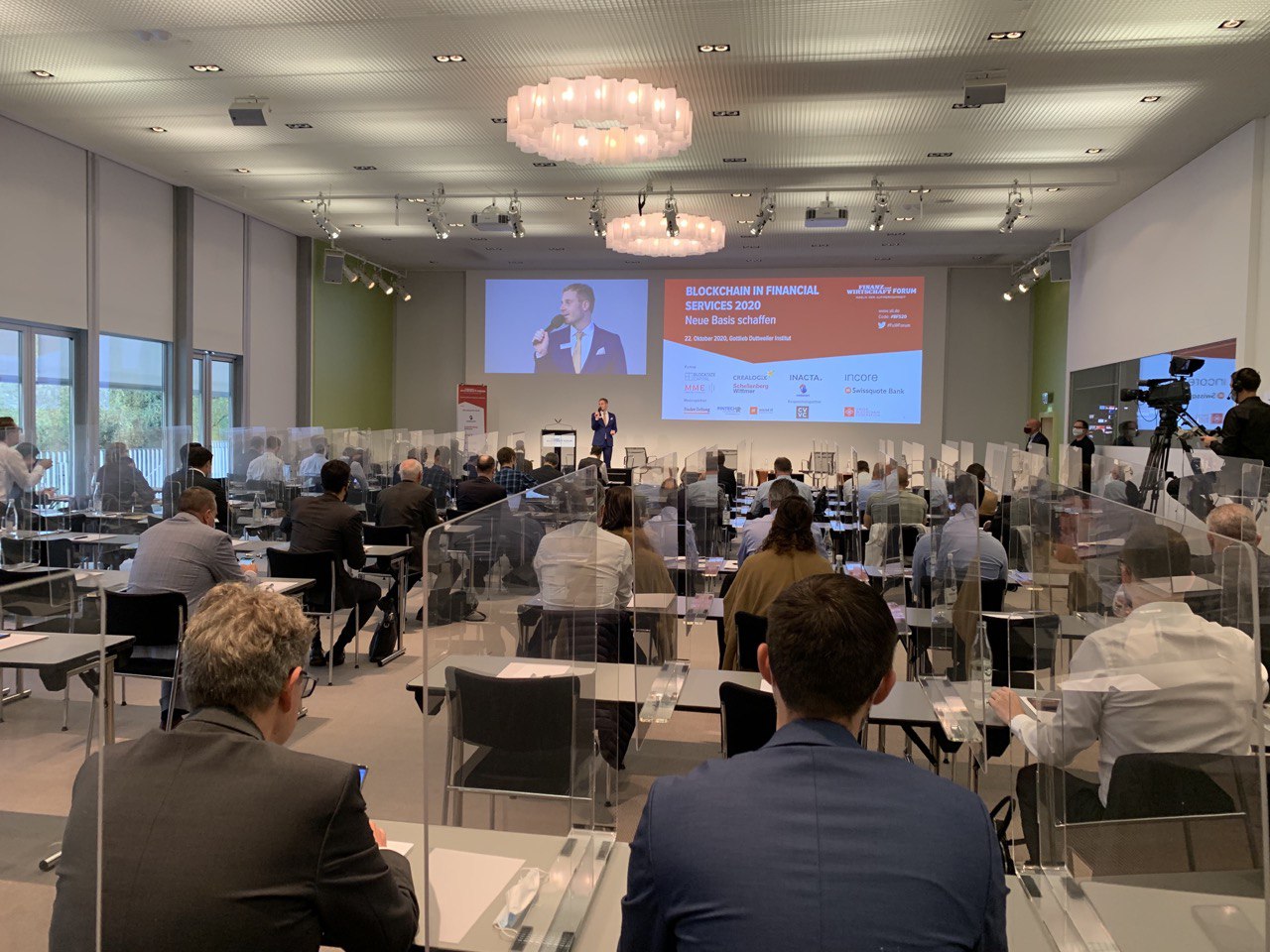
Yesterday, the Finanz und Wirtschaft Forum took place on the topic of blockchain in financial services. A wide range of topics were covered, from CBDCs to crypto currencies and their regulation, and the tokenization of things like real estate.
Below are insights straight from the Forum:
The event took place at the Gottlieb Duttweiler Institute, and was held as part of the Finanz und Wirtschaft Forum. Under the topic "Blockchain in Financial Services 2020", speakers from various parts of the financial sector addressed important questions. Sébastien Kraenzlin explained the view of the Swiss National Bank (SNB) on digital central bank currencies (CBDCs). In five workshops, different companies presented various blockchain use cases. Mark Branson, CEO of FINMA, presented the risks from the perspective of the financial market supervisory authority, and more. This was a very exciting event, with a very diverse selection of topics. In the context of this article, we will only cover two topics.
Tokenization
Asset tokenization enables the use of smart contracts to automate processes such as settlement, compliance, distribution and reporting. Global transferability, 24/7 markets, and partial ownership of assets will improve accessibility for investors. Assets such as real estate, private equity and works of art can gain liquidity through tokenization, with increasingly easy transferability.
The first use case of tokenization was discussed by Prof. Dr. Michael Trübestein (Lucerne University of Applied Sciences and Arts) and Bastiaan Don (Token Factory). The "Hello World" project was the first to bring part (20%) of a property to the blockchain, and distribute it digitally. This trade was not only completely digital, but also completely transparent and can still be viewed today on the Ethereum Blockchain.
The project was a pilot project in cooperation with Swiss Crypto Tokens and FINMA. It was intended to be a first step towards the digitization of real estate trading, and brought to light important questions: How can trading places with sufficient liquidity for the corresponding tokens be ensured? Can the full potential of a blockchain be used with today's legal complexity? Is the market mature enough for tokenization projects, or are we still far from it?
The interactive workshop of Inacta AG and InCore Bank also focused on the many opportunities and challenges that asset tokenization presents. There is undoubtedly a large number of assets that could be made available to a much broader audience - especially retail investors - through digital representation on the blockchain. However, the design of such a token is complex, as there are numerous details to consider. The Finka project, for example, is the result of the cooperation between the two companies. The tokenization of a cattle farm in Bolivia using security tokens.
Regulation of Blockchain and Stablecoins
In almost all of the presentations, discussions and workshops at the Forum, it became very clear how important the regulatory framework is for this new industry. This is precisely why the presentation by Mark Branson, Director of the Swiss Financial Market Supervisory Authority (FINMA), was particularly impressive. FINMA was one of the world's first regulatory authorities to be open to, and pave the way for blockchain technology. Branson is also convinced that new innovations are needed in the financial sector due to high transaction costs and a lack of transparency.
"In the financial sector, the lighthouse project for the DLT technology, which proves that this will revolutionize the global financial market, is still missing." - Mark Branson, CEO FINMA.
Finally, the new private blockchain projects should follow the same rules as their traditional counterparts. Private stablecoin projects like Libra and Co. also have to adhere to them. The issues of security, compliance and client protection are particularly important to FINMA. Branson was generally very open to blockchain projects, and believed that they could compete with traditional means of payment on these points. Nevertheless, he personally thinks that there is still a lot to do.