Within the last few days, news circulated in parts of the XRP community that JPMorgan had adopted XRP as a settlement currency or entered into a partnership with Ripple. However, the official announcement does not support that interpretation.
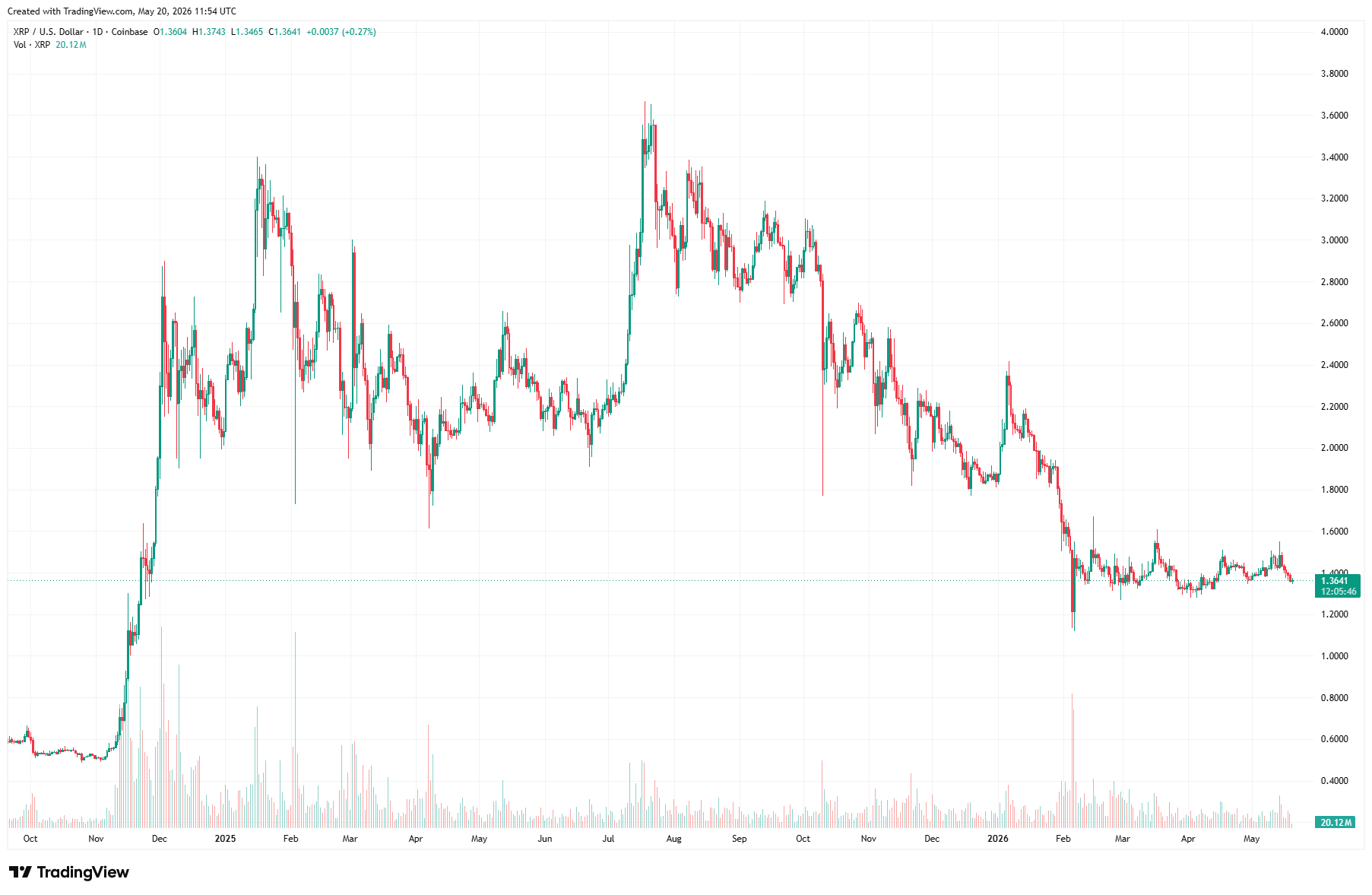
What is described is a one-time pilot in which Ondo Finance, Kinexys by J.P. Morgan, Mastercard and Ripple settled a tokenised US Treasury bond across borders. In this transaction, XRP served solely to cover minimal network fees. As a result, the XRP price reacted in a correspondingly muted manner. On the day of the announcement, the token traded around 1.42 USD, up roughly 1% on a daily basis. Anyone seeing institutional settlement adoption priced in would have to expect a different reaction.
What the pilot was, and what it was not
The participants completed the asset leg of the transaction in under five seconds, outside regular banking hours. By comparison, a similar cross-border settlement via correspondent banks typically takes one to three business days. That is the actual point of the exercise. Furthermore, it is the only point that is undisputed.
Between the official press release and the community reading, there is a semantic gap. For example, several media outlets initially used the term "settlement" in the technical sense of transaction clearing. In forums and on social networks, however, users sometimes read this as a legal settlement or a formal partnership, an echo of the recurring rumour patterns around XRP. In reality, this was a one-time pilot, not a production integration. JPMorgan is not migrating its operations to the XRP Ledger. Moreover, no partnership tie to Ripple exists in any publicly documented sense beyond this pilot.
The crucial distinction lies between the XRP Ledger and the XRP token. The actual asset leg ran via RLUSD, Ripple's dollar stablecoin. As a result, RLUSD embodied the economic value in the transaction. XRP itself only carried the network fees, a contribution in the cent range per transaction. Therefore, for demand for the token, such a configuration means little.
How the pilot transaction was executed
The test connected five components. First, Ripple redeemed OUSG holdings on the XRP Ledger, after which Ondo initiated the fiat payout via Mastercard's Multi-Token Network (MTN). Then, MTN forwarded the instruction to Kinexys, and JPMorgan's tokenisation platform debited Ondo's Blockchain Deposit Account. At the end of the chain, the USD amount reached Ripple's bank account at DBS Bank in Singapore.
OUSG is Ondo's tokenised product for short-dated US Treasury bonds. Furthermore, it is based on BlackRock's BUIDL fund and is active on Ethereum, Solana, Polygon and the XRP Ledger. On the XRP Ledger, around 2.8 million OUSG tokens are in circulation, which corresponds to a monthly transfer volume of about 101 million USD. The total volume of OUSG stood at around 680 million USD on 9 May; in addition, Ondo's Total Value Locked exceeded 3 billion USD for the first time in April.
Ondo Finance Total Value Locked (TVL) / Source: DeFi Llama
The hybrid character of the settlement remains noteworthy. The asset side runs publicly on-chain, while the fiat clearing takes place in the conventional banking system via Kinexys. Anyone reading this configuration as a migration overestimates the binding nature of a pilot. Instead, a more realistic reading is that of an interoperability model between private banking infrastructure and a public blockchain.
For JPMorgan, the step is bigger than for Ripple
In this pilot, it is not Ripple but JPMorgan that makes the most interesting break with prior practice. Kinexys, formerly Onyx, has operated exclusively on private infrastructure since its launch in October 2024, processing transactions worth more than 3 trillion USD since then. As a result, the link-up with Ondo, Mastercard and Ripple marks the first publicly documented interaction between Kinexys and a public blockchain outside its own network. For a bank that favoured its own private chain for years, this is a notable break with the previous line.
For Ripple, the gain lies primarily in visibility. The XRP Ledger appears as a technical settlement layer in a transaction with three heavyweights of financial infrastructure. On the economic level, however, the effect for XRP holders remains limited. Without structural demand for the token from this kind of settlement, no direct price impulse emerges. Moreover, market action confirms this interpretation.



Tokenised Treasuries become the standard RWA class
Tokenised US Treasury bonds have become the dominant Real-World-Asset category in the current cycle. On 11 February, market volume exceeded 10 billion USD for the first time, and in early April it stood at around 12.88 billion USD. As a result, this corresponds to growth of 225% in 15 months. In addition, BlackRock's BUIDL forms the institutional basis for several products, including Ondo's OUSG.
In 2026 so far, Ripple has publicly announced roughly ten major institutional partnerships, including with Deutsche Bank (1.6 trillion USD AUM) and Mastercard (9 trillion USD payment network). Furthermore, DTCC plans to launch its own tokenisation service later this year. The movement is running less through XRP as a token and more through the XRP Ledger as a settlement layer and through RLUSD as a regulatorily acceptable dollar token. For institutional compliance, precisely this combination is relevant: a stable, audited stablecoin on a public, high-performance chain.