Dogecoin, the world’s biggest memecoin, is now in the sights of Qubic, an AI-focused blockchain community that recently pulled off a 51% attack on Monero.
Normally, no single miner holds enough power to compromise a network, but with majority control, attackers can outvote the rest and destabilize confidence. Qubic’s announcement rattled the Dogecoin community, pushing DOGE down 5% within 24 hours. Should Dogecoin investors be worried?
First, understand what exactly Qubic is, and what they want
Qubic is an AI-focused blockchain built on a model it calls Useful Proof-of-Work (UPoW). Unlike traditional mining, which only secures the blockchain, Qubic’s approach also contributes to AI research.
The goal is to make mining do more than solve cryptographic puzzles by both securing blockchains and advancing AI simultaneously. Qubic frames this as a path toward an “AI that belongs to everyone,” built transparently and powered by distributed computing power, rather than a single corporation.



So, how did Qubic attack Monero?
To show its model could work at scale, Qubic recently ran an experiment on Monero, a privacy-focused cryptocurrency. During the test, Qubic claimed control of 51% of Monero’s mining power and briefly reorganized six blocks.
While presented as a “demonstration,” the move triggered fears of a real 51% attack, causing Monero’s price to drop 6% in a single day and 16% over the week, and prompting exchanges like Kraken to temporarily suspend deposits.
Qubic’s approach increased miner profits by pairing Monero rewards with QUBIC token burns, drawing in significant mining power. Some, however, question whether it ever truly gained majority control, calling it more of a marketing stunt. Still, the demonstration showed Qubic can temporarily redirect substantial mining resources and create a real market impact in the process.
Now, why is Qubic going after Dogecoin next?
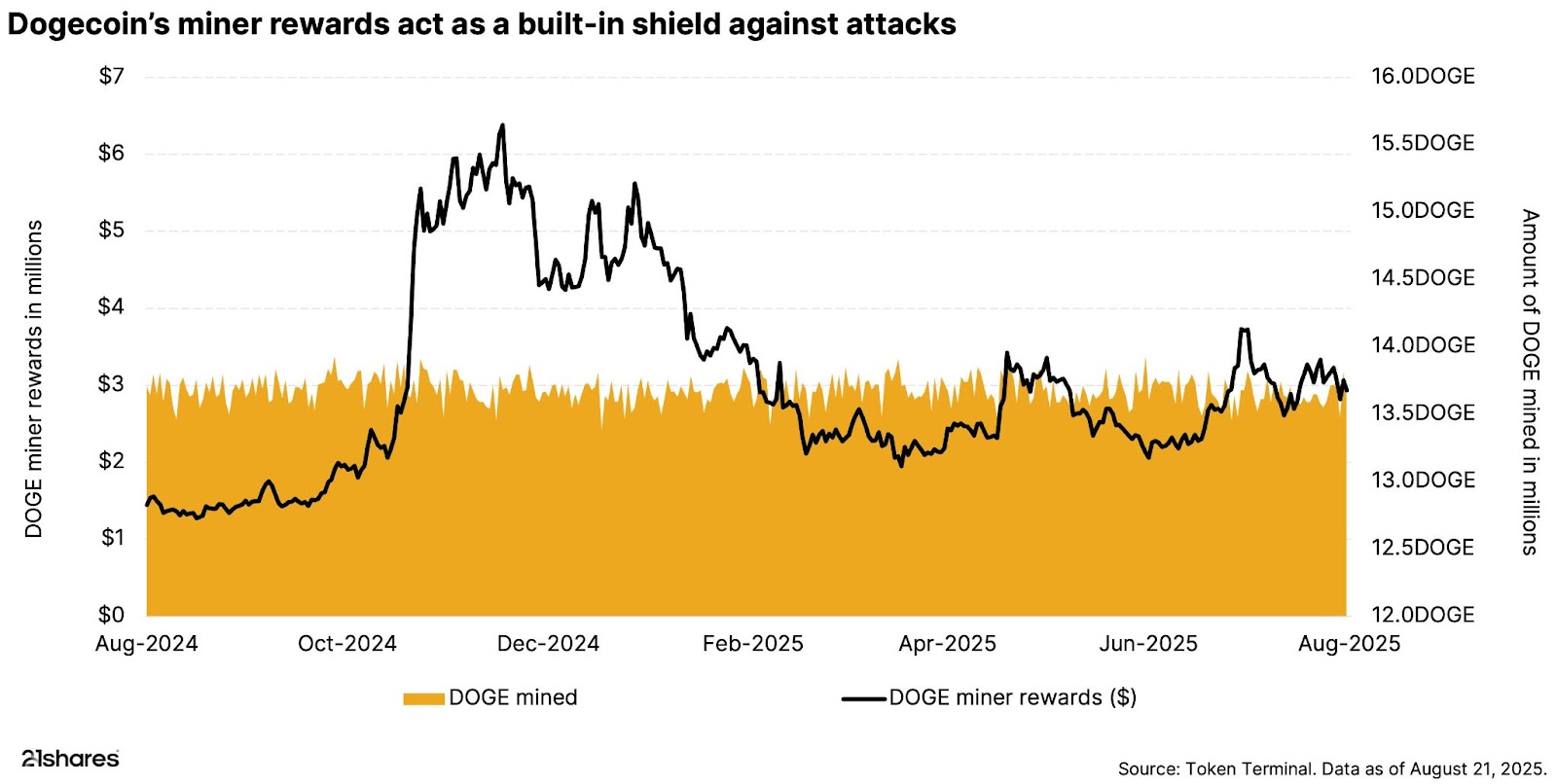
After the Monero experiment, Qubic’s community decided to turn its attention to Dogecoin. The logic is straightforward: Dogecoin isn’t just the biggest memecoin; it’s also a major proof-of-work network with a strong economic footprint. Each block produces 10'000 DOGE, with roughly 14.4 million DOGE (3.4 million USD) mined daily. Even redirecting a small portion of this reward flow into QUBIC burns could greatly boost Qubic’s economic model.
…But attacking Dogecoin is not a joke
That said, Dogecoin’s network is very different from Monero’s, making it much harder to attack. Here’s why:
Dogecoin’s hashrate is now at an all-time high of roughly 2.78 PH/s, reflecting the massive computing power that keeps the network secure. In proof-of-work systems, the higher the hashrate, the tougher it is for any single party to gain majority control.
For Qubic to pull off a brute-force 51% attack, it wouldn’t be enough to just add 1.39 PH/s (51% of Doge’s 2.78 PH/s hashrate). Without any existing ASIC mining power, Qubic would need to match the entire 2.78 PH/s of Dogecoin and then surpass it to achieve a majority. That translates to roughly 2.85 billion USD in hardware plus 2.5 million USD per day in electricity, not even counting housing and logistics. Such costs make a direct attack virtually impossible.
The vampire mining approach
Qubic’s “vampire mining” is a strategy where it doesn’t try to overpower a blockchain directly (like in a 51% attack). Instead, it attracts or redirects existing miners from the target network to mine in a way that benefits Qubic’s system.
The Monero example wasn’t about controlling the network; it was about making mining through Qubic more profitable than mining alone. By offering higher rewards, Qubic enticed miners to shift their hashpower.
The question now: could the same strategy work on Dogecoin? Several obstacles make this far less likely:
- Scale of incentives: Monero’s hashrate was measured in gigahashes; Dogecoin’s is measured in petahashes. Incentives that reportedly would have cost Qubic 75 million USD per day on Monero would balloon on Dogecoin, given that it boasts 500,000 times the hashrate.
- Hardware incompatibility: Qubic’s UPoW is CPU/GPU-oriented, but ASICs dominate Dogecoin mining. Qubic cannot simply spin up a pool and contribute; it would need existing ASIC miners to defect.
- Miner distribution: Dogecoin’s hashrate is spread across multiple pools. The top five control ~75% of the network (similar to Bitcoin), persuading enough of them to switch en masse is unlikely.
- Institutional anchors: Entities with heavy investments in Dogecoin ASIC infrastructure, such as the recently announced 50M USD acquisition of Dogehash by Thumzup, have little incentive to jeopardize long-term value for short-term payouts.
- Community loyalty: Dogecoin’s grassroots culture, which helped it grow from meme to movement, makes mass defection culturally unlikely, particularly seeing as miners have enjoyed over 1B USD in block rewards over the last year.
What should investors keep in mind?
Qubic’s Monero demonstration proved that markets can react sharply when proof-of-work security is challenged, showing how outside incentives can redirect mining power and shake confidence.
For Dogecoin, however, the risk looks far lower. Its massive hashrate, ASIC-driven hardware, diverse mining pools, institutional backing, and strong community loyalty all serve as robust defences, making a successful Qubic attack highly unlikely.