Imagine owning a slice of a luxury villa in Bali, a share of gold in a Zurich-based vault or exposure to US Treasuries – all from your phone, in minutes, no broker required. That’s the promise of RWA tokenisation.
Once reserved for institutional giants and high-net-worth individuals, assets like real estate, bonds and commodities are now being transformed into blockchain-based tokens, making them globally accessible, available 24/7 and instantly liquid.
- Real-world asset (RWA) tokenisation converts tangible assets like real estate, gold, and treasuries into blockchain-native tokens with built-in Know Your Customer (KYC), custody and compliance.
- Major institutions, including BlackRock, JPMorgan and Visa are driving adoption alongside crypto-native protocols like Ondo and Centrifuge.
- Ethereum, Solana and Avalanche provide the mature infrastructure needed to issue tokenised assets, ensuring scalability and security.
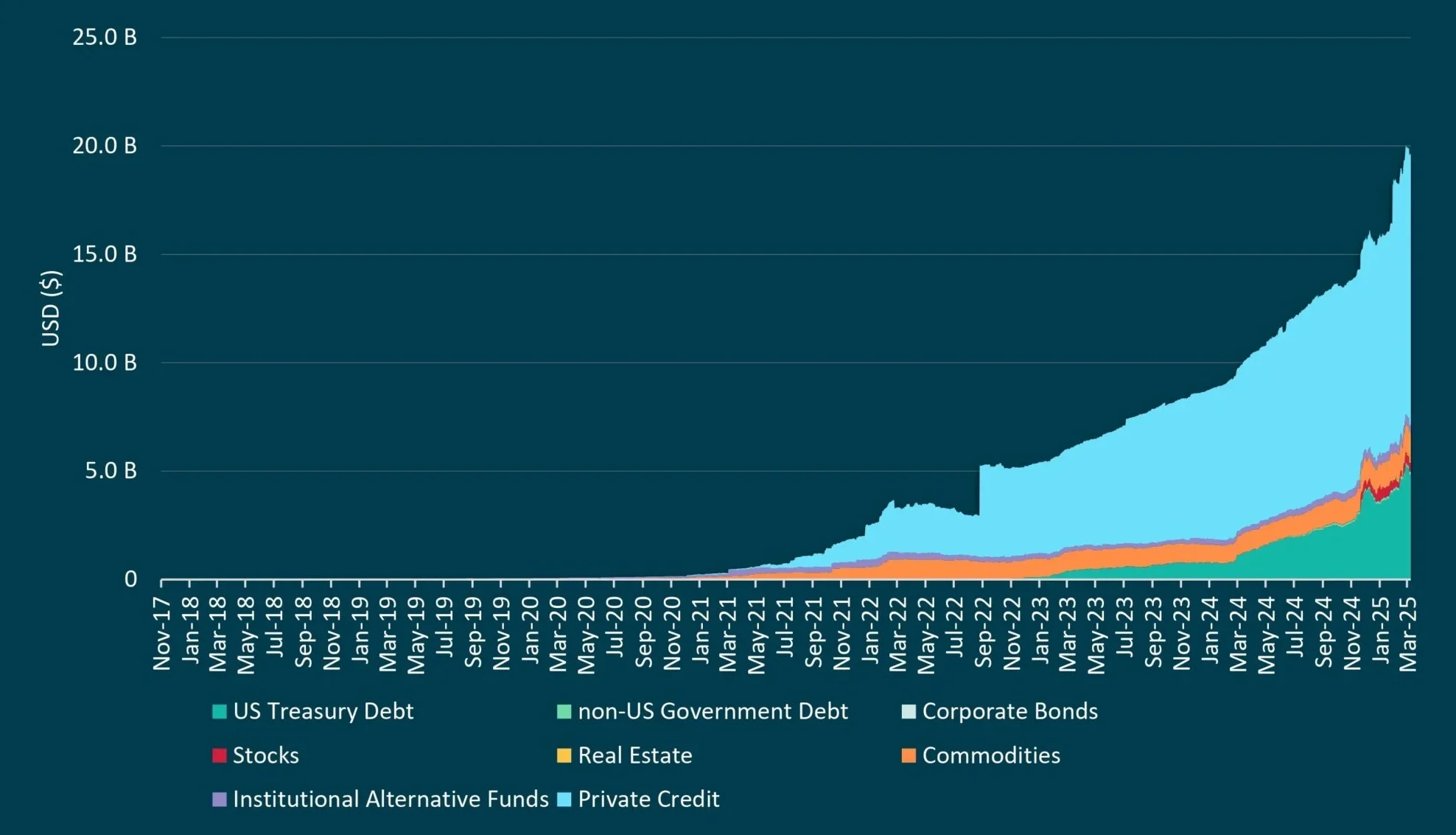
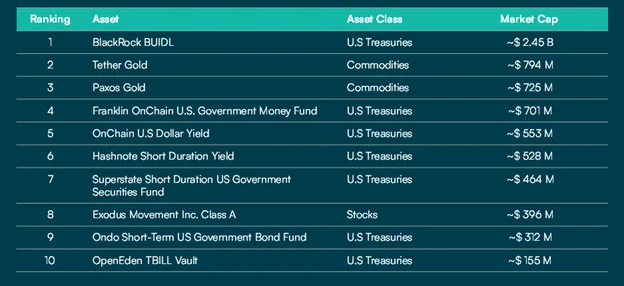
- RWA platforms currently hold over 10 billion USD in value, excluding stablecoins with BlackRock’s BUIDL fund leading the way at approximately 1.95 billion USD.
- RWA infrastructure is maturing with advances in blockchain tech, enabling deeper integration with decentralised finance (DeFi).
- What’s next? The markets are evolving in a way that may support an evolution toward tokenised Exchange-Traded Funds (ETFs), bonds and real-world collateral that can be natively used in DeFi ecosystems in the foreseeable future.
The rise of real-world assets (RWAs)
Real-world assets (RWAs) are quickly becoming a foundational pillar of blockchain adoption, driving the convergence of traditional finance and decentralised infrastructure. What was once a niche seems to be becoming central to the future of global capital markets. Institutions like BlackRock, HSBC and JPMorgan are now actively exploring blockchain infrastructure to tokenise a broad range of assets, from US Treasuries to private credit markets. Governments, too, are joining in: Hong Kong’s Monetary Authority issued tokenised green bonds on-chain; Singapore’s Project Guardian is piloting tokenised government securities; and the UK’s Debt Management Office has explored blockchain-based settlement for sovereign debt instruments.
Meanwhile, crypto-native platforms like Ondo Finance and Centrifuge are pushing the boundaries of innovation. They’re building specialised protocols that allow users to invest in tokenised debt – essentially lending in a digitised, transparent format – and yield-generating assets that offer the potential for compounding returns, all without traditional financial intermediaries.
But how did we get here and where is this all heading? Let’s explore the evolution of RWA tokenisation, the technology driving it, the regulatory frameworks taking shape and why this trend could unlock one of the biggest shifts in global finance this decade.
The spark: early experiments (2015 to 2018)
Tokenising RWAs began as a bold idea: what if physical assets could be represented on a blockchain? Early pioneers like Digix launched gold-backed tokens on Ethereum. Projects like Harbor and Polymath started building tokenised securities that acted as digital shares of real-world companies.
In 2018, a Manhattan condo was tokenised on Ethereum. Investors could now buy fractional ownership in real estate through blockchain. This proved that tokenisation was no longer just theoretical.
Building momentum: from real estate to debt (2019 to 2020)
By 2019, platforms were enabling ownership of small amounts of a broad range of assets from property to invoices. Simultaneously, institutions began testing tokenised corporate bonds. The narrative began to shift from “what if” to “what next?”
DeFi’s rise in 2020 accelerated this shift. Tokenised assets could now be used as collateral in lending, integrated into yield strategies and traded 24/7. RWAs became active components of decentralised ecosystems.
When tech started to catch up (2021 to 2022)
Blockchain trailblazers like Solana helped in advancing this concept further. Smart contracts automated ownership and payouts. Oracles like Chainlink provided real-time pricing. Institutional custody solutions improved trust. RWA tokenisation evolved from concept to robust financial product.
How it works: turning real-world assets into tokens
The first step is identifying an asset, such as property, commodities, credit portfolios or sovereign bonds. Legal checks and valuations are performed upfront. The asset is broken into various pieces like digital tokens, each representing ownership. These are minted on blockchains like Ethereum, Solana or , chosen based on speed, cost and compliance features.
Compliance is required from the get-go. Investors must complete KYC and AML checks. Licensed custodians safeguard the assets. Smart contracts automate ownership, payouts and collateralisation. Once issued, RWA tokens can trade on centralised and decentralised platforms. Some list on regulated exchanges. Others integrate into DeFi. Investors may earn passive income via rent, interest or DeFi yields.
The new market landscape: key players and emerging trends
Protocols and platforms are driving the RWA revolution across verticals. Ondo Finance operates a protocol that tokenises US Treasuries, bringing fixed-income exposure to the blockchain. Centrifuge is transforming private credit markets by enabling loans and invoices backed by real-world assets. Maple Finance is opening access to tokenised private credit in decentralized markets.
BlackRock’s BUIDL fund, which tokenises short-term Treasuries on Ethereum, underscores how seriously certain institutions are approaching this space. Traditional finance isn’t far behind. Franklin Templeton and WisdomTree have launched tokenised funds, JPMorgan is piloting on-chain collateral and Visa is exploring how tokenised yields can be integrated into payment systems. Real-world assets now sit at the intersection of TradFi and DeFi – offering liquidity, transparency and programmable ownership like never before.
Regulatory roadblocks and compliance hurdles
Despite the momentum, legal and regulatory considerations remain. Know Your Customer (KYC) and Anti-Money Laundering (AML) regulations are mandatory in most jurisdictions. In the US, the SEC and FinCEN require platforms to follow identity verification rules. December 2024, brings harmonised digital asset regulation to the region. Singapore and the UAE lead with innovation-friendly policies while maintaining rigorous compliance.
However, the classification of tokenised assets remains complex. The US applies the Howey Test, often classifying Real-World Assets (RWAs) as securities. Switzerland takes a more progressive approach. Regulations remain fragmented, with Europe taking the lead on MiCA, while Asia and the Middle East drive innovation in RWA-specific developments.
The road ahead: what’s next for tokenisation?
The infrastructure for tokenisation is now established, with institutions actively engaged and regulations steadily evolving to keep pace. In the coming years, trillions of dollars in real-world assets could move on-chain, with tokenised treasuries, real estate and commodities integrating into DeFi. Enhanced interoperability will make these assets easily transferable across blockchains and borders.
Imagine a bond minted on Ethereum, used as collateral on Solana. A Singapore real estate token rehypothecated under Swiss law. Legal and technical convergence could redefine global finance. On-chain identity and KYC standards will streamline compliance. We may see tokenised ETFs and structured products inside everyday finance apps.
RWA tokenisation is more than a crypto use case. It’s a shift in how value is created, transferred, and accessed. By merging DeFi’s flexibility with traditional finance’s trust, tokenised assets could become as common as ETFs or bonds. For both retail and institutional investors, the age of RWA tokenisation may not just be near – it’s arguably already here and it’s just getting started.