
The TerraUSD (UST) has quickly become the leading algorithmic dollar-stablecoin. In order to counter fears of a de-pegging, the protocol is in the midst of a 10 billion USD plan to diversify its treasury reserves with Bitcoin and other digital assets.
Algorithmic stablecoins are, as opposed to their centralized counterparts, not backed by collateral. Therefore, they are also referred to as unbacked stablecoins. The algorithm or protocol underlying these stablecoins acts as a “central bank”. Terra uses a token-burning mechanism which creates financial incentives for arbitrageurs to maintain the dollar peg. To further hedge against residual risks, founder Do Kwon has announced Bitcoin purchases as part of a 10 billion USD plan. Over the past weeks, the Terra protocol has already invested 1.7 billion in Bitcoin (42,500 BTC) and has moved into the top 20 largest Bitcoin holders.
Rapid growth exacerbates risks
The Terra blockchain with its UST stablecoin and numerous DeFi applications has established itself as one of the fastest growing ecosystems in the crypto space. A large portion of the demand comes from the savings protocol Anchor which offers a very attractive return on stablecoins of nearly 20% per year. This has led to over 15 billion USD worth of digital assets being deposited on Anchor today, making the savings protocol the third largest DeFi application by total value locked (TVL).
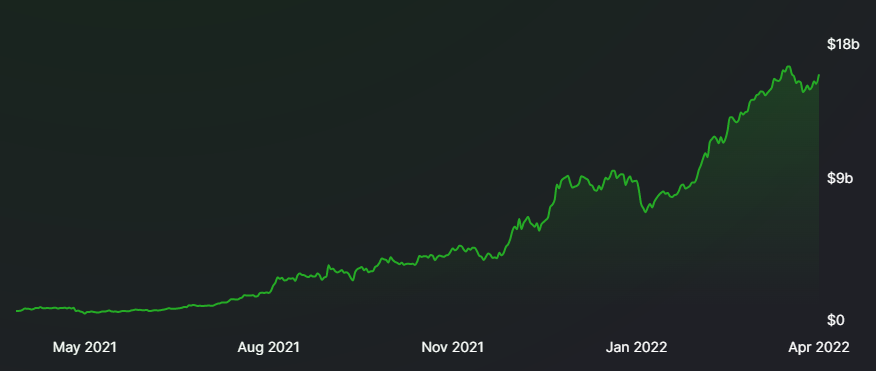
However, the rapid growth of the Terra ecosystem also exacerbates the risk of a loss of peg. Since UST is directly linked to the LUNA token, strong price fluctuations can have a drastic effect on the peg. Such a loss of peg occurred during the general market crash on May 23, 2021, when 2 billion UST were only backed by 1.6 billion USD in LUNA. The peg could only recover when Terraform Labs and other investors bought up LUNA and restored the 1:1 dollar price. A similar event would be devastating with the current amount of assets locked.
Treasury diversification with Bitcoin
Bitcoin is often referred to by investors as “digital gold”. In combination with numerous advantages over the precious metal, the crypto asset has established itself as one of the most efficient store of value. In light of this, Terra has now also decided to hold a portion of its reserves in Bitcoin.
$UST with $10B+ in $BTC reserves will open a new monetary era of the Bitcoin standard.
P2P electronic cash that is easier to spend and more attractive to hold #btc
— Do Kwon 🌕 (@stablekwon) March 14, 2022
These decentralized foreign exchange reserves are intended to support the Terra blockchain’s UST stablecoin and be used to hedge against short-term UST redemptions. In numerous purchases, the protocol has already invested 1.7 billion USD into the cryptocurrency. This has made Terra the second largest Bitcoin corporate holder after MicroStrategy (3.9 billion dollars).
A systemic risk for the industry
While Terra’s billions of dollars worth of purchases does provide some form of insurance for the native stablecoin UST, if Terra’s peg were to fail, a portion of the Bitcoin reserves would have to be exchanged for USD. Thus, a potential liquidation of these reserves could create a significant risk for the entire cryptocurrency industry according to some voices.
With 10 billion in Bitcoin, the Terra protocol would be the largest Bitcoin holder after the pseudonymous founder Satoshi Nakamoto. A sell-off of this magnitude would inevitably lead to large price losses even if the coins don’t end up on the open market. Do Kwon himself is aware of this but seems to interpret it as an advantage for his project.
“besides Satoshi, we will be the largest single holder of $BTC in the world”
“the failure of $UST is equivalent to the failure of crypto itself”
🧠🧠🧠 pic.twitter.com/VqsUgp5iLk
— Legomakers (@legomakers1) March 29, 2022