Since the tightening of U.S. regulation in response to the FTX debacle and in the aftermath of the USDC bond loss, a once-competitive subsector of the crypto industry is once again centralizing in the hands of a single stablecoin issuer: Tether.
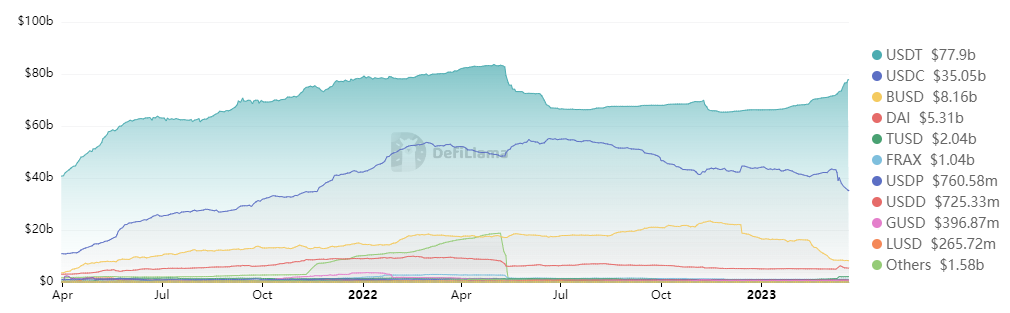
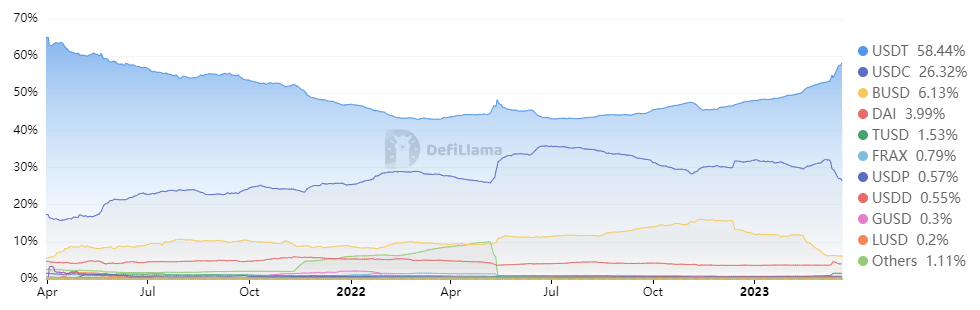
Stablecoins are digital currencies designed to maintain a stable value against a specific asset such as the US dollar. As recently as last December, three serious players shared the $133 billion market; Tether (USDT), Circle (USDC) and Binance/Paxos (BUSD). However, within the few months since the FTX debacle, $22 billion flowed out of the market or partially back into the initial provider from the two Tether competitors.
Regulators drive number three out of the market
Binance USD (BUSD) was launched in 2019 as part of a partnership between Paxos and Binance. In this, Paxos acted as the issuer of the stablecoin with a branding license from the largest crypto exchange, which used BUSD as its primary base currency for a long time. The regulator in charge was the New York Department of Financial Services (NYDFS). The authority regularly reviewed various requirements at Paxos, such as capital reserves, consumer protection, and anti-money laundering measures. Binance USD (BUSD) was therefore considered one of the best regulated stablecoins on the market.
However, in early February, SEC staff had sent the stablecoin issuer a letter known as a "Wells Notice," which the agency used to notify companies and individuals of potential enforcement actions. The notice claimed that the Binance USD (BUSD) digital asset issued and listed by Paxos was an unregistered security. Further, the New York Department of Financial Services (NYDFS) ordered Paxos Trust Co. to stop issuing additional BUSD tokens, which ultimately marked the end for the third largest stablecoin by market capitalization. Of the once $23 billion, $8 billion in BUSD is still in circulation.
Billions in USDC redemptions after US banking crisis
While some of the BUSD holders withdrew from the market completely, a good USD 7 billion flowed into USDT and USDC. The second largest stablecoin "USD Coin" is issued by the registered US institution Circle Financial and is widely considered the best-regulated stablecoin. USDC reserves are deposited with well-known banking giants such as BlackRock and BNY Mellon, and a comprehensive audit by "Big Four" auditors Deloitte is conducted once a year. However, the counterparty risk of the banks remains, as the incident over the weekend before last impressively demonstrated.
The collapse of Silicon Valley Bank (SVB) - the largest bank failure since the 2008 financial crisis - had a significant impact on USDC's bond coverage. The bank, which had been insolvent for nearly two weeks, held about 8% of the blockchain dollar's reserves. Amid the ensuing panic, USDC plunged to below 88 cents. The government bailout of Silicon Valley Bank restored the stablecoin's bond, but Circle is feeling the loss of confidence. Within a week, USDC lost 8.2 billion in market capitalization (-20%).


Stablecoin market dominated by controversial provider
A significant portion of BUSD and USDC outflows directly benefited market leader Tether. The USDT stablecoin of the controversial issuer gained 12.4 billion in market capitalization since the regulatory shutdown of Binance USD. Its place as number one is thus once again secured. While USDC's overtaking seemed within reach less than a year ago, Tether accounts for over 58% of the sector at this point.
However, the unpalatable reality is that Tether can by no means be classified as more trustworthy than its former competitors. True, the USDT stablecoin has been on the market since early 2015 and has so far withstood the test of time. However, countless controversies surrounding the stablecoin's reserves - including a conviction in a US court - blacken Tether's reputation.
Further, the issuer has refused for years to undergo a full audit of its reserves by a "Big Four" auditor. Which banks are holding Tether's securities is also unknown. The only recourse for some crypto-investors thus remains a withdrawal to the house bank or an exchange into transparent and immutable money: Bitcoin.