
Decentralised finance (DeFi) applications and the conventional financial sector are increasingly converging. The innovative use of blockchain technology is at the forefront of this trend. The development of equity tokens could revolutionise early-stage financing.
In the third part of our series, we look at the development of crypto-assets, where traditional financial institutions can use blockchain technology to create their own crypto-assets and currencies. We will explore the potential of blockchain-based equity tokens as a means to more efficiently connect capital seekers with investors. These tokens not only facilitate this crucial connection, but also serve as a bridge between innovation and tradition. Ultimately shaping the future financial landscape.
Why early-stage finance matters
Financing for businesses is a critical factor in ensuring their success and sustainable growth. Especially in the early stages of entrepreneurship, securing funding is essential to move ideas and projects forward. Financing is a critical approach in acquiring capital beyond operating cash flow. This plays an important role in reducing operational risks for early-stage companies and ensuring their continued growth. However, geographical limitations, high costs and slow processes due to the number of intermediaries involved, can prove as challenging. In response to these challenges, innovative solutions have been developed in recent years.
Crowdfunding and ICOs
Crowdfunding is revolutionising the way businesses raise capital, offering a digital alternative to traditional funding methods. Platforms such as EquityNet allow companies to present their business plans and financials on the internet, attracting a diverse group of potential investors. This differs from platforms such as Kickstarter, which focus on non-equity projects. While both crowdfunding and traditional financing offer global reach and brand awareness, crowdfunding democratises investment by allowing smaller contributions from a wider range of businesses.
Equity-based crowdfunding, a unique form, offers investors equity-like rights (similar to company shares). Despite the popularity of crowdfunding platforms, equity-based crowdfunding is still in its infancy and offers opportunities for growth. However, equity-based crowdfunding faces challenges, including questions about the credibility of platforms, increased administrative costs and a lack of secondary markets. To overcome these obstacles, it is important to operate within regulatory frameworks, expand global access, promote crowdsourced due diligence, and implement simplified (sometimes multi-stage) funding processes.
Blockchain technology has sparked a new funding mechanism for early-stage companies through the issuance of digital tokens, enabled by smart contracts. These digital tokens can be categorised into utility and security types. Utility tokens, distributed through Initial Coin Offerings (ICOs), facilitate access to digital services or serve as a means of payment. These allow issuers to define associated rights and entitlements. In essence, this model offers new ways to raise capital. However, ICOs face challenges such as valuation uncertainty, regulatory hurdles and inconsistent reporting standards, which are further complicated by governance and technology complexities. Overcoming these issues is critical to fostering trust between investors and entrepreneurs, paving the way for a transparent, efficient and secure financial ecosystem.
Equity crowdfunding through security token offerings (STOs)
Security Token Offerings (STOs) bridge the gap between traditional financing and the drawbacks of ICOs by meeting regulatory requirements while representing tokenised value. The synergy of regulation and technology is attracting interest from investors and capital seekers. This combination has the potential to improve the banking and financial sector by making business financing more accessible and efficient. Especially beneficial for start-ups and early-stage companies. As part of our research, we asked the following question: Can blockchain-based STOs serve as an alternative financing infrastructure, particularly in the context of equity-based crowdfunding?
Imagine a world where investment barriers are removed, allowing startups to raise global capital easily and securely. This vision is becoming a reality with the introduction of blockchain-based equity tokens. These tokens promise to redefine the terms of investment and crowdfunding. Below, we examine the key benefits of equity tokens:
- Efficiency: Traditional investment processes often involve complex steps and intermediaries, driving up costs and time. In contrast, equity-based tokens can simplify these processes. They leverage the benefits of blockchain to reduce transaction costs and the need for intermediaries.
- Democratising investments: Historically, investment opportunities with high growth potential have been reserved for investors with greater capital resources. Equity tokens have the potential to lower these barriers and enable broader participation. By facilitating access and reducing barriers to entry, the democratisation of investment can be promoted.
- Trust through transparency and security: Equity tokens leverage the tamper-resistant properties of the blockchain to provide unprecedented transparency and security. Innovative identification methods and customised regulations that can be technically integrated into the tokens secure invested capital.
- Evolution of ICOs: Equity-based tokens build upon the ICO concept but add an additional layer of regulatory compliance and stability, providing a more robust alternative for business funding.
- Harmony with regulation: Like any disruptive technology, blockchain-based forms of financing face regulatory challenges. However, the standardisation of technical protocols is crucial for these digital tokens to be verified by independent parties and gain widespread acceptance.




A design proposal for equity-based tokens
In our study, we have developed a prototype for a blockchain-based equity token that aims to address the challenges of equity-based crowdfunding and ICOs. At the core of this innovation, we present an Ethereum-based implementation that uses smart contracts to automate key business operations, thereby increasing the efficiency and transparency of transactions.
What sets this design apart is its focus on individual customisation and security. Each equity token operates within its own smart contract, providing a separate environment for different funding rounds. For example, to represent digital forms of common stock, preferred stock or convertible bonds. This modularity not only enhances security, but also gives companies the flexibility to issue token types such as revenue share tokens for retail investors and governance tokens for institutions. Furthermore, compatibility with existing Ethereum token standards, such as the ERC-20, ensures a smooth exchange of assets across different platforms.
In addition, our proposed design significantly simplifies critical operations such as know-your-customer (KYC) procedures, share issuance and transaction logs, increasing the security and efficiency of funding activities. To implement these processes, our prototype uses the InterPlanetary File System (IPFS). IPFS enables secure data exchange in compliance with KYC and anti-money laundering (AML) regulations. This is achieved through app-like smart contracts that facilitate smooth interactions between corporates, investors and other relevant parties.
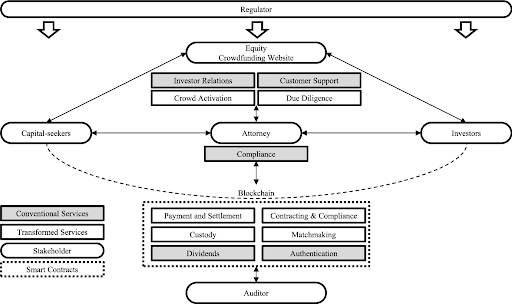
Framework for a blockchain-based equity crowdfunding ecosystem / Source: BlockchainResearchLab
As we have learned, blockchain technology has the potential to reshape traditional finance at the infrastructure level by reducing the need for banks and payment service providers and transferring their roles to the blockchain network. It is important to note that not all intermediaries will become obsolete. For example, regulators, legal experts and external auditors will continue to play an essential role in this ecosystem. Despite claims to the contrary, we believe that blockchain will not make all intermediaries obsolete. Similar to crypto exchanges offering additional services for ICO tokens, crowdfunding platforms can support due diligence.
In addition, tasks traditionally performed by banks, such as identity verification procedures, custody responsibilities and dividend distribution, can be automated through smart contracts. Blockchain and smart contracts not only speed up payments, but also enable instant transaction settlement. This reduces delays and transaction rates.
Security token offerings as a new standard for issuing digital securities
We conclude that blockchain technology can serve as a catalyst for a more open and inclusive future, particularly in the context of equity-based forms of financing. These digital tokens offer a crucial funding route for start-ups and early-stage companies, and could fundamentally revolutionise venture capital funding. While some traditional intermediaries remain relevant