
It could be argued that the current NFT craze will not be going away anytime soon. And this is despite the fact that many industry experts and leaders missed the (first) boat. More and more people, as well as companies, are starting to explore the opportunities NFTs have to offer.
A brief look at digital NFT use cases: NFTs are less about expensive images, and more about the exploration of new technology, and with it, potential revenue models and use cases for the metaverse.
Digital Art / Collectibles
The first NFT projects started rather early. Already in 2017, amidst the ICO mania and crypto bull run, the CryptoPunks were released as one of the first NFTs on the Ethereum blockchain. At this time, not many of us were really paying much attention to the 10,000 unique pieces of digital art, all of which were made digitally scarce via the blockchain. Each piece was algorithmically generated with computer code, which meant that no two characters were exactly alike, and some traits were more rare than others. An NFT representing the ownership of one of these pixelated punks recently sold for over six million USD. The success of this project triggered a massive wave of code-generated art projects, which are today traded at remarkable volumes on marketplaces such as Opensea and Solanart.
Earlier this year in March, an NFT by a digital artist known as “Beeple” was sold through a first-of-its-kind auction at Christie’s. The most important NFT project – at least measured in terms of media attention – sold one single NFT for USD 69 million, which positions the artist “among the top three most valuable living artists”. Beeple himself sees this as “the next chapter of art history”. Later this year, another “purely” digital-only asset was sold for no less than USD 2.9 million. Jack Dorsey, the founder of Twitter and Square, created an NFT linked to the first tweet.
Although digital art currently seems to be the most popular use case, the valuation and raison d’être of many other NFTs do not only derive from owning the ownership-token of subjectively aesthetic, rare, or randomly generated digital assets.
Gaming
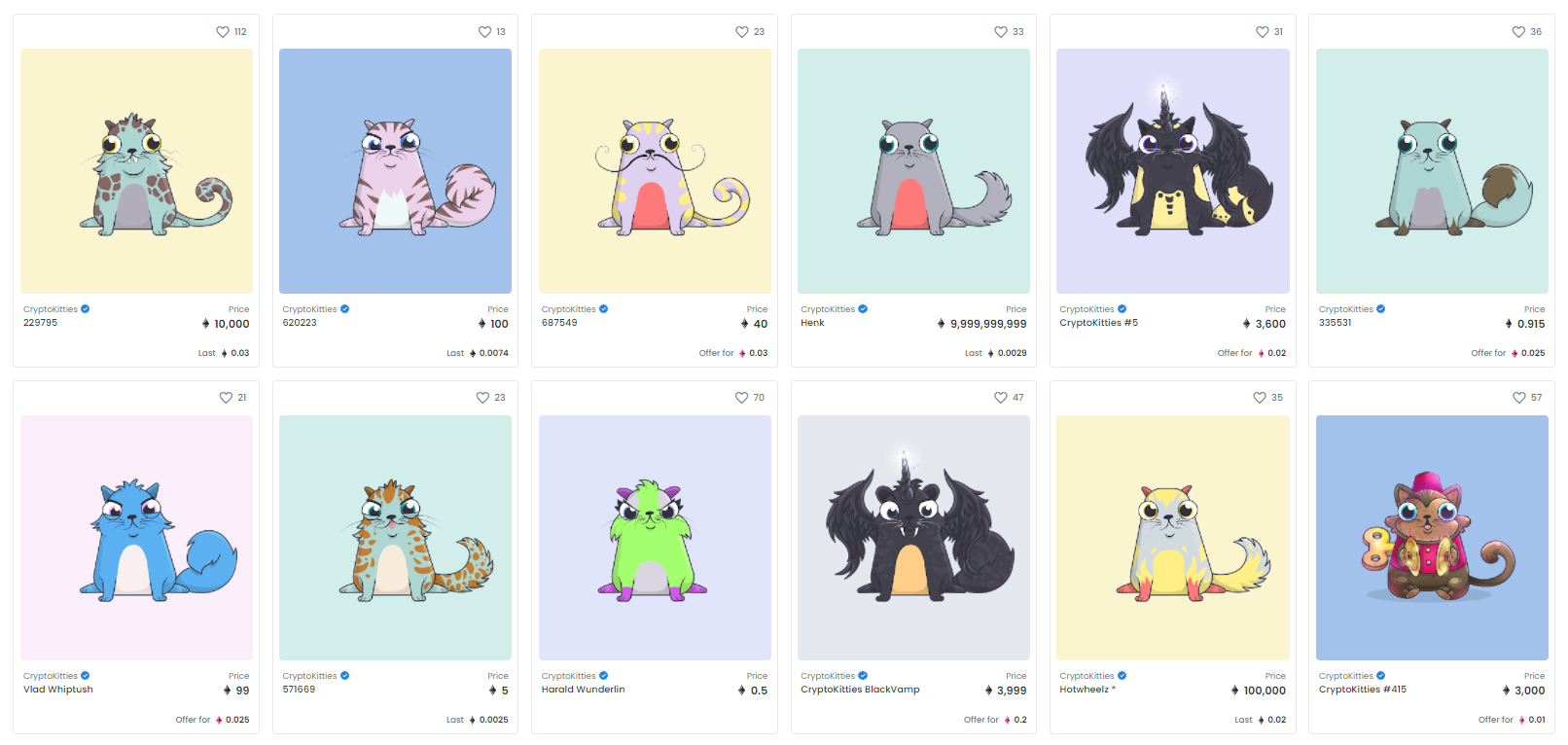
Gaming is an industry predestined for using NFTs. Exploration started relatively early in gaming as well. Early in crypto time means 2017, when the famous blockchain game CryptoKitties came out. Besides trading those NFTs, the virtual cats are breedable, carry a unique number and a 256-bit distinct genome with DNA and different attributes (cattributes) that can be passed on to offspring. The game was one of the earliest attempts to deploy the blockchain for this NTF version of Tamagotchi. In December 2017, the game’s popularity congested the Ethereum network, which consequently led to a massive slowdown of its transaction speed as well as astronomically high transaction (gas) fees.
Four years later, the sophistication and creativity of blockchain games have increased tremendously. It is not only about breeding and collecting anymore. The first relevant and freely accessible “pay-to-earn” games have emerged. One great example of this is the Pokémon-inspired game called Axie Infinity. Currently, it is not only the most expensive NFT collection, with more than USD 42 million in sales in June 2021 but also the first cryptocurrency-powered game that is allowing some people in developing countries to earn a living thanks to it. In order to play the trading and battling game, you are required to hold at least six Axie NFTs. As a reward, you receive a cryptocurrencies return, which can be used to acquire in-game items or can be sold on the open market. Since Axie NFTs are too expensive to acquire for most people living in developing countries, they apply for scholarships via reddit. NFT holders provide the Axie NFTs while scholarship applicants actually play the game. The revenue in cryptocurrencies then gets split between the parties. Depending on where in the world you live, Axie NFTs can be either an investment with passive income or provide a real alternative to your job.
In addition to these examples, NFTs facilitate (and even serve to accelerate) the monetisation of games – especially in-game items. Thinking again of the “metaverse”, this idea becomes quite relevant regarding ownership of digital items and how to use them cross-platform.
Music / Entertainment
Last year, when the Covid-19 measures eliminated live concerts, the music industry was turned on its head. Now, as the world continues to be predominantly digital, artists are looking for ways to connect with and create for their audiences, as well as to compensate for lost income streams. NFTs are making it possible for artists to connect with and create new experiences for their fans. Offering exclusive experiences such as lifetime VIP concert access for NFT holders is just one of the easiest use cases to implement. Things become really interesting, however, when we start talking about disrupting the value chain. Since the music industry has a great deal of “middlemen” (production companies, labels, streaming providers, etc.), NFTs open up possibilities for artists to sell directly to their fans. Artists can also give special attention to their “super fans” – marketing and selling new music to them, as well as offering them artwork, concert tickets, and merchandise. If done right, NFTs offer the ease of internet distribution (think of Napster), but with already built-in digital rights protection (think of iTunes).
If artists combine NFTs with digital events, e.g. the first digital in-game concert held by Travis Scott where over 12 million people joined live, it suddenly removes many boundaries of the imagination for our future metaverse.
Despite the advanced state of world digitalisation, we can rest assured that humans will always live in the physical world. The question is, however, where do and will we spend most of our time and resources? And how do and will our two worlds merge into one interconnected one? There are in fact several global projects that are currently trying to merge our real “physical” world with our digital one, balancing value creation between both worlds. These are probably the most powerful and future-oriented use cases that will shape our future and create new and enhanced business models.