Four US law enforcement organizations have warned, in a letter to Acting Attorney General Todd Blanche and White House crypto adviser Patrick Witt, that Section 604 of the Clarity Act would hinder investigations into crypto crime involving mixers, tumblers and certain DeFi services.
The Clarity Act, officially the Digital Asset Market Clarity Act (H.R. 3633), is the most comprehensive US market structure law for digital assets. No comparable bill has passed a chamber of Congress before. It divides jurisdiction: the SEC retains oversight of investment contract assets, while the CFTC gains exclusive authority over spot markets for digital commodities. Rep. French Hill first introduced the bill in May 2025. The House of Representatives passed it in July 2025 by a vote of 294 to 134, including 78 Democrats. The legislation then cleared the Senate Banking Committee only in May 2026, by a vote of 15 to 9. Since then, it has sat on the Senate's legislative calendar. For a floor vote, however, the chamber needs 60 votes. Because Republicans hold only 53 seats, at least seven Democrats must agree.
Section 604 protects developers but creates loopholes, police say
Section 604 traces back to the Blockchain Regulatory Certainty Act. Rep. Tom Emmer originally introduced it as a standalone bill in 2018. Only later did lawmakers fold the provision into the Clarity Act. It codifies a federal safe harbor. Non-custodial software developers and infrastructure providers that neither hold nor control customer funds therefore do not count as money transmitters under 31 U.S.C. § 5330 and 18 U.S.C. § 1960. The standard is a "no-control test." This qualifies a developer only when they possess neither the legal right nor the unilateral capacity to initiate transactions or control user funds. Thus the provision largely codifies what FinCEN had already set out in a 2019 administrative guidance.
Nevertheless, the law enforcement agencies see this as a gateway. The National District Attorneys Association, the National Association of Assistant U.S. Attorneys, the International Association of Chiefs of Police and the National Sheriffs' Association back the letter. They argue that broad exemptions could weaken KYC and AML requirements. Moreover, such exemptions would hinder investigations into mixers, tumblers and certain DeFi services. These services obscure the origin of funds and have long been a focus of money laundering investigations. The four associations deliberately distinguish their criticism, however, from that of pure software developers.
"Our concern is not with persons who merely write or publish software code, nor with responsible technological innovation. Our concern is with broad exemptions that could protect persons or entities whose activities facilitate the movement of digital assets, impede legitimate oversight, or undermine longstanding investigative and enforcement powers of law enforcement." - Joint letter of the four law enforcement organizations
Warner and Cortez Masto tie their yes to Section 604
The political weight of the letter stems from the vote arithmetic in the Senate. Because at least seven Democrats are needed for the 60-vote threshold, every single commitment counts. Senators Mark Warner and Catherine Cortez Masto, however, have explicitly tied their support to one condition. Law enforcement agencies would have to agree to Section 604. Cortez Masto had previously voted against the Clarity Act in committee. She justified this by saying the law would undermine law enforcement's ability to track illicit finance and recover victims' funds.
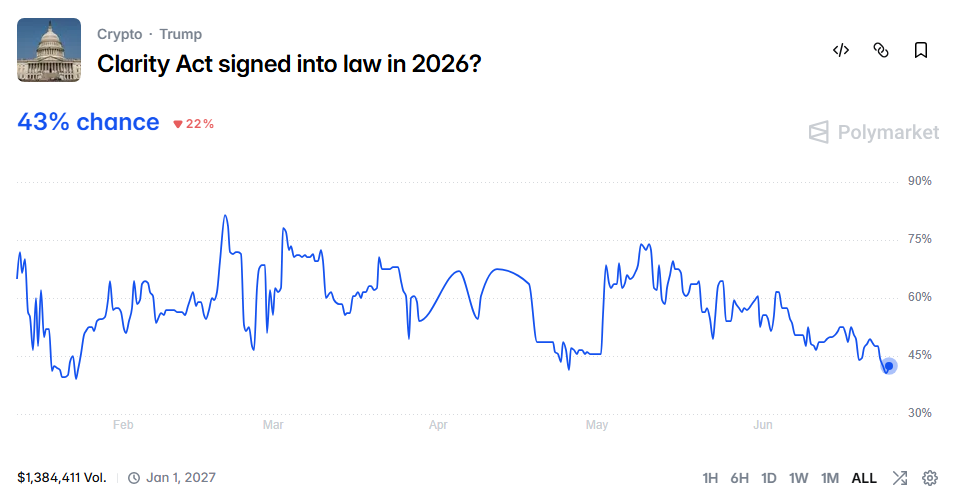
At the same time, the Senate is running out of time. Only a few weeks remain before the summer recess. As a result, the original White House target date of July 4, 2026, has effectively passed. Competing priorities such as FISA, immigration funding, the Farm Bill and the NDAA also claim Senate time. The shift in mood can also be read off the prediction market. Polymarket now puts the probability of passage in 2026 at just 43 percent. A month earlier, the figure stood at 74 percent. Senator Cynthia Lummis warned, finally, that if the bill fails in 2026, Congress might not take up the issue again until 2030.
Industry and White House defend the Clarity Act safe harbor
The other side considers the criticism overblown. Patrick Witt, Executive Director of the Presidential Council of Advisors for Digital Assets, called the Clarity Act a "pro-regulatory, pro-enforcement bill." The remark came at a town hall held by the Blockchain Association. Furthermore, more than 60 crypto CEOs urged the Senate by letter to keep Section 604. The signatories include the leaders of Coinbase, Uniswap, Kraken, a16z and Paradigm. Their central argument: under the wording of the "no-control test," mixer operators that actively route transactions remain excluded from the safe harbor anyway, and thus exposed to prosecution.
Lindsay Fraser, Chief Policy Officer of the Blockchain Association, by contrast called the law enforcement letter a "fundamental misunderstanding." Section 604 protects only developers that neither hold funds nor control transactions. Supporters cite the case of Tornado Cash developer Roman Storm as evidence. A jury convicted him even though a safe harbor would have offered no protection in that configuration.




Banks, church and police form a broad opposing coalition
The law enforcement letter does not stand alone. On June 23, 2026, more than 100 Catholic leaders likewise wrote to the Senate leadership around Majority Leader John Thune and Minority Leader Chuck Schumer. The signatories include the Sisters of Saint Joseph of Philadelphia, the Sisters of the Blessed Virgin Mary and the Alliance to End Human Trafficking. They warn of facilitated human trafficking and organized crime. The simultaneous timing of both letters thus underscores the breadth of the opposition.
This opposition reaches further into the institutional camp. The American Bankers Association formally rejected a White House compromise proposal back in March 2026. The core dispute was stablecoin interest payments to holders. In addition, the AFL-CIO union federation warned senators that crypto legalization could endanger financial stability and retirement accounts. An earlier compromise attempt between Senators Chuck Grassley and Cynthia Lummis and the law enforcement organizations also failed. The groups judged the proposed changes to be insufficient. Meanwhile, an unresolved ethics dispute over conflicts of interest among government officials is weighing on the legislative process.