Close Menu
Crypto Valley Journal
    Facebook X (Twitter) Instagram
    Crypto Valley Journal
    • Hot Topics
      • News
      • Minds
    • Focus
      • Background
      • Blockchain
      • Legal & Compliance
      • Non-Fungible Token (NFTs)
    • Investing
      • Markets
      • Financial Products
      • Decentralized Finance (DeFi)
      • Exchange overview
    • Education
      • Basics
      • Glossary
      • Politicians on crypto
    • Statistics
      • Bitcoin-ETF-Flows
      • Ethereum-ETF-Flows
      • Crypto market data
      • On-chain data
    • Academy
      • Overview
      • Part 1: Blockchain
      • Part 2: Money
      • Part 3: Bitcoin
      • Part 4: Cryptocurrencies
      • Part 5: Decentralized Finance
      • Part 6: Investing
    • English
      • Deutsch
    Crypto Valley Journal
    You are at:Home » Glossary » Backwardation
    Backwardation

    Backwardation

    By Redaktion cvj.ch on 23. April 2020 Glossary

    Backwardation is a term commonly used in the world of finance to describe a specific market condition that occurs in commodity futures markets. It is characterized by an unusual situation where the future price of a commodity is lower than its spot price.

    Backwardation is often observed in commodity markets, particularly those for perishable goods or commodities with limited storage capacities. When a market is in backwardation, it indicates that there is immediate demand and a shortage of supply for the underlying commodity.

    Reasons for backwardation

    Such a condition can be attributed to various factors, including natural disasters affecting the supply chain, geopolitical tensions disrupting production or transportation, or even seasonal fluctuations. The scarcity of the commodity in the present prompts investors to be willing to pay a premium for immediate delivery. This results in a higher spot price compared to the future price.

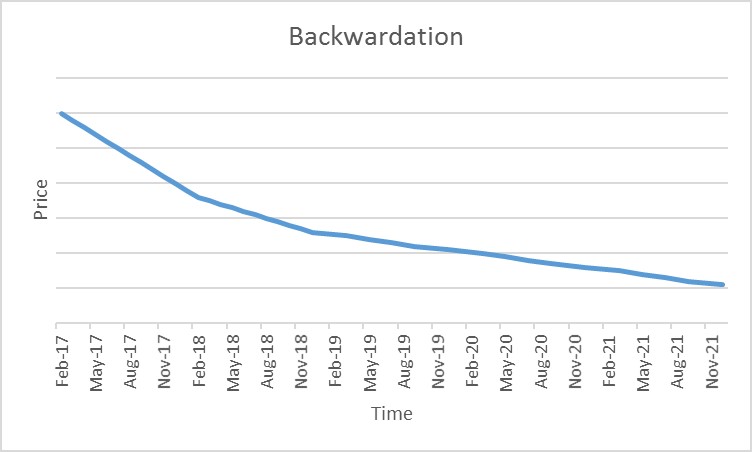
    Backwardation can have significant implications for market participants, including traders, speculators, and hedgers. Traders and speculators often use backwardation as a signal of short-term scarcity and increased market volatility. They can take advantage of this condition by purchasing the commodity at the lower futures price and selling it in the spot market at a higher price, aiming to profit from the price difference. On the other hand, hedgers, such as producers or consumers of the underlying commodity, may face difficulties in managing their risk. The higher spot prices can increase production costs for manufacturers, while consumers may experience higher prices for the end product. In the chart below, the spot price is above the futures price, creating a downward sloping forward curve.

    What separates Dogecoin from Bitcoin is its unlimited supply, and the 2013 satire coin now trades through its own US spot ETF. Basics
    5. August 2026

    What is Dogecoin? From satire project to ETF asset

    What separates Dogecoin from Bitcoin is its unlimited supply, and the 2013 satire coin now trades through its own US spot ETF.

    Bitcoin overtakes gold in the US: per River's report, 49.6 million Americans own Bitcoin, while just 28.8 million still hold gold. Background
    22. July 2026

    Bitcoin overtakes gold among US investors for the first time

    Bitcoin overtakes gold in the US: per River’s report, 49.6 million Americans own Bitcoin, while just 28.8 million still hold gold.

    Digital asset security faces a new gap: crypto losses topped USD 4.70 billion in 2025, up 63%, as fraud follows multi-asset users.
    22. July 2026

    Digital finance has gone multi-asset. Security needs to catch up.

    The Chainalysis Crypto Crime Report puts illicit activity below 1% of on-chain volume, countering the myth of Bitcoin as a criminal currency.
    21. July 2026

    Myth: Bitcoin and cryptocurrencies mainly serve criminal activity

    Falling qubit estimates bring the quantum computer threat to Bitcoin closer and spark a debate over freezing Satoshi's coins.
    20. July 2026

    Quantum computers put Bitcoin’s cryptography under pressure

    Most crypto cards hide who issues them. After mapping the licensed issuers, here is why Switzerland's self-issuing model reads differently.
    8. July 2026

    The bank you never chose: who really issues Switzerland’s crypto cards

    18 percent hold crypto assets in Switzerland, an IFZ and LUKB study shows. Banks see potential for up to 1 million advisory clients.
    29. June 2026

    HSLU and LUKB study: 18% of the Swiss population hold crypto assets

    29. June 2026

    The four-year Bitcoin cycle remains intact

    Popular Posts
    About Crypto Valley Journal
    About Crypto Valley Journal

    On the pulse of the movement

    • Academy
    • Contact
    • Advertising
    • About us
    • Partner
    • Imprint
    • Privacy
    • Disclaimer
    Search

    Type above and press Enter to search. Press Esc to cancel.