

Close Menu
Crypto Valley Journal
    Facebook X (Twitter) Instagram
    Crypto Valley Journal
    • Hot Topics
      • News
      • Minds
    • Focus
      • Background
      • Blockchain
      • Legal & Compliance
      • Non-Fungible Token (NFTs)
    • Investing
      • Markets
      • Financial Products
      • Decentralized Finance (DeFi)
      • Exchange overview
    • Education
      • Basics
      • Glossary
      • Politicians on crypto
    • Statistics
      • Bitcoin-ETF-Flows
      • Ethereum-ETF-Flows
      • Crypto market data
      • On-chain data
    • Academy
      • Overview
      • Part 1: Blockchain
      • Part 2: Money
      • Part 3: Bitcoin
      • Part 4: Cryptocurrencies
      • Part 5: Decentralized Finance
      • Part 6: Investing
    • English
      • Deutsch
    Crypto Valley Journal
    You are at:Home » Glossary » DAO – Decentralized Autonomous Organization
    DAO - Decentralized Autonomous Organization
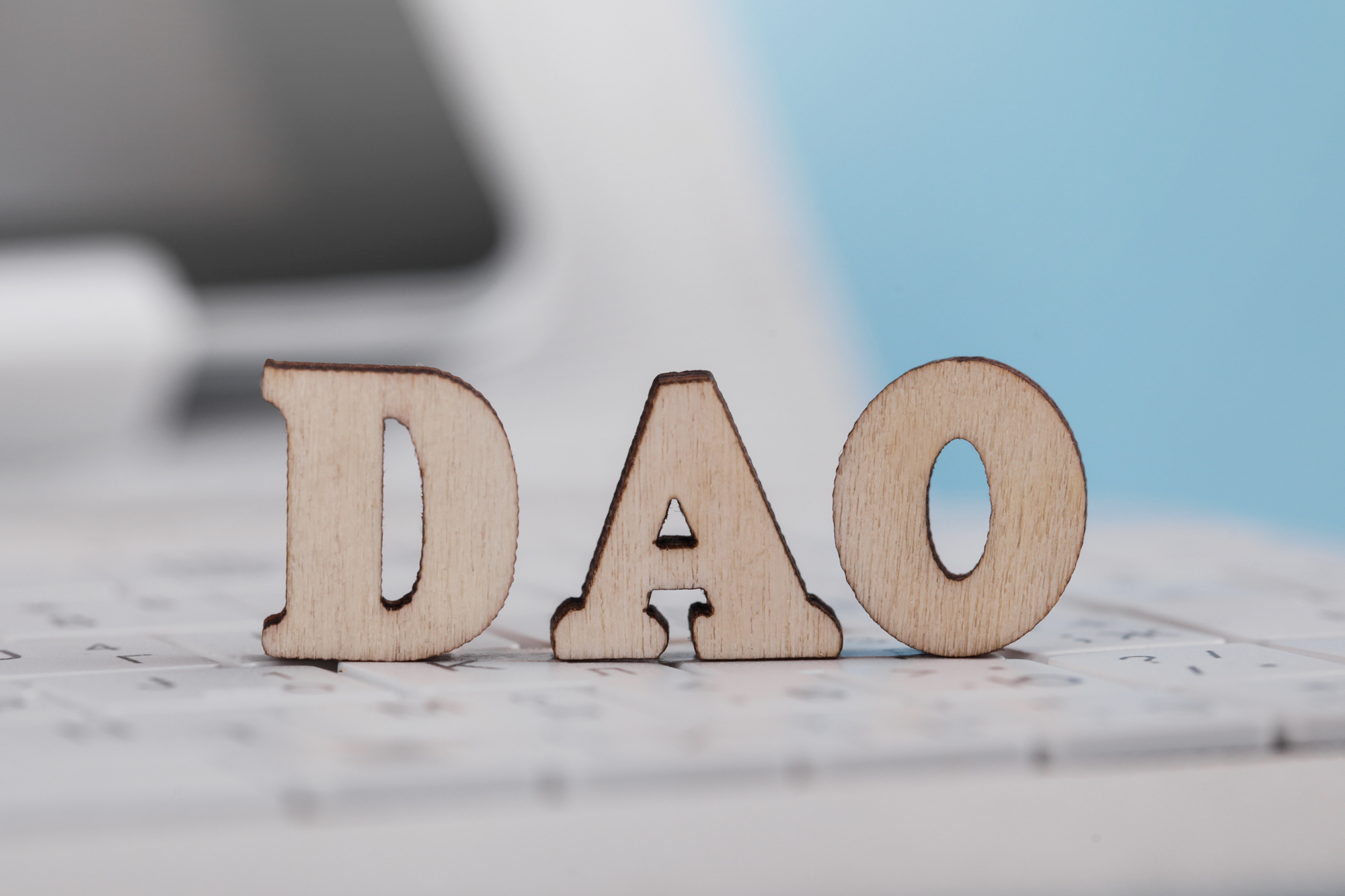
    DAO. Decentralized Autonomous Organization. Letter DAO, on keyboard background

    DAO – Decentralized Autonomous Organization

    0
    By Editorial Office CVJ.CH on 23. April 2020 | Updated 20. November 2023 Glossary

    A Decentralized Autonomous Organization (DAO) is an innovative form of organization that is based on blockchain technology and is controlled by smart contracts.

    Since these rules are embedded in the code, no managers are needed, eliminating all bureaucratic and hierarchical hurdles. "Decentralized Autonomous Organizations" or DAOs represent exactly what they are called; they are:

    • Decentralized, so that the rules cannot be changed by a single person or a central party;
    • Autonomous, so they operate based on logic written into a smart contract, without human intervention. They remain operational as long as the underlying blockchain works;
    • Organizations or entities that coordinate the activities between a distributed community of stakeholders - for example, developers and users in a specific blockchain network.

    DAO - Decentralized Autonomous Organization or in plural DAOs, are examples of what is referred to as "on-chain governance". In traditional corporate governance, for example, companies have bylaws that prescribe certain policies, such as the election of a board of directors. Members of a DAO can participate directly in decisions, for example by voting on proposals, depending on the amount of tokens they own. A DAO extends this concept into the digital world by encoding bylaws into smart contracts.

    Various use cases of DAOs

    Bitcoin is generally regarded as the first fully functional DAO, as it has programmed rules, operates autonomously, and is coordinated through a consensus protocol. The explosion of decentralized finance (DeFi) in 2020 has led to new interest in DAOs: So far, DAOs are used for many purposes, e.g., for investments, charity, fundraising, borrowing, or buying NFTs, all without intermediaries. A DAO, for example, can accept donations from anyone around the world, and the members can decide how to spend the donations.

    DAOs have the potential to revolutionize traditional business structures by reducing the need for intermediaries and putting power and control in the hands of the community. They are often used in areas such as financial technology, crowdfunding, and collective ownership.


    Ethereum Foundation researcher Justin Drake calls for Bunker Mode because AI mathematics could break ECDSA before quantum computers do. Background
    9. October 2026

    Ethereum researcher warns AI could break crypto encryption

    Ethereum Foundation researcher Justin Drake calls for Bunker Mode because AI mathematics could break ECDSA before quantum computers do.

    The privacy coins sector grew from USD 6.2 billion to USD 30 billion in one year, while institutions make privacy a precondition for moving on-chain. Background
    8. October 2026

    Privacy coins: the missing layer between crypto and institutions

    The privacy coins sector grew from USD 6.2 billion to USD 30 billion in one year, while institutions make privacy a precondition for moving on-chain.

    Automated market makers manage liquidity pools like rule-based portfolios, with direct consequences for impermanent loss and hedging.
    8. October 2026

    Automated market makers as decentralized portfolio managers

    Bitcoin in 2026 trades around USD 84,000, while US spot ETFs hold about USD 102 to 104 billion and listed companies 1.27 to 1.29 million BTC.
    29. September 2026

    Bitcoin in 2026: what the numbers actually say

    24. September 2026

    Unit bias in crypto: Why cheap coins mislead investors

    The Chainalysis Crypto Crime Report puts illicit activity below 1% of on-chain volume, countering the myth of Bitcoin as a criminal currency.
    23. September 2026

    Myth: Bitcoin and cryptocurrencies mainly serve criminal activity

    Zcash hides transaction data with zk-SNARK proofs and now sits between a US spot ETF listing and the EU privacy coin ban of 2027.
    22. September 2026

    What is the privacy coin Zcash (ZEC)?

    The Trezor data breach at fulfillment provider ShipMonk exposed names, addresses and phone numbers of 13,689 customers.
    21. September 2026

    Hardware wallet comparison 2026: Ledger vs. Trezor – new models, new risks

    Popular Posts
    About Crypto Valley Journal
    About Crypto Valley Journal

    On the pulse of the movement

    • Academy
    • Contact
    • Advertising
    • About us
    • Partner
    • Imprint
    • Privacy
    • Disclaimer
    Search
    © 2026 ThemeSphere. Designed by ThemeSphere.

    Type above and press Enter to search. Press Esc to cancel.