Close Menu
Crypto Valley Journal
    Facebook X (Twitter) Instagram
    Crypto Valley Journal
    • Hot Topics
      • News
      • Minds
    • Focus
      • Background
      • Blockchain
      • Legal & Compliance
      • Non-Fungible Token (NFTs)
    • Investing
      • Markets
      • Financial Products
      • Decentralized Finance (DeFi)
      • Exchange overview
    • Education
      • Basics
      • Glossary
      • Politicians on crypto
    • Statistics
      • Bitcoin-ETF-Flows
      • Ethereum-ETF-Flows
      • Crypto market data
      • On-chain data
    • Academy
      • Overview
      • Part 1: Blockchain
      • Part 2: Money
      • Part 3: Bitcoin
      • Part 4: Cryptocurrencies
      • Part 5: Decentralized Finance
      • Part 6: Investing
    • English
      • Deutsch
    Crypto Valley Journal
    You are at:Home»Glossary»DPoS – Delegated Proof of Stake
    DPOS - Delegated Proof of Stake
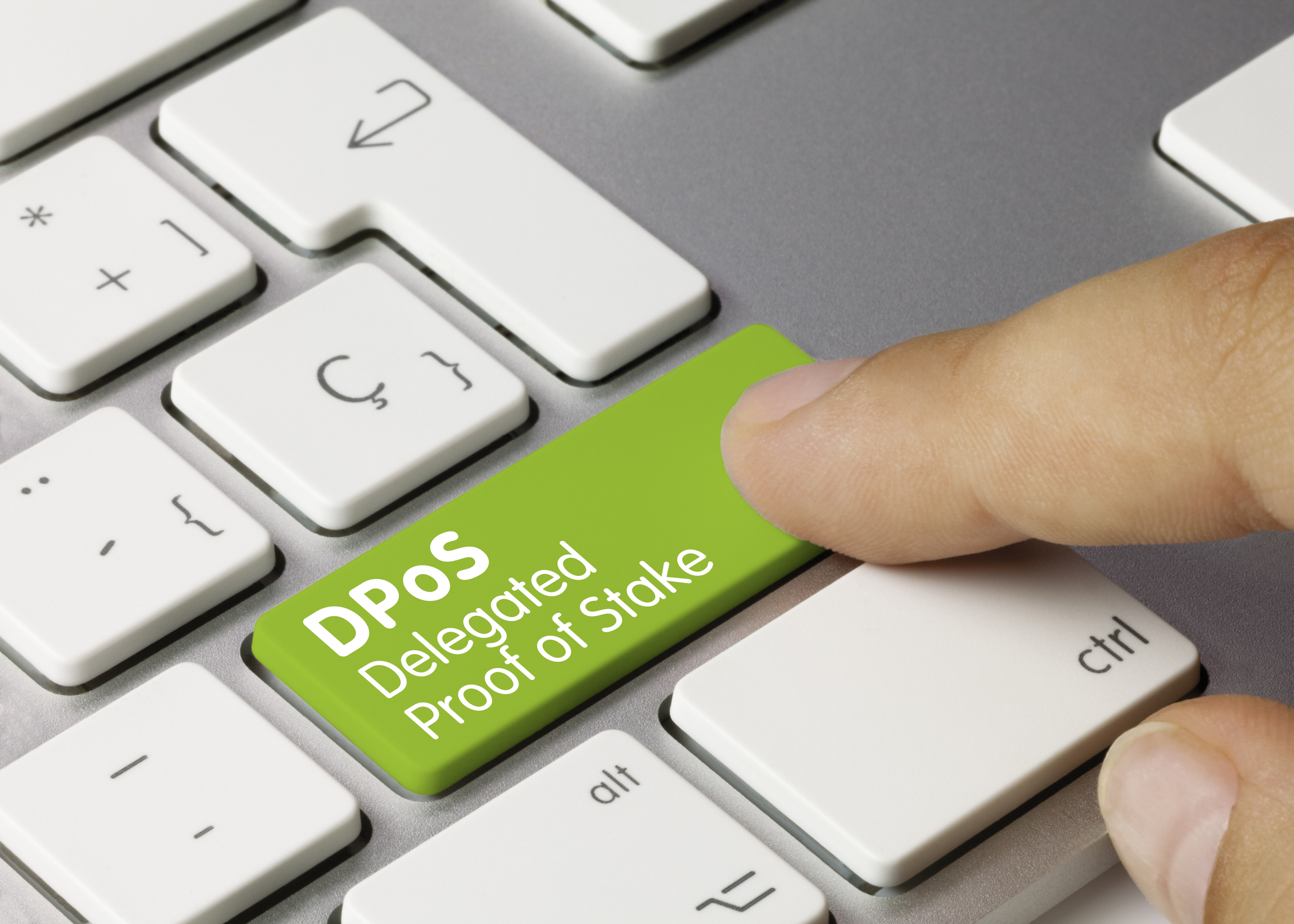
    DPoS Delegated proof of stake Written on Green Key of Metallic Keyboard. Finger pressing key.

    DPoS – Delegated Proof of Stake

    By Redaktion cvj.ch on 2. April 2020 Glossary

    Delegated Proof of Stake (DPoS) is a consensus algorithm used in blockchain networks to validate and secure transactions. It is an alternative to the more traditional Proof of Work (PoW) and Proof of Stake (PoS) algorithms and offers a different approach.

    The DPoS mechanism is a variation of the Proof of Stake (PoS) system. In contrast to the traditional PoS system, where every token holder has the chance to validate transactions and add new blocks to the blockchain, in the DPoS system validation is restricted to a limited number of "delegates". These delegates are elected by the network's token holders, with the number of tokens held often determining the number of votes a user can cast.

    Delegates responsible for validation

    Delegates are responsible for validating transactions and adding new blocks to the blockchain. They are also compensated for performing these tasks. However, should they do a poor job or act fraudulently, they can be voted out of office by the network's token holders. This creates an incentive for delegates to work honestly and efficiently.

    Delegated Proof of Stake (DPoS) networks are known for its speed and efficiency compared to other consensus mechanisms. By limiting the number of validating nodes, the network can confirm transactions faster while consuming less power than networks using Proof-of-Work (PoW) or traditional PoS systems. However, this centralization of power also leads to concerns about the decentralization and security of the network.

    In summary, Delegated Proof of Stake offers an efficient and fast consensus method, but it also comes with challenges in terms of decentralization and security. It is a fine balance between efficiency and decentralization that plays a significant role in blockchain technology, and striving for the perfect balance remains an ongoing challenge. The continuous improvement and adaptation of these systems is therefore crucial for the sustainable and robust future development of blockchain technology.


    Analysis by Bitget Research on Bitcoin quantum computing risks, ECDSA exposure, NIST post-quantum standards, and BIP-360 migration paths. Background
    17. April 2026

    Bitcoin quantum computing: What recent developments mean for network security

    Analysis by Bitget Research on Bitcoin quantum computing risks, ECDSA exposure, NIST post-quantum standards, and BIP-360 migration paths.

    XRPL validator analyzes quantum risk: only 0.03% of XRP supply is exposed, compared to up to 35% for Bitcoin. Google sets 2029 deadline. Background
    14. April 2026

    Quantum risk: Is XRP more secure than Bitcoin?

    XRPL validator analyzes quantum risk: only 0.03% of XRP supply is exposed, compared to up to 35% for Bitcoin. Google sets 2029 deadline.

    13. April 2026

    Power Shift in Crypto Exchanges: Retail Overtakes Institutional

    Entdecken Sie die Vorteile von Bitcoin im Portfolio als Werkzeug zur Renditesteigerung und zum Schutz vor Inflation.
    9. April 2026

    Bitcoin’s role within an institutional portfolio

    AI agent security risks grow as autonomous systems shift from analysis to execution in crypto markets, a Bitget and SlowMist report warns.
    8. April 2026

    New research highlights security risks as AI agents shift to execution

    6. April 2026

    Crypto Myths 2026: Four Costly Mistakes Investors Make

    $500 million in minutes: Pump.fun writes ICO history
    3. April 2026

    Have launchpads like Pump.fun destroyed the altcoin market?

    2. April 2026

    Unit bias in crypto: Why cheap coins mislead investors

    Popular Posts
    About Crypto Valley Journal
    About Crypto Valley Journal

    On the pulse of the movement

    • Academy
    • Contact
    • Advertising
    • About us
    • Partner
    • Imprint
    • Privacy
    • Disclaimer
    Search

    Type above and press Enter to search. Press Esc to cancel.