Close Menu
Crypto Valley Journal
    Facebook X (Twitter) Instagram
    Crypto Valley Journal
    • Hot Topics
      • News
      • Minds
    • Focus
      • Background
      • Blockchain
      • Legal & Compliance
      • Non-Fungible Token (NFTs)
    • Investing
      • Markets
      • Financial Products
      • Decentralized Finance (DeFi)
      • Exchange overview
    • Education
      • Basics
      • Glossary
      • Politicians on crypto
    • Statistics
      • Bitcoin-ETF-Flows
      • Ethereum-ETF-Flows
      • Crypto market data
      • On-chain data
    • Academy
      • Overview
      • Part 1: Blockchain
      • Part 2: Money
      • Part 3: Bitcoin
      • Part 4: Cryptocurrencies
      • Part 5: Decentralized Finance
      • Part 6: Investing
    • English
      • Deutsch
    Crypto Valley Journal
    You are at:Home » Glossary » EIP-1559
    EIP-1559

    EIP-1559

    By Editorial Office CVJ.CH on 17. August 2020 Glossary

    Ethereum Improvement Proposal 1559 (EIP-1559) is an upgrade for the Ethereum protocol that solves the problems of volatile transaction fees and inflation of Ether. The burning mechanism, which was part of the Ethereum London upgrade, was introduced in early August 2021.

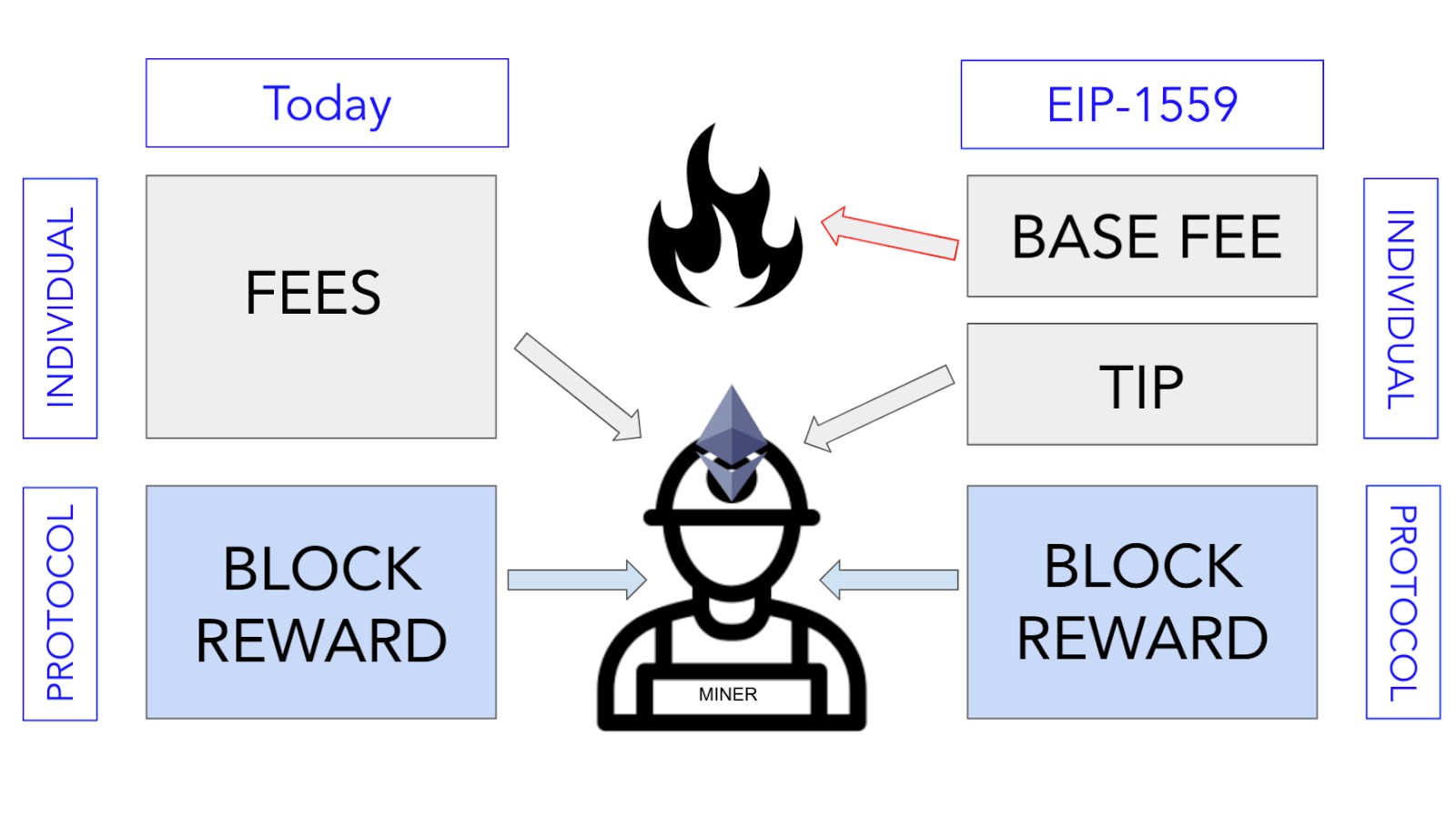
    EIP-1559 introduced a new fee structure designed to address the inefficiencies and volatility of the previous system. The core concept of EIP-1559 is the introduction of a base fee, a fixed price that all transactions must pay to be included in a block. This base fee is dynamically determined based on network demand, ensuring that miners are fairly compensated for their efforts.

    The EIP-1559 proposal

    EIP-1559 is both an upgrade for the Ethereum network and an economic upgrade for ETH as an asset. Prior to the upgrade, a user essentially had to bid on their transaction to get it included in a block. This drove up prices during periods of high demand. The proposal introduced fixed prices (or base fees) for network transactions, eliminating auctions. This base fee has been eliminated.
    EIP-1559
    Changes introduced by EIP-1559 / Source: Consensys

    The new fee structure aims to make ETH deflationary over time, as this could burn more ETH in base fees than is generated in mining rewards. It is also intended to reduce network congestion by making more efficient use of block capacity. Block capacity is increased and decreased based on network usage, resulting in either higher or lower fees. Similarly, the implementation of EIP-1559 resulted in the decoupling of transaction fees from network security and the introduction of a permanent block subsidy.

    EIP-1559 changes

    The changes introduced by EIP-1559 can be summarized as follows:

    1. Reduced fee volatility
      The burning of base fees has helped to stabilize gas prices, making them less prone to unpredictable spikes. This has made it easier for users to estimate transaction costs and plan their transactions accordingly.
    2. More predictable transaction fees
      EIP-1559 has replaced the auction-based fee model with a more predictable system, reducing the guesswork involved in estimating transaction costs.
    3. Deflationary effect
      The burning of base fees has a deflationary effect on the Ethereum network, potentially increasing the value of Ether over time.
    4. Miner incentives
      EIP-1559 has introduced a more equitable fee distribution system, ensuring that miners are fairly compensated for their work while also addressing concerns about potential rent-seeking behavior.

    While EIP-1559 has made significant progress in improving Ethereum's fee structure, there are still some ongoing challenges that need to be addressed. For example, the dynamic adjustment of base fees can lead to occasional fee fluctuations, and the transition to the new fee mechanism has had some minor impacts on DApp performance.


    18 percent hold crypto assets in Switzerland, an IFZ and LUKB study shows. Banks see potential for up to 1 million advisory clients. Background
    29. June 2026

    HSLU and LUKB study: 18% of the Swiss population hold crypto assets

    18 percent hold crypto assets in Switzerland, an IFZ and LUKB study shows. Banks see potential for up to 1 million advisory clients.

    Background
    29. June 2026

    The four-year Bitcoin cycle remains intact

    The 21Shares mid-year report rates the Bitcoin cycle as intact despite a 50 percent correction and sees prediction markets ahead.

    The EU Parliament's ECON committee has approved the legal framework for the digital euro and ordered trilogue negotiations to begin.
    23. June 2026

    EU Parliament approves legal framework for the digital euro

    The Ethereum Glamsterdam upgrade is the biggest hard fork since the Merge: ePBS and parallel processing boost network throughput.
    19. June 2026

    Ethereum Glamsterdam upgrade: The biggest hard fork of the year explained

    Strategy sold 32 Bitcoin in late May and rebought 1,550 a week later. What the move reveals about corporate Bitcoin treasury resilience.
    16. June 2026

    Strategy sells Bitcoin: What it signals for corporate treasuries

    More than 50% of the bitcoin supply now sits at a loss. K33 sees parallels to earlier bear market lows that followed within weeks.
    11. June 2026

    Crypto winter: More than 50% of bitcoin supply at a loss

    A Reuters analysis estimates the Trump family's crypto gains at $2.3 billion, while investors incurred book losses of the same amount.
    9. June 2026

    Trump family earns $2.3 billion from crypto projects

    IC3 researchers refute three central promises of the AI and blockchain market narrative in a 155-page survey on crypto and AI.
    9. June 2026

    The synergy between AI and blockchain is overstated

    Popular Posts
    About Crypto Valley Journal
    About Crypto Valley Journal

    On the pulse of the movement

    • Academy
    • Contact
    • Advertising
    • About us
    • Partner
    • Imprint
    • Privacy
    • Disclaimer
    Search

    Type above and press Enter to search. Press Esc to cancel.