Close Menu
Crypto Valley Journal
    Facebook X (Twitter) Instagram
    Crypto Valley Journal
    • Hot Topics
      • News
      • Minds
    • Focus
      • Background
      • Blockchain
      • Legal & Compliance
      • Non-Fungible Token (NFTs)
    • Investing
      • Markets
      • Financial Products
      • Decentralized Finance (DeFi)
      • Exchange overview
    • Education
      • Basics
      • Glossary
      • Politicians on crypto
    • Statistics
      • Bitcoin-ETF-Flows
      • Ethereum-ETF-Flows
      • Crypto market data
      • On-chain data
    • Academy
      • Overview
      • Part 1: Blockchain
      • Part 2: Money
      • Part 3: Bitcoin
      • Part 4: Cryptocurrencies
      • Part 5: Decentralized Finance
      • Part 6: Investing
    • English
      • Deutsch
    Crypto Valley Journal
    You are at:Home » Glossary » Hash
    Hash function

    Hash

    By Editorial Office CVJ.CH on 3. April 2020 Glossary

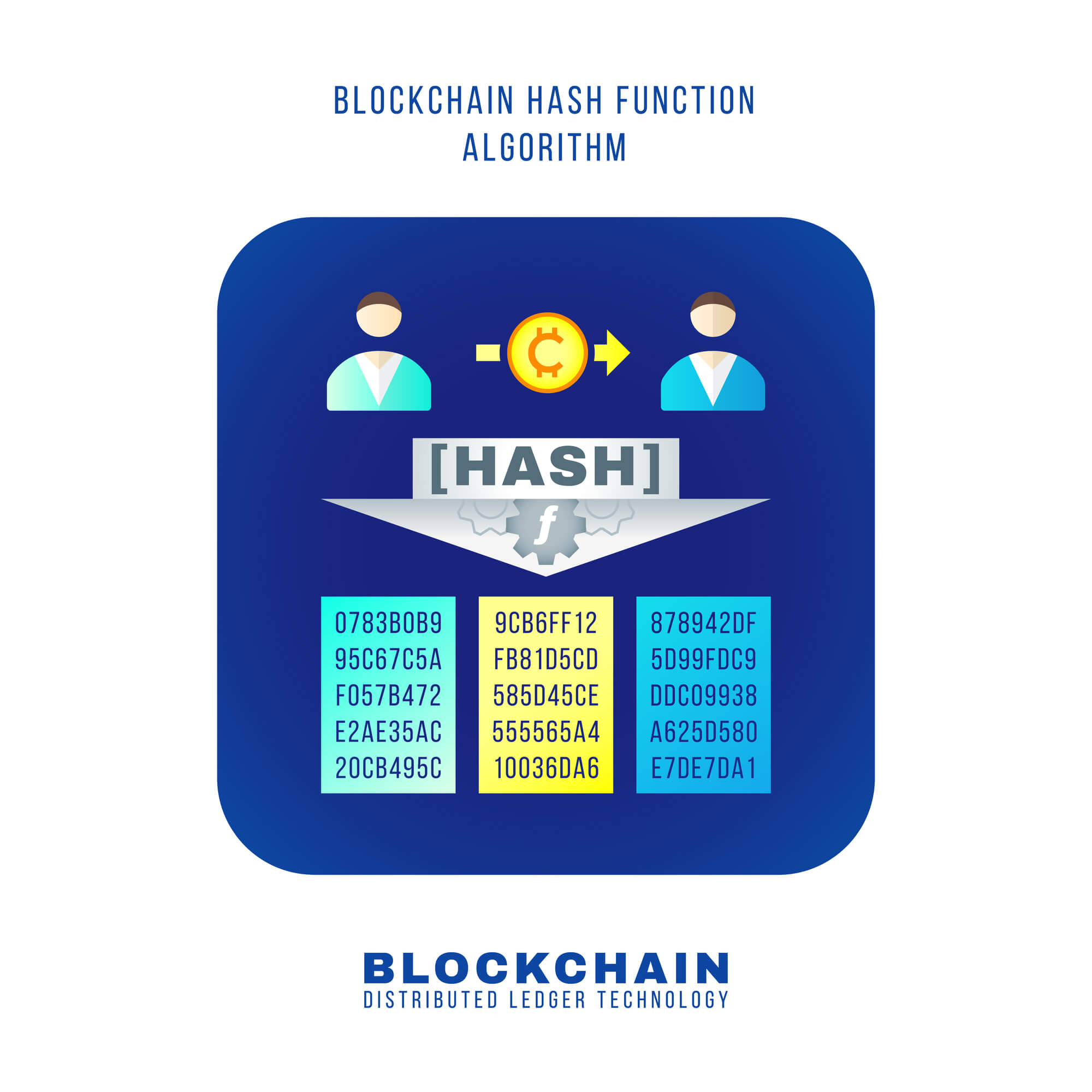
    The term "hash" or "to hash" has different meanings depending on the context. In general, it refers to the process of applying a hash function to data to generate a new identifier called a hash value or hash code. This process is widely used in computer science and cryptography to create digital signatures and to index data.

    Literally translated, "hash" means to chop or slice something into small pieces. This is what the hash function does, transforming a data set into a new string of letters and numbers representing the original data set. The original data set cannot be reproduced from the newly generated hash value. This is a fundamental property of hash functions that is essential to their security and applications in cryptography.

    Application of the hashing in blockchain

    The hash rate is defined as the speed at which a computer can convert a record (transaction data) into a hash value (a string of letters and numbers). The hash rate is usually calculated in hashes per second (h/s) and indicates the speed at which a network can process and verify transactions. It can also be expressed as the combined speed of each computer on the network.

    Hash rate is a measure used in the context of mining in Proof-of-Work (PoW) blockchain networks. Mining is the process of recording and verifying the information of data collected as a block of transactions on the blockchain. To control when blocks are created, or "mined," nodes solve a mathematical problem or puzzle that involves hashing. These proof-of-work puzzles are based on hash functions and form the basis of proof-of-work security models such as Bitcoin.

    In general, a higher network hash rate corresponds to a higher level of security. Bitcoin's security guarantees assume that no single miner controls a large portion of the hash rate. If they did, they could launch a 51% attack. A 51% attack is a "hostile takeover" where the hostile miners have a higher hash rate than the rest of the network. An attacker could effectively rewrite the rules of the protocol and double his own previous transactions (double spending).


    More than 50% of the bitcoin supply now sits at a loss. K33 sees parallels to earlier bear market lows that followed within weeks. Background
    11. June 2026

    Crypto winter: More than 50% of bitcoin supply at a loss

    More than 50% of the bitcoin supply now sits at a loss. K33 sees parallels to earlier bear market lows that followed within weeks.

    A Reuters analysis estimates the Trump family's crypto gains at $2.3 billion, while investors incurred book losses of the same amount. Background
    9. June 2026

    Trump family earns $2.3 billion from crypto projects

    A Reuters analysis estimates the Trump family’s crypto gains at $2.3 billion, while investors incurred book losses of the same amount.

    IC3 researchers refute three central promises of the AI and blockchain market narrative in a 155-page survey on crypto and AI.
    9. June 2026

    The synergy between AI and blockchain is overstated

    Strategy and BitMine are deep in the red: around USD 21 billion in unrealized losses. The Digital Asset Treasury (DAT) sector is wobbling.
    5. June 2026

    Strategy and BitMine underwater: USD 21 billion unrealized loss

    Crypto VC deals fell to around 50 in May 2026, a five-year low. Mega-rounds like Kalshi's Series F keep the dollar volume elevated.
    4. June 2026

    Crypto VC deals fall to five-year low in May 2026

    IBM is investing over USD 10 billion in quantum computing: What the roadmap to 2029 means for the Bitcoin risk.
    3. June 2026

    IBM’s quantum computing push shifts the timeline for Bitcoin risk

    Citi forecasts tokenized securities reaching 5.5 trillion USD by 2030, as DTCC, Nasdaq and ICE build out the underlying market infrastructure.
    1. June 2026

    Citi forecasts tokenized securities reaching 5.5 trillion USD by 2030

    Tokenization opens up new ways for companies to engage investors flexibly and structure financing efficiently.
    27. May 2026

    Tokenized equity shares: a tax-efficient alternative to traditional equity?

    Popular Posts
    About Crypto Valley Journal
    About Crypto Valley Journal

    On the pulse of the movement

    • Academy
    • Contact
    • Advertising
    • About us
    • Partner
    • Imprint
    • Privacy
    • Disclaimer
    Search

    Type above and press Enter to search. Press Esc to cancel.