The Blockweave forms the underlying data structure of the Permaweb. An arrangement of data, web pages and decentralized applications hosted on the Blockweave and accessible via normal web browsers. The 2017 whitepaper outlined the Archain; an open, irrevocable, uncorruptible and un-censorable archive for the Internet. Arweave coined the term Permaweb.
In addition to describing current protocol implementations, the Yellow paper includes possible future areas of work, as well as adaptive mechanisms that support these developments. In addition to outlining incentive mechanisms for achieving sustainable data permanence, the paper outlines key technologies that will enable scalable on-chain storage.
How Arweave is setup
The protocol is a new mechanism design-based approach to achieving a sustainable and durable record of knowledge and history. Because the Arweave network itself is built on HTTP, browsers have direct access to all data stored on the network.
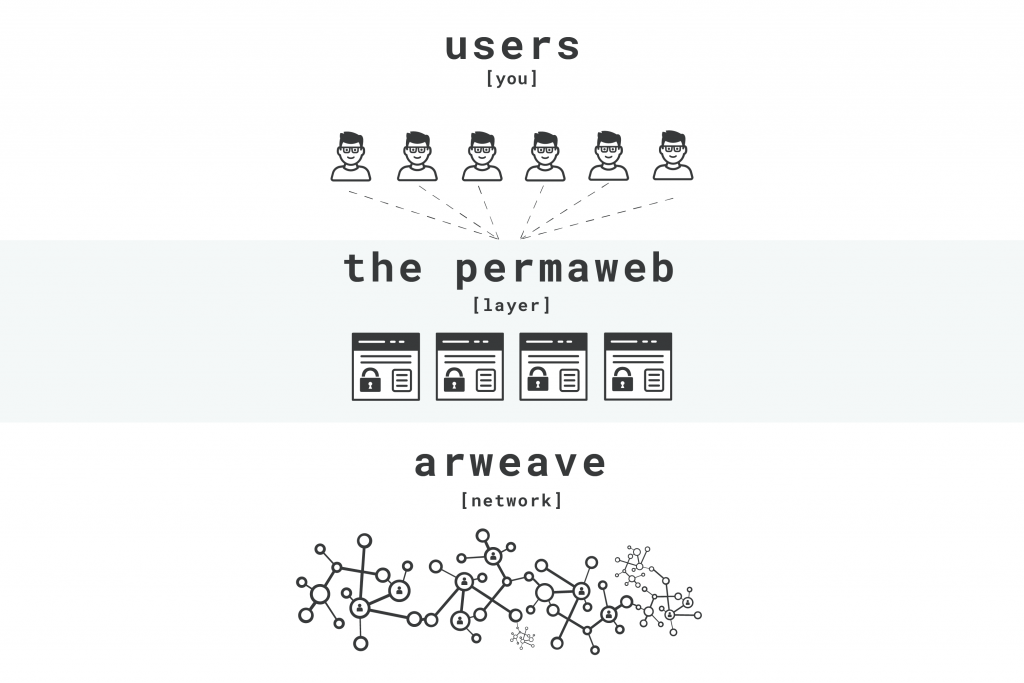
Basically, the Permaweb is a collection of interlinked documents and applications - just like the traditional web - with the difference being that all content is completely permanent. Because the network itself is content-independent, the Permaweb can be used for all kinds of information - from Wikis to PDFs, to videos, to web applications.
Once added to the network, these files are accessible forever, from anywhere in the world, at any time. What's more, once uploaded, they cannot be modified - ensuring application integrity and document verifiability.
Upload filter
As with the traditional Web, potential misuse is a serious issue. The community of developers and storage providers handle these issues carefully. Unlike the traditional Web, the Permaweb has tools for democratic moderation of its content built into the core of the protocol - putting control of the new Web back into the hands of the people, the users. The Arweave founding team is working with the Internet Watch Foundation. Network maintainers are trained to protect their systems and the Permaweb from abusive material.
Node operators share responsibility and express their preferences regarding content through content policies. These can be arbitrary computations that are performed on transactions and classify them as acceptable or unacceptable to the local node. In the reference implementation of Arweave, content policies are supported in the form of substring matches as well as hashes of the data stored in the transaction. Other protocol implementations may use their own content policy mechanisms, such as computer vision technologies and fuzzy hash matching.
The Decentralized Content Policy Mechanism Creates Two Complementary Incentives:
- Not to reject too many transactions, as this would lead to a decrease in rewards.
- Not to accept transactions that the majority of the network is likely to reject, as this will lead to mining blocks that the rest of the network will ignore.
These incentives forces miners to strike a balance between overindulgence, which could be harmful to the network in the long run, and over-rejection, which could lead to reduced network benefits. Developers are incentivized to expand the ecosystem with decentralized applications.
Gateways Enforce Content Policy
Just as the decentralized content policy mechanism affects the addition and storage of content on the network, gateways apply this mechanism to index data which is already stored on the network. Gateways index only the content that matches their own content policies. For example, when a user views a decentralized social media application on the Arweave, the gateway they choose determines what content is displayed to them, according to that gateway's content policies.
Thus, users can choose what types of network content they are exposed to by choosing between gateways with different content policies. Although users can choose what they see, they cannot prevent others from seeing the content on the Blockweave, since everyone has a choice of which gateway (and associated content policies) they want to see the Blockweave through.
Decentralized Web Hosting
The Internet, which began as a large-scale experiment in the "free flow of information," has transformed into an increasingly controlled, monitored, and censored web. As the internet has become an important part of our way of life, it is important to think about ways to better manage our own data and privacy. Since 2018, static websites can be easily migrated to the Permaweb via a browser extension.
Because a significant amount of allocated storage is never used, website or content creators have to pay for capacity they never use. Arweave's content management system solves this problem and is based on a serverless structure. The data storage model allows content providers to save money. By providing free disk space through the Arweave platform, users can also earn money. Arweave's network acts as a marketplace where people can search for web hosting services and get unused disk space from other users.
Compared to the traditional web hosting model, Arweave's serverless architecture is much more efficient as it optimizes network utilization. Billions of people around the world are able to create and disseminate information via traditional web-based data exchange protocols.