The Ethereum Foundation budget for 2026 falls by roughly 40 percent, and the foundation is eliminating 54 positions, which corresponds to about 20 percent of its workforce. As a result, the foundation is stepping back from its role as the central development engine and repositioning itself as a lean endowment organized into five clusters.
The Ethereum Foundation is a foundation established in 2014 in Zug, Switzerland, that historically served as the primary steward of the Ethereum protocol. It financed research, awarded grants, coordinated protocol development and hosted the annual Devcon conference. Specifically, a treasury policy from June 2025 already laid the groundwork for the overhaul, and it set out a glide path for annual spending from roughly 15 to 5 percent of foundation assets by 2030. Subsequently, a new, 38-page mandate from March 2026 positioned the foundation as "one of several stewards" rather than the sole authority. Moreover, the foundation now holds assets estimated at more than 820 million USD, of which roughly 735 million USD sits in the form of 172,650 ETH. However, the overhaul falls into a weak environment. The ETH price trades at around 1,650 USD and has lost roughly 67 percent since its high of about 4,950 USD in August 2025.
Five clusters instead of a central development engine
The new structure organizes the foundation's work into five clusters. For example, the Protocol Layer bundles core protocol development, scaling and security, including post-quantum cryptography, zkEVMs and MEV reduction. Meanwhile, the Access Layer builds infrastructure for users and software agents and follows the guiding principle of "Zero Option," under which a credible, non-intermediated alternative must always exist. Alongside these sit a User Layer for usage research without its own product studio, a Community Layer for open-source connections and privacy advocacy, and an Institutional Layer for work with banks, governments and universities. In addition, an Operations cluster handles internal functions.
As a shared filter across all clusters, Buterin defined the so-called CROPS framework, which bundles five priorities: censorship resistance, protection from capture, openness, privacy and security. Future investments and projects should measure up against these criteria. Furthermore, the foundation is dissolving the previously independent Privacy and Scaling Explorations (PSE) unit, its incubator for ZK proofs, privacy and scaling. However, the foundation is not discontinuing the ZK work itself but integrating it directly into the Protocol and the Access Layer. Thus the focus shifts from exploration toward implementation. In addition, the foundation now expects stronger specialization of execution and consensus clients instead of redundant parallel implementations, while AI-supported formal verification should free up resources for specialized functions.
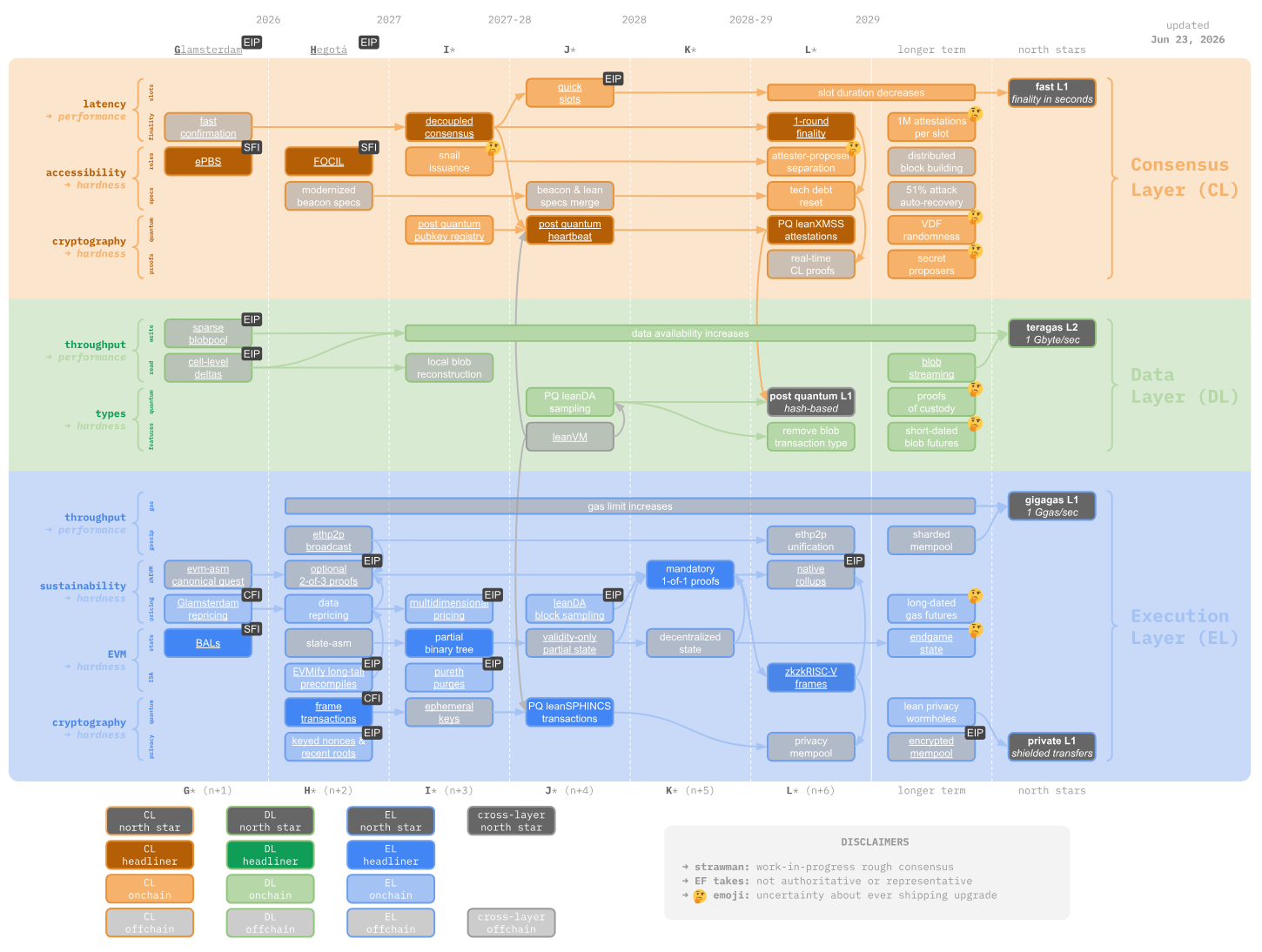
As a strategic horizon, the foundation cites the so-called Strawmap, a roadmap meant to replace or improve nearly every major protocol component, from consensus and proofs to accounts and state management. Vitalik Buterin frames this as the third major Ethereum iteration after proof-of-work and The Merge. Once the Strawmap is complete, protocol development should remain limited in the long term to security fixes and a few high-quality improvements, modeled on Bitcoin's conservative base layer.
Ethereum Foundation budget rate falls from 15 to 5 percent by 2030
The treasury policy from June 2025 provides the financial framework. It sets out a linear glide path that lowers the annual spending rate from roughly 15 percent of foundation assets to a target of 5 percent by 2030. The current budget cut of 40 percent therefore marks a first concrete step on this path. Specifically, the foundation describes the transition as a "subtraction" strategy, that is, a move away from the active development engine toward the lean endowment provider.
At the same time, the foundation is managing its assets more actively, in order to generate returns rather than merely spend them. Since February 2026, it has staked 70,000 ETH through the open-source infrastructure of Bitwise. Additionally, it deposited just under 19 million USD in Morpho Vaults, the second-largest DeFi lending protocol by total value locked. A first tranche of roughly 11.3 million USD flowed in October 2025, and a second tranche of 3,400 ETH (about 7.5 million USD) followed in March 2026. Notable, too, is the company the foundation now keeps. Private equity giant Apollo Global Management, with assets under management of roughly 940 billion USD, holds a token stake of up to 9 percent in Morpho. Thus the EF is investing its endowment in an infrastructure that increasingly attracts institutional capital as well.
Devcon is likely to feel the austerity course too. The foundation plans future spending on the conference to be smaller, more cost-effective and with a significantly smaller deficit.



Leadership change and Ethlabs as a parallel structure
A series of departures preceded the job cuts. Since January 2026, at least nine senior executives and researchers have left the foundation. Co-Executive Director Tomasz Stańczak stepped down in February, and Hsiao-Wei Wang recently gave up her post as Co-Executive Director and board member after eight years at the foundation. Josh Stark, Trent Van Epps, Tim Beiko, Barnabé Monnot, Carl Beek and Julian Ma also departed. Bastian Aue remains as acting sole Executive Director.
For those remaining staff who are now leaving, standardized terms apply. The foundation calculates severance as the higher value of one month's salary per year of service or the respective jurisdictional minimum, supplemented by career coaching and small transition grants. Notably, the timing of a parallel launch stands out. One day before the blog post on the restructuring, five former EF researchers founded Ethlabs, an independent non-profit research lab. Behind the venture by Ansgar Dietrichs, Barnabé Monnot, Caspar Schwarz-Schilling, Josh Rudolf and Julian Ma stand Joe Lubin as well as more than 50 community partners, including Bitmine, SharpLink and Anchorage. As a result, a second authority for protocol research is emerging outside the foundation.