
Revolut has announced EURR, its first own euro stablecoin, pegged at a fixed ratio of 1 EURR to EUR 1.00. Bridge, the Stripe subsidiary, issues the token. The rollout starts with selected customers in Denmark, Poland and Portugal.
Revolut is a British neobank that bundles accounts, card payments, securities trading and crypto trading in one app. According to company figures, around 80 million retail customers now use the platform worldwide. More than 16 million of them use the crypto section. A stablecoin is a token whose value stays pegged to a fiat currency through backing reserves. For EURR that currency is the euro, regulated under the EU regulation MiCA. The app also integrates the token fully and should allow switching between euro and crypto on-chain. Later in 2026, EURR should reach further markets in the European Economic Area. Overall, the global stablecoin market that the neobank is entering carries a market capitalization of around USD 290 billion.
Stripe subsidiary Bridge issues Revolut's EURR
The issuer of the token is Bridge Building S.A., a Stripe-owned firm specialized in stablecoin infrastructure. Bridge further holds and manages the reserve assets that back EURR, in line with MiCA requirements. Its supervisory seat sits in Luxembourg. The regulator there, the CSSF, has authorized Bridge on two counts. It also holds a Crypto-Asset Service Provider (CASP) license and an electronic money institution (EMI) license. The authorizations carry the numbers N00000012 and W00000024. The first covers crypto services, the second the issuance of electronic money. Regulatory responsibility for the token therefore does not sit with Revolut itself. Distribution, app and customer base come from the neobank instead.
Until now, the offering covered only trading in tokens from other issuers. With EURR, a product carries the company's own name for the first time. Product Owner Iman Olya points to the neobank's core business. The company first removed hidden fees and friction in currency exchange. Crypto now follows. Revolut also calls the euro token a "first step" toward a broader stablecoin strategy. Further tokens with other currency pegs should follow. As a result, the provider moves closer to the business model of regulated issuers. It does not run the reserves itself, though. Emil Urmanshin, Head of Crypto and New Bets at Revolut, frames the move broadly.
"EURR connects 80 million Revolut customers directly to on-chain finance. By combining our global scale and licensed banking infrastructure with instant, euro-denominated access to the crypto ecosystem, we unlock real stablecoin utility. Neither a traditional bank nor a crypto-native company can offer that." - Emil Urmanshin, Head of Crypto and New Bets, Revolut
Two stablecoins share the EURR ticker
The EURR ticker is not new to the European market, however. StablR, an issuer licensed in Malta, already puts out a MiCA-compliant euro stablecoin under exactly this symbol. The company additionally runs the dollar token USDR. Malta's financial regulator MFSA granted StablR an EMI license in July 2024. Moreover, Tether has held an equity stake in the issuer since December 2024. Tokenization runs through Tether's Hadron platform, and trading takes place on Ethereum and Solana.
Two independent products now carry the same ticker symbol. Behind Revolut's EURR stand Bridge and Stripe, behind the older token StablR and Tether. Issuer, license structure and distribution route differ completely. No connection between the two providers has surfaced. Both tokens likewise fall into the MiCA category of euro-backed e-money tokens. Yet supervision sits in different countries.
In wallets and price lists they still appear under the same symbol. For investors who check the reserves, prices or contract addresses of an "EURR", the attribution therefore matters. Tether has been building its European business through StablR and Hadron since taking the stake.




Tether withdraws from Revolut
As EURR launches, the world's largest stablecoin disappears from the Revolut platform. The provider first stopped new USDT deposits in late July 2026. Revolut then set the full withdrawal for 31 August 2026. Until that date, users have to shift or move out existing holdings. Afterward the platform converts remaining balances into fiat automatically. European regulation stands behind the step. Tether forgoes a MiCA registration for USDT. Among other things, the group criticizes the requirement to hold at least 60% of reserves in European bank deposits. Trading venues in the EEA consequently drop unregistered tokens from their line-up.
A gap thus opens in Revolut's offering, and EURR pushes straight into it. The new token targets MiCA from the start, because a licensed issuer runs the reserves. EURR moves into the role of a regulatory-approved USDT substitute in European distribution. The withdrawal affects only the Revolut platform, and Tether's European business remains untouched. For customers in Denmark, Poland and Portugal little changes for now, especially since access stays limited to selected users.
USDT and USDC hold nearly 89% of the stablecoin market
Revolut is not the first established payments firm with its own stablecoin. PayPal brought PYUSD to market back in 2023. In addition, Visa, Klarna and several globally active banks announced initiatives of their own last year. The use case has shifted along the way. Originally, stablecoins served mainly as a trading currency on crypto exchanges. Later, payments moved to the fore. There the tokens count as a fast and cheap alternative to classic transfers.
Still, the influx of new providers changes little about market shares. Tether's USDT reaches a market capitalization of USD 183.2 billion, Circle's USDC USD 73.7 billion. The entire stablecoin market stands at around USD 289.8 billion, so the two leaders account for nearly 89%. Circle's USDC reaches around 40% of USDT's capitalization by comparison. Bloomberg puts the share at around 85%, citing DefiLlama data. New issuers thus compete for a good tenth of the market. Euro-pegged tokens remain a niche within it.
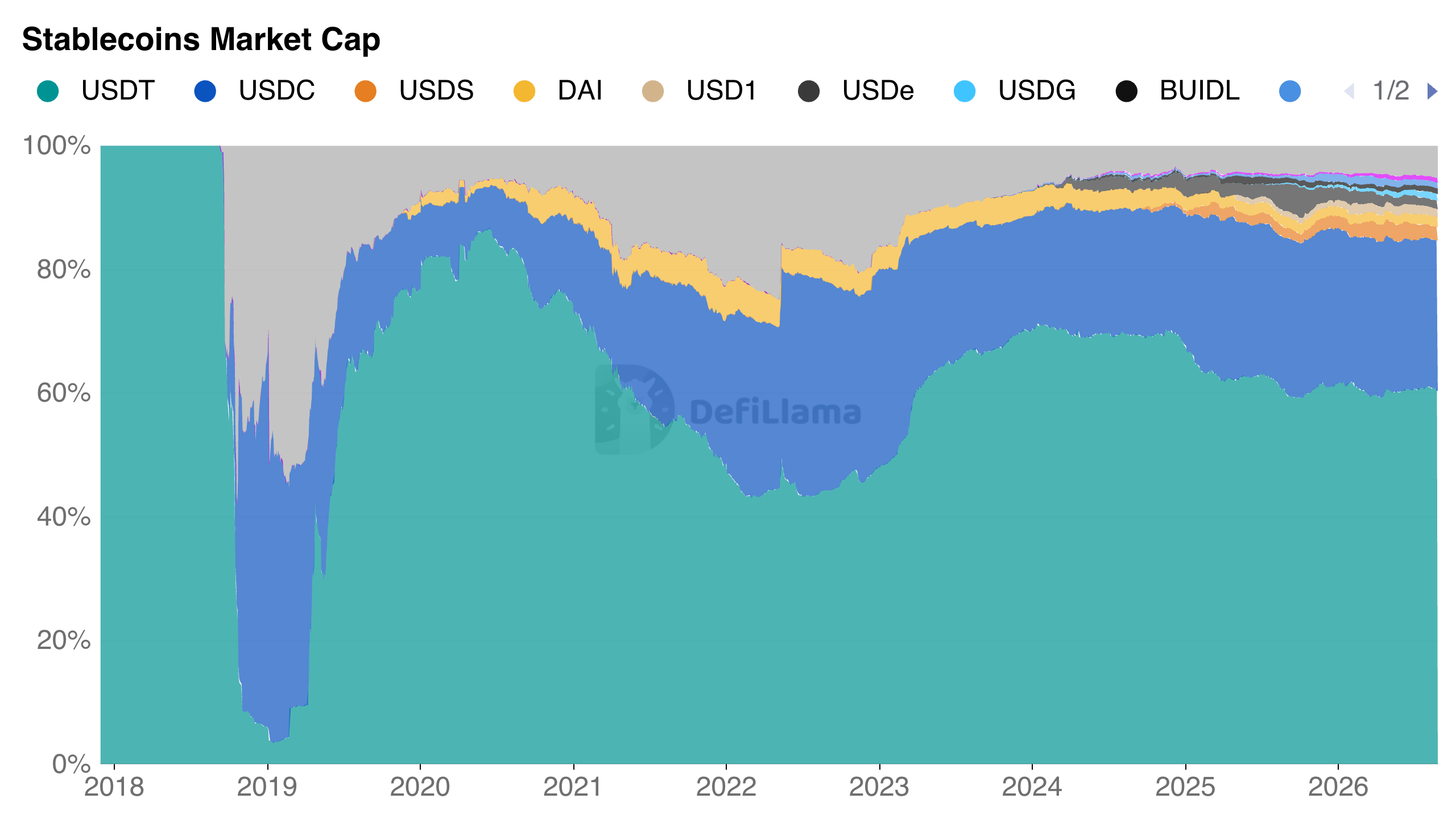
Regulation has given the asset class a tailwind lately. Just over a year ago, US President Donald Trump pushed through a law to regulate stablecoins. The market figures, however, do not follow that impulse. Since the start of 2026, total market capitalization has continued to stagnate. Visa's usage data likewise shows a cooling of transaction volumes in 2026, after they had risen since mid-2023. A regulatory breakthrough ultimately does not translate into volume on its own. Overall, Revolut enters a market that no longer grows. For the neobank, access to its own 80 million customers counts more than market growth.